Booknotes
Item set
Items
-
 The bill : how the adventures of Clinton's National Service bill reveal what is corrupt, comic, cynical, and noble, about Washington Offers a detailed and sometimes humourous account of the political process of trying to revamp the college loan system and create the the program now known as AmeriCorps.
 -
 Stars in their courses : the Gettysburg campaign, June-July 1863 Recreates the Battle of Gettysburg from both the Confederate and Union perspectives.
 -
 Creating a new civilization : the politics of the Third Wave Alvin Toffler's work on the "Knowledge Revolution" in which he describes the effects of the Information Age.
 -
 On the edge : the Clinton presidency Elizabeth Drew's On the Edge is the first inside, full-spectrum report on the Clinton Presidency. Since he came to office, Clinton has been hard to read - ambitious and uncertain, looking toward the future and hounded by the past. From the first days of the administration, Drew has been speaking with and learning from the President's top advisers, key Cabinet officers, and well-placed members of Congress, as she has watched - up close, behind the scenes - as plans are hammered out, policies set, and problems confronted. Drew tells the remarkable story of this turbulent term - and deciphers what it means.Clinton's far-reaching domestic proposals and considerable achievements are recounted, as well as the distracting and corrosive personal struggles, especially Whitewater. Drew portrays his legislative gambles - from health care to NAFTA - and his costly inattention to foreign policy - the confused policymaking on Somalia, Bosnia, Haiti. She reveals the struggles within the President's foreign policy team. She traces how controversies over such a wide range of issues and events - gays in the military, the mishandling of Zoe Baird's and Lani Guinier's nominations, the $200 haircut, the travel office, and the death of Vincent Foster - have undermined confidence in Clinton's Presidency and fanned the flames of "the character issue." She shows sides of Clinton never seen before and explores the critical and little-understood role of Hillary Rodham Clinton - both as a power and as a personality - and measures the truly unprecedented influence of Vice President Al Gore.On the Edge answers the questions of who Bill Clinton is, and what his Presidency means for this country.
 -
 The road to serfdom Work by Friedrich Hayek on political philosophy, intellectual and cultural history, and economics.
 -
 China wakes : the struggle for the soul of a rising power Nicholas Kristof's work on China's transformation into an economic and political superpower.
 -
 John C. Calhoun : a biography In this important and highly readable biography of John C. Calhoun, Irving Bartlett sees a man almost unique in American history, a lifelong politician who was also a profound political philosopher. Born on the South Carolina frontier, Calhoun grew up in a postrevolutionary culture which valued both African slavery and the republican ideology of the Founding Fathers. He was orphaned in his teens and, with almost no formal education, suddenly became a man. In less than ten years he had become a Yale graduate, a lawyer, a former state legislator, and a congressman-elect prepared to help James Madison lead the country into the War of 1812. As a congressman and later as James Monroe's secretary of war Calhoun articulated the nationalism of the new nation as cogently as any other American leader. Calhoun was ambitious beyond his years. He was an unsuccessful candidate in the disputed presidential election of 1824 but was easily elected vice president under John Quincy Adams and Andrew Jackson. Determined to avoid the obscurity of that office, Calhoun managed to get into monumental public disputes with both presidents and resigned in the last days of Jackson's first administration to become senator from South Carolina and champion his state's right to nullify the Tariff of 1832. Along with his famous contemporaries Henry Clay and Daniel Webster, Calhoun dominated the Senate of the United States in the 1830s and 1840s. Serving briefly as secretary of state in the beleaguered Tyler administration, he played a key role in the annexation of Texas and created a furor on both sides of the Atlantic with his strident defense of American slavery and his denunciation of what he perceived as the pseudophilanthropy of British abolitionism. Returning to the Senate, he acted as peacemaker in helping avoid a near war with Britain over the Oregon boundary dispute, and he persistently opposed the popular Mexican War. Long before his death in 1850 Calhoun had become known as the cast-iron leader of the South, who never curried to popular opinion, spurned party loyalty, and defended slavery and states' rights with a vigor and intelligence that even leading abolitionists had to respect. In this major new biography Irving Bartlett goes behind the cast-iron image to explain the cultural and psychological forces that shaped Calhoun's political career and thought; he maintains that however wrong Calhoun was about slavery, many of his ideas still speak to us today.
 -
 The bell curve : intelligence and class structure in American life Cognitive class and education, 1900-1990 -- Cognitive partitioning by occupation -- The economic pressure to partition -- Steeper ladders, narrower gates -- Poverty -- Schooling -- Unemployment, idleness, and injury -- Family matters -- Welfare dependency -- Parenting -- Crime -- Civility and citizenship -- Ethnic differences in cognitive ability -- Ethnic inequalities in relation to IQ -- The demography of intelligence -- Social behavior and the prevalence of low cognitive ability -- Raising cognitive ability -- The leveling of American education -- Affirmative action in higher education -- Affirmative action in the workplace -- The way we are headed -- A place for everyone.
 -
 Beyond the promised land : Jews and Arabs on the hard road to a new Israel Glenn Frankel's work on the status of government, politics, the economy, and relations between jews and arabs in the modern state of Israel.
 -
 Paul Revere's ride David Hackett Fischer's account of Paul Revere's ride from the perspective of both Revere and British General Thomas Gage.
 -
 Lincoln in American memory Lincoln's death, like his life, was an event of epic proportions. When the president was struck down at his moment of triumph, writes Merrill Peterson, "sorrow - indescribable sorrow" swept the nation. After lying in state in Washington, Lincoln's body was carried by a special funeral train to Springfield, Illinois, stopping in major cities along the way; perhaps a million people viewed the remains as memorial orations rang out and the world chorused its praise. It was the apotheosis of the martyred president - the beginning of the transformation of a man into a mythic hero. In Lincoln in American Memory, historian Merrill Peterson provides a fascinating history of Lincoln's place in American thought and imagination from the hour of his death to the present. In tracing the changing image of Lincoln through time, this wide-ranging account offers insight into the evolution and the struggles of American politics and society - and into the character of Lincoln himself. Westerners, Easterners, even Southerners were caught up in the idealization of the late president, reshaping his memory and laying claim to his mantle, as his widow, son, memorial builders, and memorabilia collectors fought over his visible legacy. Peterson also looks at the complex responses of blacks to the memory of Lincoln, as they moved from exultation at the end of slavery to the harsh reality of free life amid deep poverty and segregation; at more than one memorial event for the great emancipator, the author notes, blacks were excluded. He makes an engaging examination of the flood of reminiscences and biographies, from Lincoln's old law partner William H. Herndon to the poet Carl Sandburg and beyond. Serious historians were late in coming to the topic; for decades the myth-makers sought to shape the image of the hero president to suit their own agendas. He was made a voice of prohibition, a saloon-keeper, an infidel, a devout Christian, the first Bull Moose Progressive, a military blunderer and (after the First World War) a military genius, a white supremacist (according to D.W. Griffith and other Southern admirers), and a touchstone for the civil rights movement. Through it all, Peterson traces five principal images of Lincoln: the savior of the Union, the great emancipator, man of the people, first American, and self-made man. In identifying these archetypes, he tells us much not only of Lincoln but of our own identity as a people. This absorbing book leads us on a revealing tour through our changing image of our greatest president - and our changing image of ourselves.
 -
 Never stop running : Allard Lowenstein and the struggle to save American liberalism Lowenstein became famous for the "dump Johnson" movement in 1968, Robert Kennedy's campaign for the presidential nomination and for being on Nixon's infamous "enemies list."
 -
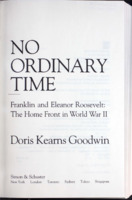 No ordinary time : Franklin and Eleanor Roosevelt : the home front in World War II. Biographical work on Eleanor Roosevelt by Doris Kearns Goodwin
 -
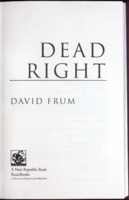 Dead right David Frum's work on the conservative movement during the Reagan-Bush years.
 -
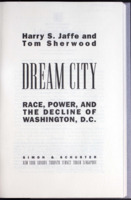 Dream city : race, power, and the decline of Washington, D.C. Harry Jaffe's work on the city of Washington, D.C.
 -
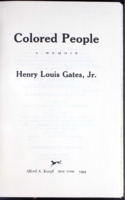 Colored people : a memoir Memoir by Henry Louis Gates.
 -
 The shadow of the panther : Huey Newton and the price of Black power in America In the early morning of August 22, 1989, on the corner of Ninth and Center Streets in Oakland, Huey Newton faced Tyrone Robinson and two other drug dealers, asking them for crack. Robinson refused, took a 9-mm automatic from one of his companions and pointed it at Newton's head. Huey stood still and said, "You can kill my body, but you can't kill my soul. My soul will live forever!" Robinson shot him three times in the head. Huey Newton, once considered the nation's premier symbol of black resistance to the entire American power structure, was pronounced dead at 6:12 a.m. The Shadow of the Panther is the most ambitious, engaging, and balanced history of the Black Panthers to date. It is also an unflinchingly honest account of what amounts to human tragedy. Hugh Pearson's account of Huey Newton's rise to power and descent into addiction and powerlessness is set against a century-long quest for civil rights and empowerment. Beginning with the formation of the Brotherhood of Sleeping-Car Porters in the 1920s, Hugh Pearson then traces the development of civil-rights activism through a series of "Premier Negro Leaders" from Booker T. Washington, W. E. B. Du Bois, and Adam Clayton Powell, Jr., to Martin Luther King, Jr., Stokely Carmichael, and Malcolm X. The extraordinary progress and crushing defeats of the early- and mid-1960s set the stage for the rise of the Black Power Movement and its offspring, the Black Panther Party. The details of this evolution from nonviolence to violence, and, finally, to militarism, are presented here with clarity and insight, showing clearly how Black Power spelled the beginning of the end of the Civil Rights Movement, and paved the way for the emergence of the Panthers as the nation's primary symbol of black disenchantment. Through meticulous research and exclusive cooperation from many of those close to Newton, Pearson paints a detailed portrait of life in the Party. Newton's own opposing tendencies - the intellectual who earned a Ph.D. and the street thug - had parallels in the structure and activities of the Party: while creating positive change through political organization and community programs, the Party also had all the characteristics of a violent, repressive, gangster mob. Persistent problems with internal conflicts, the wide gap between Newton's elite corps and rank-and-file members, sexual abuse and mistreatment of women, and the abandonment, torture, and frequent murder of members and ex-members all contributed to the ultimate demise of the Party. The result is a fine-grained portrait of the complex and evolving relationship of revolutionary blacks and white leftist college students in the face of growing black militancy and the Vietnam War, and a vivid and varied cast of characters that includes Stokely Carmichael, James Forman, Bob Scheer, Elaine Brown, and David Horowitz. A powerful and undeniably bold take on an era both pivotal and persistent in the American consciousness, The Shadow of the Panther will no doubt be the benchmark for all future books on Huey Newton and the Black Panther Party.
 -
 News and the culture of lying Paul Weaver's commentary on the news media.
 -
 The tyranny of the majority : fundamental fairness in representative democracy Jurist Lani Guanier's commentary on the state on American Democracy.
 -
 Rebellions, perversities, and main events In today's society, the model citizen is too often one with neither memory nor traditions. Murray Kempton's refusal to relinquish either is among his greatest achievements. He knows that the chaos of daily events can only be understood through the prism of the past. He is a man suffused with a seemingly inexhaustible appetite for the life of the mind. He is that rare reporter whose skepticism has never succumbed to cynicism.
 -
 Martyrs' Day : chronicle of a small war Michael Kelley's work on the Gulf War.
 -
 Live from the battlefield : from Vietnam to Baghdad : 35 years in the world's war zones Peter Arnett is undeniably the dean of his generation's war correspondents, a breed apart. Daring, wily, willing to put himself at enormous risk for a story. Arnett is a thinking man and a man of action. From his youth in New Zealand in the 1940s, Arnett knew journalism would be his ticket to the world. And it was - to Bangkok; then to Laos, where Arnett swam across the Mekong River to file his dispatches from Thailand; and then on to Indonesia, where he traveled with Sukarno until he was expelled after only thirteen months for his reporting on the developing war.In 1962, Arnett was sent to Vietnam along with David Halberstam, Neil Sheehan, Mal Browne, Stanley Karnow and the rest of a new young group of foreign correspondents that would later include Dan Rather, Ted Koppel and Peter Jennings. When American ground forces were committed, Arnett went right in with them. His controversial coverage for the Associated Press incurred the wrath of President Johnson but won him a Pulitzer Prize. After the fall of Saigon, when many of his peers had gone, Arnett stayed behind to get the whole story.With the dedication, passion and intelligence that one finds in great foreign correspondents, Arnett has pursued the whole story ever since. After covering wars in Cyprus and Lebanon, he joined CNN in 1981. News was going live, twenty-four hours a day, and Arnett was going with it - from San Salvador to Moscow to Iraq. And then to Afghanistan, after the defeat of the Soviet-sponsored government, a place of anarchic conflict, where Islamic radicals plot to export terrorism to the mainland United States. Satellite communications have forever changed the way we see war. Arnett's on-the-ground reporting of the Gulf War from Baghdad had an immediacy and suspense we had not experienced before. No one who watched will ever forget. Now, in the same vivid eye-of-the-Desert-Storm way in which he reported the drama and danger of the Gulf War, Peter Arnett shares the adventures, the gambles and the glory of his lifemore than thirty-five years inside the world's war zones.
 -
 Japanophobia : the myth of the invincible Japanese Bill Emmott's work on Japanese corporate entities.
 -
 A journey through economic time : a firsthand view John Kenneth Galbraith exhibits unmatched insight and broad scope - from World War I and the Russian Revolution to the implications of Communism's fall, from the "superbly insane decade of the twenties" and the Great Depression to the Reagan era and beyond. Whether he is analyzing the advent of Keynesian theory or the end of colonialism and the emergent Third World, Galbraith epitomizes the hindsight and the vision of one who has been an active and outspoken participant in the world's economic history. He writes with authority about the forging of Kennedy's New Frontier and Johnson's Great Society and examines the consequences of the "unintended history of the 1980s." Keenly observed and brilliantly composed, A Journey Through Economic Time is the crowning achievement of a remarkable career, a comprehensive and accessible view of twentieth-century economic and political history that will be read and referred to for years to come.
 -
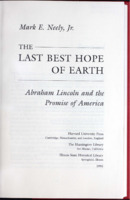 The last best hope of earth : Abraham Lincoln and the promise of America Mark R. Neely, Jr., provides for the general reader the first compact biography of Abraham Lincoln based on new scholarship. There is no comparable, succinct work on this nation's greatest president. "The Last Best Hope of Earth vividly recaptures the central place of politics in Lincoln's life. In Illinois, Lincoln was an established and prosperous lawyer, married to a refined and educated southern belle, and the father of four boys. Throughout his life, however, politics remained his first love. In Neely's depiction of Lincoln, power was never sought for its own sake. Having triumphed over the hardscrabble circumstances of his youth in Kentucky and Indiana, Lincoln, early in his political career, tied his ambition to the search for solutions to the economic underdevelopment of the American West. And in the last eleven years of his life, Lincoln's political ambitions became yoked to a fierce nationalism and a keen moral purpose - the preservation of the Union and the demise of slavery. Lincoln could not remember a time when he did not hate slavery, or revere the federal system. He made his position clear in the decade leading up to his presidential election campaign, and a civil war erupted." "Through Neely's eyes we see the growth of this president's advanced ideas about military strategy, despite their price in blood; his husbanding of the resources of the home front, regardless of its cost in national treasure; and his complex defense of the Constitution, notwithstanding a momentary loss of civil liberties. We also see Lincoln's steadfast dedication to the Emancipation Proclamation, while the fate of the republic and the future of four million black Americans hung in the balance." "Richly illustrated, nuanced and accessible, written with attention to the age in which Lincoln lived, yet ever alert to universal moral questions, this is a portrait of Lincoln as an extraordinary man in his own time and ours."--BOOK JACKET.
 -
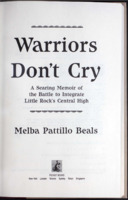 Warriors don't cry : a searing memoir of the battle to integrate Little Rock's Central High In 1957 Melba Pattillo turned sixteen. That was also the year she became a warrior on the front lines of a civil rights firestorm. Following the landmark 1954 Supreme Court ruling, Brown v. Board Education, she was one of nine teenagers chosen to integrate Little Rock's Central High School. This is her remarkable story. You will listen to the cruel taunts of her schoolmates and their parents. You will run with her from the threat of a lynch mob's rope. You will share her terror as she dodges lighted sticks of dynamite, and her pain as she washes away the acid sprayed into her eyes. But most of all you will share Melba's dignity and courage as she refuses to back down.
 -
 The Roosevelts : an American saga The story of the Roosevelts is usually seen as a tale of two presidents - Theodore and Franklin - who were distant cousins from distinct worlds, separated by time and politics. And of two families - the Oyster Bay and Hyde Park branches - that had little to do with each other. Now comes an explosive new portrait, The Roosevelts: An American Saga, which offers a completely unique view of America's longest lasting and most powerful dynasty. The Roosevelts were one family, an exclusive elite who began their history intimately related by bonds of love and ambition. In this brilliant biography, we see for the first time how the family divided into two branches and began an epic battle for the family legacy. We see for the first time how the ideals of two presidents were passed on to members of later generations, ennobling some and crushing others. The Roosevelts is a rare look at what brought this exceptional group of people together and what drove them apart. In this riveting book we see Teddy, the flamboyant politician and Rough Rider, who was also a "Papa Bear," passing on an ethos of sacrifice and achievement to his "cubs." There is Theodore Jr., the "crown prince," handpicked by his father to carry on the traditions of Oyster Bay but unable to complete the mission. And Alice, Teddy's acid-tongued and fiercely loyal daughter, whose antics became the talk of Washington and who finally became a caricature, raving against her cousin's New Deal and trying desperately to preserve her father's legacy. There's also Eleanor, daughter of Teddy's tragic brother, Elliott, who translated the unhappiness of her marriage to FDR into political activism, eventually becoming First Lady of the World. And finally there is Franklin, always underestimated by Teddy's family, who made an alliance with Eleanor to become the nemesis of the Oyster Bay Roosevelts and, in the web of ironies that bind this family together, a truer heir to Teddy than any of his own children. Filled with drama and anecdote, presenting familiar characters in a penetrating new light, The Roosevelts is a soaring tale of triumph over heartbreak and frailty. But it is also a daunting story of the vanity of human wishes.
 -
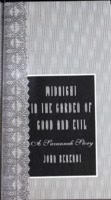 Midnight in the garden of good and evil : a Savannah story Shots rang out in Savannah's grandest mansion in the misty, early morning hours of May 2, 1981. Was it murder or self-defense? For nearly a decade, the shooting and its aftermath reverberated throughout this hauntingly beautiful city of moss-hung oaks and shaded squares. John Berendt's sharply observed, suspenseful, and witty narrative reads like a thoroughly engrossing novel, and yet it is a work of nonfiction. Berendt skillfully interweaves a hugely entertaining first-person account of life in this isolated remnant of the Old South with the unpredictable twists and turns of a landmark murder case. "It is a spellbinding story peopled by a gallery of remarkable characters: the well-bred society ladies of the Married Woman's Card Club; the turbulent young redneck gigolo; the hapless recluse who owns a bottle of poison so powerful it could kill every man, woman, and child in Savannah; the aging and profane Southern belle who is the "soul of pampered self-absorption"; the uproariously funny black drag queen; the acerbic and arrogant antiques dealer; the sweet-talking, piano-playing con artist; young blacks dancing the minuet at the black debutante ball; and Minerva, the voodoo priestess who works her magic in the graveyard at midnight. These and other Savannahians act as a Greek chorus, with Berendt revealing the alliances, hostilities, and intrigues that thrive in a town where everyone knows everyone else." "Midnight in the Garden of Good and Evil: A Savannah Story is a sublime and seductive reading experience. Brilliantly conceived and masterfully written, this enormously engaging portrait of a most beguiling southern city is certain to become a modern classic."--BOOK JACKET.
 -
 The American presidency : an intellectual history Historian Forrest McDonald's work on the history of the American presidency .
 -
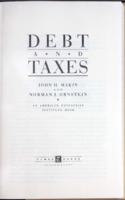 Debt and taxes No subject arouses - and perplexes - Americans more than debt and taxes. They are agreed about only one thing: they would like to rid themselves of both. It is a fantasy of course, as Benjamin Franklin knew when he observed in 1789 that "in this world nothing is certain but death and taxes." The only certainty Franklin neglected to mention was the lasting controversy that these confounding issues would always provoke.Debt and Taxes is a fresh look at America's budget mess by two of the country's most respected experts. John H. Makin, author of The Global Debt Crisis, and Norman J. Ornstein, an election consultant to CBS News and a contributor to The MacNeil/Lehrer NewsHour, provide a compelling and enlightening history of fiscal policy in the United States. They demonstrate how the political and economic aspects of the problem must be seen in broader patterns of ideology and philosophy. They trace our budget problems from the debate between Jefferson and Hamilton on how our government should work to the surprising struggles to formulate its policy. Most important, the authors examine where our policies are taking us, where they should be taking us, and how we can make our budget process more effective. The purpose of this book is to look behind he popular excitement over debts and deficits and to ask why and how we became entangled in our current predicament; how the fiscal struggles of the 1980s and early 1990s fit into historical patterns of political and economic thought concerning debt and taxes; and how much of the budgetary process is a real problem. Throughout the book, the authors take pains to place the subject in historical perspective. They point out that debate about the moral and political consequences of government debt, the power to tax, and the role of government itself lay behind both the Revolutionary War and the establishment of the republic. Sound fiscal policy was central to the Founding Fathers' philosophical and practical struggle over the direction that the new nation was to take. Debt and Taxes is an eye-opening - indeed, magisterial - account of the origins of the mechanisms of change and the belief in structural reform, of the competition between President and Congress, and of the philosophical and practical continuities, despite real and distinct changes, in public policy on taxing, spending, and debt. It is, as Senator Daniel Patrick Moynihan observes, "a clarifying, liberating book," one that all Americans should read.
631–660 of 728