Booknotes Annotations
Item set
Items
-
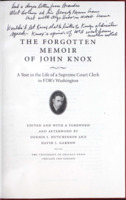 The forgotten memoir of John Knox : a year in the life of a Supreme Court clerk in FDR's Washington The Forgotten Memoir of John Knox - edited by Dennis J. Hutchinson and David J. Garrow - offers a candid, at times naive, insider's view of the showdown between Roosevelt and the Court that took place in 1937. At the same time, it marvelously portrays a Washington culture now long gone. Although the new Supreme Court building had been open for a year by the time Knox joined McReynolds' staff, most of the justices continued to work from their homes, each supported by a small staff. Knox, the epitome of the overzealous and officious young man, after landing what he believes to be a dream position, continually fears for his job under the notoriously rude (and nakedly racist) justice.But he soon develops close relationships with the justice's two black servants: Harry Parker, the messenger who does everything but breathe" for the justice, and Mary Diggs, the maid and cook. Together, they plot and sidestep around their employer's idiosyncrasies to keep the household running while history is made in the Court." "A foreword by Dennis Hutchinson and David Garrow sets the stage, and a gallery of period photos of Knox, McReynolds, and other figures of the time gives life to this engaging account, which like no other captures life in Washington, D.C., when it was still a genteel southern town."--BOOK JACKET.
 -
 The poet and the murderer : a true story of literary crime and the art of forgery Chronicles Mark Hofmann's attempt to forge an Emily Dickinson poem at the end of the twentieth century, and discusses how his deceit and greed undermined some of the most prominent institutions of present-day academia.
 -
 Staying tuned: a life in journalism Autobiographical work by journalist Daniell Schorr.
 -
 A storm in Flanders : the Ypres salient, 1914-1918 : tragedy and triumph on the Western Front An analysis of a pivotal battle of World War I revisits the four-year-long Battle of Ypres, an engagement that cost hundreds of thousands of lives and forever changed the way war would be waged.
 -
 King of the mountain : the nature of political leadership Political leaders govern countries, negotiate treaties, control military forces, and shape economies. Advanced as these activities may seem, however, psychiatrist Arnold M. Ludwig contends that rulers' actions are rooted in the alpha-male behaviors of monkeys and apes.."Profiling every ruler of a recognized country in the twentieth century - over 1,900 people in all - Ludwig establishes how rulers came to power, how they lost power, the dangers they faced, and the odds of their being assassinated, committing suicide, or dying a natural death. Concentrating on a smaller set of rulers for whom more extensive personal information was available, Ludwig profiles the six different kinds of leaders, examining their characteristics, childhoods, and mental stability or instability to pinpoint chief predictors of later political success."--BOOK JACKET.
 -
 What happened to Johnnie Jordan? : the story of a child turning violent On an icy night five years ago, Johnnie Jordan - just fourteen years old - brutally murdered his elderly foster care mother, leaving the state of Ohio shocked and outraged. He could not tell police why he did it or even how it made him feel; all he knew was that something inside him made him kill. At the time, few people predicted the swift emergence of a class of young so-called super-predators" - criminals like Johnnie who injure and kill without conscience, personified to the nation by the Littleton, Colorado, tragedy in 1999." "In What Happened to Johnnie Jordan? journalist Jennifer Toth, author of The Mole People and Orphans of the Living once again takes a look at the people in our society whom we so often discard and altogether ignore. As Toth investigates Johnnie's crime and life, she unravels the mysteries of a child murderer unable to identify his emotions even after they converge in acts of fury and rage. In the course of her research, Johnnie grows dangerously into a young man who "will probably kill again," he says, "though I don't want to." Yet he also demonstrates great kindness and caring when treated as more than just a case number, when treated as a human. Through Johnnie's harrowing story, Toth examines how some children manage to overcome tragic beginnings, while others turn their pain, anger, and loss on innocents."--BOOK JACKET.
 -
 Tuxedo Park : a Wall Street tycoon and the secret palace of science that changed the course of World War II Wall Street legend Alfred Lee Loomis, who once owned Hilton Head Island, was devoted to his hobby of science experiments in his mansion. During World War II, Loomis played a key role in the development of radar and the atomic bomb.
 -
 A good fight. The wife of Ronald Reagan's former press secretary describes life with her husband before and after he was shot by John Hinckley, the circumstances that led her to become a gun control activist, and her own battle with lung cancer.
 -
 The news about the news : American journalism in peril Leonard Downie, Jr. and Robert G. Kaiser - both reporters and editors at the Washington Post for nearly four decades - take us inside the American news media to reveal why the journalism we watch and read is so often so bad, and to explain what can be done about it. "They demonstrate how the media's preoccupation with celebrities, entertainment, sensationalism and profits can make a mockery of news. They remind us of the value of serious journalism with inside accounts of how great stories were reported and written - a New York Times investigation of Scientology and the IRS, and a Washington Post expose of police excesses. They recount a tense debate inside their own newsroom about whether to publicize a presidential candidate's long-ago love affair."--BOOK JACKET.
 -
 The pretender : how Martin Frankel fooled the financial world and led the feds on one of the most publicized manhunts in history Explains how Martin Frankel, a nerdy financial whiz, created a complex Ponzi scheme that embroiled some of the world's most powerful business leaders and led federal authorities on a bizarre manhunt from America across Europe.
 -
 A problem from hell : America and the age of genocide A Problem from Hell is a path-breaking interrogation of the last century of American history. Samantha Power poses a question that haunts our nation's past: Why do American leaders who vow "never again" repeatedly fail to marshal the will and the might to stop genocide? She provides the answer in the form of the suspenseful story of courageous individuals who risked their careers and lives in an effort to get the United States to act. Drawing upon exclusive interviews with Washington's top policymakers, access to thousands of pages of newly declassified documents, and her own reporting from the modern killing fields, Power shows how those who urged U.S. action were thwarted again and again by ignorance, indifference, and, above all, a failure of imagination."--BOOK JACKET.
 -
 Nigger : the strange career of a troublesome word Nigger is arguably the most consequential social insult in American history. In this book, the author traces how the word has been used and by whom, while analyzing the controversies to which it has given rise. The author explores such topics as how "nigger" should be defined and whether blacks have a right to use "nigger" while others do not.
 -
 John Marshall and the heroic age of the Supreme Court John Marshall (1755-1835) was arguably the most important judicial figure in American history. As the fourth chief justice of the United States Supreme Court, serving during the formative years of the Republic from 1801 to 1835, he helped move the Court from the fringes of power to the epicenter of constitutional government. His great opinions in cases like Marbury v. Madison and McCulloch v. Maryland, cited by the Court thousands of times over the years, are still part of the working discourse of constitutional law in America. Drawing on a new and definitive edition of Marshall's papers, R. Kent Newmyer combines engaging narrative with new historiographical insights in a fresh interpretation of John Marshall's life in the law.."Newmyer unfolds Marshall's early Virginia years - his Americanization in Fauquier County before the Revolution, his decision to fight for independence as "a principled soldier," and his emergence as a constitutional nationalist in the 1780s. Marshall's experience as a Federalist politician and a leading Virginia lawyer during the turbulent partisan decade of the 1790s, Newmyer argues, defined his ideas about judicial review and the role of the Supreme Court as a curb on party-based, states' rights radicalism."--BOOK JACKET.
 -
 What went wrong? : Western impact and Middle Eastern response For many centuries, the world of Islam was in the forefront of human achievement - the foremost military and economic power in the world, the leader in the arts and sciences of civilization. Christian Europe, a remote land beyond its northwestern frontier, was seen as an outer darkness of barbarism and unbelief from which there was nothing to learn or to fear. And then everything changed, as the previously despised West won victory after victory, first on the battlefield and in the marketplace, then in almost every aspect of public and even private life. "In this volume, Bernard Lewis examines the anguished reaction of the Islamic world as it tried to understand why things had changed, how they had been overtaken, overshadowed, and to an increasing extent dominated by the West. Lewis provides a fascinating portrait of a culture in turmoil. He shows how the Middle East turned its attention to understanding European weaponry and military tactics, commerce and industry, government and diplomacy, education and culture. He describes how some Middle Easterners fastened blame on a series of scapegoats, both external and internal, while others asked, not "who did this to us?" but rather "where did we go wrong?" and, as a natural consequence, "how do we put it right?" Lewis highlights the striking differences between the Western and Middle Eastern cultures from the eighteenth to the twentieth centuries with thought-provoking comparisons of such things as Christianity and Islam, music and the arts, the position of women, secularism and the civil society, the clock and the calendar."--BOOK JACKET.
 -
 Yellow : race in America beyond Black and white Discussion of how changing ideas of racial identity will affect race relations in the twenty-first century in the context of affirmative action, globalization, immigration, and other issues.
 -
 A clearing in the distance : Frederick Law Olmsted and America in the nineteenth century In a collaboration between writer and subject, the author of Home and City life illuminates Frederick Law Olmsted's role as a major cultural figure and a man at the epicenter of nineteenth-century American history. "We know Olmsted through the physical legacy of his stunning landscapes - among them, New York's Central Park, California's Stanford University campus, Boston's Back Bay Fens, Illinois's Riverside community, Asheville's Biltmore Estate, and Louisville's park system." "Olmsted's contemporaries knew a man of even more diverse talents. Born in 1822, he traveled to China on a merchant ship at the age of twenty-one. He cofounded The Nation magazine and was an early voice against slavery. He wrote books about the South and about his exploration of the Texas frontier. He managed California's largest gold mine and, during the Civil War, served as general secretary to the United States Sanitary Commission, the precursor of the Red Cross."--Jacket.
 -
 The anatomy of racial inequality An account of how racial classifications are created and perpetuated and how they resonate through the social, psychological, spiritual and economic life of this nation.--cover.
 -
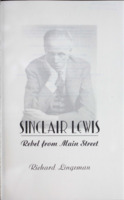 Sinclair Lewis : rebel from Main Street The critic Edmund Wilson called Sinclair Lewis one of the national poets." In the 1920s, Lewis fired off a fusillade of sensational novels, exploding American shibboleths with a volatile mixture of caricature and photographic realism. With an unerring eye for the American scene and an omnivorous ear for American talk, he mocked such sacrosanct institutions as the small town (Main Street), business (Babbitt), medicine (Arrowsmith), and religion (Elmer Gantry). His shrewdly observed characters became part of the American gallery, and his titles became part of the language." "Bringing to bear newly uncovered correspondence, diaries, and criticism, Richard Lingeman, distinguished biographer of Theodore Dreiser, paints a sympathetic portrait - in all its multihued contradictions - of a seminal American writer who could be inwardly the loneliest of men and outwardly as gregarious as George Follansbee Babbitt himself. Lingeman writes with sympathy and understanding about Lewis's losing struggle with alcoholism; his stormy marriages, including one to the superwoman Dorothy Thompson, whose fame as a newspaper columnist in the 1930s outshone Lewis's fading star as a novelist; and his wistful, autumnal love for an actress more than thirty years younger than he."--Jacket.
 -
 Lonesome rangers : homeless minds, promised lands, fugitive cultures John Leonard, "the fastest wit in the East" (The New York Times Book Review), is back with the off-beat, wide-ranging style that earned his last book, When the Kissing Had to Stop, a place among the Voice Literary Supplement's "25 Favorites of 1999." Now, with an eye to the social and political experience of writers, Leonard's Lonesome Rangers explores the literature of exile. In these pages, he considers Salman Rushdie as a rock 'n' roll Orpheus, who -- after ten years in fatwa-enforced exile -- bears a striking resemblance to his continually disappearing characters. He addresses Robert Putnam's Bowling Alone, where exile manifests itself in solitary bowling, reflecting a declining sense of community. And Leonard also explores Primo Levi's exile of survival, Bruce Chatwin's self-imposed exile in travel, as well as the work of Saul Bellow, Ralph Ellison, Philip Roth, Barbara Kingsolver, and Don DeLillo, among others. As always, Leonard's writing jumps off the page, engaging the reader in what Brigitte Frase termed his "criticism as performance art," making Lonesome Rangers an enjoyable read for anyone.
 -
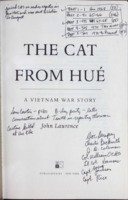 The cat from Hué : a Vietnam war story After years of reckoning with his memories, the author has made sense of them in this memoir by weaving them into a compelling story. It is laced with humor, anger, love, and the unforgettable tale of a very idiosyncratic cat who was determined to play his part in the Vietnam revolution. In reconstructing his experiences, he has relied not only on his notes and memory, but also on hundreds of hours of film footage shot at the time. This gives the book an uncanny vividness and fidelity to facts.
 -
 Crashing the party : taking on the corporate government in an age of surrender A behind-the-scenes glimpse into the presidential campaign of one of America's most effective social critics details what it takes to fight the two-party juggernaut.
 -
 The American Revolution : a history Chronicles and examines the American Revolution, discussing its character and its consequences, covering such topics as republicanism, the Philadelphia Convention, and the debate between the Federalists and Anti-Federalists.
 -
 Lazy B : growing up on a cattle ranch in the American southwest The first female justic e of the U.S. Supreme Court describes her childhood on a ranch on the Arizona-New Mexico border.
 -
 Abraham Lincoln : redeemer president More has been written about Abraham Lincoln than about any other American. Yet very little of this literature sees Lincoln as he was in his times - as a man of ideas, as a man of deep intellectual curiosity about the raging political and economic debates in nineteenth-century America, and as a textbook Victorian doubter" who could not believe as an orthodox Christian yet could not be easy in his unbelief. This truly fresh look at the nation's sixteenth president offers the first "intellectual biography" of a man whose grasp of the powerful currents of religion, philosophy, and political economy shaped not only the outcome of a great civil war but also the outlines of American national development for the following generation."--BOOK JACKET.
 -
 On two wings : humble faith and common sense at the American founding Michael Novak's work on the religious conviction of Washington, Jefferson, and Madison and its relation to the founding if the United States.
176–200 of 540