Booknotes Annotations
Item set
Items
-
 The wish for kings : democracy at bay For the better part of twenty years Lewis H. Lapham has sketched the American social and political landscape with a fine sense of history and a sharp and caustic wit. In The Wish for Kings, his most provocative book to date, Lapham obliges us to take a long hard look at what has become of our hallowed democratic tradition. Although we like to believe that we live by Lincoln's famous words - "government of the people, by the people, for the people" - we have become accustomed to a government by and for the friends of privilege. The promise of democracy is synonymous with the idea of the citizen, but to people who have grown tired of self-government the belief in kings and queens and fairy tales replaces the will to engage in the rude and often uncomfortable arts of politics. Lapham notes the effects of our distaste for objection and dissent - an apathetic public debate, 90 percent of the wealth in the hands of 5 percent of the population, the media and the universities united in their defense of oligarchy - and discusses at length the ways in which a courtier spirit (the obverse of the democratic spirit) subverts and weakens the hopes of a free republic. It is a discussion that has particular relevance to the present moment. If the wish for kings is as old as Babylon and as modern as the worship of Hollywood celebrity, our 1992 presidential election translated the wish into nineteen million votes for H. Ross Perot. Frightened by the weakness in the economy and dissatisfied with the wisdom in office in Washington, a sizable percentage of the electorate embraced in the figure of a Texas millionaire what it imagined to be the comforts of autocracy. The question remains as to whether the enthusiasm for Perot was merely an angry protest against a government that had arrogantly distanced itself from the American people, or whether it expressed a more general longing for a magical figure capable of quieting all our fears and answering all our prayers. The question is an urgent one, and it defines the task of the Clinton administration. Unless President Clinton can sustain the public faith in the practice as well as the theory of Democracy, it is possible that the idea of democratic self-government will come to be seen as a once noble experiment no longer adequate to the specifications of the twenty-first century. The several facets of this question come into brilliant focus in this important book by one of our most incisive social critics. No one who cares about the future of our nation should miss reading The Wish for Kings.
 -
 To begin the world anew : the genius and ambiguities of the American founders The Pulitzer Prize-winning historian offers a series of profiles of the characteristics, achievements, political philosophy, influence, and ambiguities of some of the most important figures of the Revolutionary generation.
 -
 American road : the story of an epic transcontinental journey at the dawn of the motor age The story of the First Transcontinental Motor Train, an expedition of "eighty-one vehicles and nearly three hundred men" from the White House in Washington, D.C. to San Francisco in 1919.
 -
 World on fire : how exporting free market democracy breeds ethnic hatred and global instability Examining the actual impact of economic globalization in every region of the world, from Africa and Asia to Russia and Latin America, Chua exposes an unexpected reality. In every one of these regions, free markets have concentrated disproportionate, often spectacular wealth in the hands of a resented ethnic minority. "Adding democracy to this volatile mix unleashes suppressed ethnic hatreds and brings to power ethno nationalist governments that pursue aggressive policies of confiscation and revenge. Chua also shows how individual countries may be viewed as market-dominant minorities at the regional or global level, a fact that may help to explain the Arab-Israeli conflict and the rising tide of anti-American sentiment around the world. America today has become the world's leading market-dominant minority, enjoying wealth and economic power wildly disproportionate to our numbers. This, perhaps more than anything else, accounts for the visceral hatred of Americans that we have seen expressed in recent acts of terrorism." "Chua warns that, far from making the world a better and safer place, democracy and capitalism - at least in the raw, unrestrained form in which they are currently being exported - are intensifying ethnic resentment and global violence, with potentially catastrophic results."--BOOK JACKET.
 -
 Boyd : the fighter pilot who changed the art of war John Boyd may be the most remarkable unsung hero in all of American military history. Some remember him as the greatest U.S. fighter pilot ever - the man who, in simulated air-to-air combat, defeated every challenger in less than forty seconds. Some recall him as the father of our country's most legendary fighter aircraft - the F-15 and F-16. Still others think of Boyd as the most influential military theorist since Sun Tzu. They know only half the story. "Boyd, more than any other person, saved fighter aviation from the predations of the Strategic Air Command. His manual of fighter tactics changed the way every air force in the world flies and fights. He discovered a physical theory that forever altered the way fighter planes were designed. Later in life, he developed a theory of military strategy that has been adopted throughout the world and even applied to business models for maximizing efficiency. And in one of the stories of modern military history, the Air Force fighter pilot taught the U.S. Marine Corps how to fight war on the ground. His ideas led to America's swift and decisive victory in the Gulf War and foretold the terrorist attacks of September 11, 2001"--Jacket.
 -
 Two steps ahead of the thought police Two Steps Ahead of the Thought Police presents one of the liveliest, funniest, and most insightful commentators in America - John Leo. No one gets to the heart of a social issue more quickly, or with more sharpness and wit. Leo goes to an academic convention where teachers attack the "white maleness" of the game show Jeopardy, and he reveals a plaintive letter from SWAM (Straight White American Males) demanding their own minority parade. He adds up the total number of victims in America - 1.2 billion in a population of 251 million - and explains Leo's First Law of Racial Folly: All setbacks for integration will immediately be hailed as triumphs for diversity. Ranging widely over popular culture, law, education, politics, and language, Leo writes about Ozzie and Harriet, "bodice-ripping" novels, the sneaky side of the sneaker business, Republican buzzwords, and the dizzying effect of an average Mario Cuomo phone call.When Mattel brings out the first talking Barbie in twenty years, Leo gets an exclusive interview with her. He discusses Indians in their pre-Kevin Costner period, analyzes the strange sexual hostility in Newport cigarette ads, and explains why the innocent-looking word "fair" functions like a grenade when lobbed into legislation. Here is Leo on:. The "seventy-five deadly isms" plaguing America: "Handing a woman a diet cola could be construed as sizeist, lookist, and sexist, and perhaps handist and laughist as well." The problem in hate-crime laws: "The legislation in effect divides America into two classes: those whose skulls can be cracked with a criminal penalty of, let us say, six months in jail, and those whose skulls are better protected and thus warrant nine months in jail. But if the skulls of all Americans are equally valuable, why not just give everyone nine months for cracking any cranium at all?" Journalism, the official language of journalists: "Suppose you wish to point out that Senator Forbush is a clod. Do you type, 'Forbush, the well-known incompetent'? Not at all. You simply write that the poor fellow's reputation is 'still dogged by doubts about his competence.' Or if you feel he should be indicted, depict him as 'haunted by allegations,' which, as a responsible and thorough reporter, you are obliged to dig up and embellish." For Leo loyalists or for readers just discovering him - but most of all for the beleaguered majority impatient with extremists of all stripes - Two Steps Ahead of the Thought Police will be a treasured source of unconventional wit and wisdom.
 -
 Them : adventures with extremists In the tradition of Bill Bryson, a fascinating and frequently hilarious look at extremists around the globe, and the conspiracy theory that unites them. Journalist Jon Ronson, the mild-mannered but ironic observer, learns some alarming things about the looking-glass world of them and us. Are the extremists onto something? Or has Ronson become one of Them?
 -
 Paris 1919 : six months that changed the world Between January and July 1919, after "the war to end all wars," men and women from around the world converged on Paris to shape the peace. Center stage was an American president, Woodrow Wilson, who with his Fourteen Points seemed to promise to so many people the fulfillment of their dreams. Stern, intransigent, impatient when it came to security concerns and idealistic in his dream of a League of Nations that would resolve all future conflict peacefully, Wilson is only one of the characters who fill the pages of this book. David Lloyd George, the British prime minister, brought Winston Churchill and John Maynard Keynes. Lawrence of Arabia joined the Arab delegation. Ho Chi Minh, a kitchen assistant at the Ritz, submitted a petition for an independent Vietnam. For six months, Paris was effectively the center of the world as the peacemakers carved up bankrupt empires and created new countries. This book brings to life the personalities, ideals, and prejudices of the men who shaped the settlement. They pushed Russia to the sidelines, alienated China, and dismissed the Arabs. They struggled with the problems of Kosovo, of the Kurds, and of a homeland for the Jews. The peacemakers, so it has been said, failed dismally; above all they failed to prevent another war. Margaret MacMillan argues that they have unfairly been made the scapegoats for the mistakes of those who came later. She refutes received ideas about the path from Versailles to World War II and debunks the widely accepted notion that reparations imposed on the Germans were in large part responsible for the Second World War.
 -
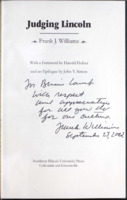 Judging Lincoln Collection of nine essays on the topic of Lincoln compiled by Frank J. Williams, chief justice of the Rhode Island Supreme Court and one of the nation’s leading authorities on Abraham Lincoln.
 -
 The moral animal : evolutionary psychology and everyday life An accessible introduction to the science of evolutionary psychology and how it explains many aspects of human nature. Unlike many books on the topic, which focus on abstractions like kin selection, this book focuses on Darwinian explanations of why we are the way we are--emotionally and morally--and interweaves episodes from Darwin's own life as illuminating examples. Wright deals particularly well with explaining the reasons for the stereotypical dynamics of the three big "S's:" sex, siblings, and society.
 -
 The two faces of Islam : the house of Saʻud from tradition to terror In this informed, compelling exploration of Moslem beliefs and of the sectarian conflicts within the community, a Jewish historian paints a sympathetic portrait of mainstream Islam and exposes the centuries-old roots of Osama bin Laden's extremism.
 -
 Freedom : a history of US The companion volume to a major 16-part PBS series brings the story of the United States as viewed through the inspiring fight to uphold the ideal of freedom--from the forging of the Declaration of Independence to the power behind the Civil Rights movement to the challenge the nation faces following the terrorist attacks of September 11.
 -
 Abraham : a journey to the heart of three faiths In this timely, provocative, and uplifting journey, the bestselling author of "Walking the Bible" searches for the man at the heart of the world's three monotheistic religions--and today's deadliest conflicts. "Abraham" uncovers fascinating, little-known details of the man who defines faith for half of the world. Endpaper maps.
 -
 First great triumph : how five Americans made their country a world power Documents how the United States rose to a significant world power one century ago through the actions of five political figures, including Theodore Roosevelt, naval strategist Alfred T. Mahan, and Senator Henry Cabot Lodge.
 -
 Napoleon and Wellington : the Battle of Waterloo and the great commanders who fought it Explores the relationship between the French emperor Napoleon Bonaparte and the Duke of Wellington prior to and in the aftermath of the Battle of Waterloo, the most decisive battle of the nineteenth century.
 -
 Passion for Islam : shaping the modern Middle East : the Egyptian experience Discusses Egypt's role in the growth of Islamic extremism.
 -
 Great white fathers : the story of the obsessive quest to create Mount Rushmore The story of how Rushmore was conceived and built, and why controversy surrounded the project from the start. Great White Fathers is about the meaning of public art, the rise of automobile tourism, and the development of kitsch culture. At its center is Rushmore's feisty sculptor Gutzon Borglum, who waged an energetic campaign on behalf of his artistic vision and then carved the faces of four presidents into a mountainside.
 -
 The ideas that conquered the world : peace, democracy, and free markets in the twenty-first century Continuing in the same tradition as Francis Fukuyama's The End of History, political science professor (and senior fellow of the Council on Foreign Relations) Mandelbaum continues the argument that capitalism and democracy are inextricably linked and that so-called "free markets" have emerged as indisputably triumphant in the world of contesting political and economic ideas. In exploring the political affairs of the United States, Europe, the Middle East, Russia, and China, he advances two propositions about liberal democracies that may seem surprising to observers of the current international scene: that democracies tend to conduct peaceful foreign affairs and that free markets naturally lead to democracy. One of America's leading foreign policy thinkers offers a major new statement about global politics in the 21st century, and shows how prevailing trends are remarkably favorable to the United States and the nations of the West.
 -
 Carnegie Explores the life and career of the industrialist who made his fortune in the steel industry, and who was also one of the nation's greatest philanthropists.
 -
 Democracy in America Contains Tocqueville's original eighteenth century writings on the American political experience and its effects upon the development of the American culture.
 -
 Buddha's child : my fight to save Vietnam Ky served as a general in the South Vietnamese Air Force and as prime minister from 1965 until 1967.
 -
 Franklin : the essential founding father Biography of Benjamin Franklin.
 -
 Slander : liberal lies about the American right Examines the shaping of political discourse in the United States as it has become increasingly hostile and more trivial, describing how the media's liberal bias has villianized the conservative right and obscured the true issues.
 -
 Six days of war : June 1967 and the making of the modern Middle East Explores the lasting impact six days of intense Arab-Israeli fighting had on world politics, providing information on the conflict's major participants, its causes, and the tragic outcome.
 -
 The reckoning : Iraq and the legacy of Saddam Hussein The reckoning is an account of the forces--historical, religious, ethnic, and political--that produced Saddam Hussein's dictatorship. Iraq was forged after World War I from the Mesopotamian region of the collapsed Ottoman Empire, and its people have never had a national identity or a sense of a common purpose. Hussein, ruling by terror, pitted the various ethnic groups, religious interests, and tribes against one another, and in so doing achieved the destruction of Iraq's middle class and civilized society. After he goes, the country could be the site of conflict even more vicious than the Balkan wars.
151–175 of 540