Booknotes Annotations
Item set
Items
-
 The collected poetry of Nikki Giovanni, 1968-1998 For the first time ever, the complete poetry collection spanning three decades from Nikki Giovanni, renowned poet and one of America's national treasures. When her poems first emerged during the Black Arts Movement, in the 1960s, Nikki Giovanni immediately took her place among the most celebrated, controversial and influential poets of the era. Now, more than thirty years later, Giovanni still stands as one of the most commanding, luminous voices to grace America's political and poetic landscape.
 -
 The road to home: my life and times Vartan Gregorian's tale starts with a childhood of poverty, deprivation, and enchantment in the Armenian quarter of Tabriz, Iran. As the world reeled from depression into six years of warfare, his mother died, leaving his grandmother Voski as the loving staff of his life. Through unlettered example and instruction, he learned about the first of his many worlds: the strenuousness required for survival, the fairy tale that explained existence, the place and name of his own star in night sky, how to maneuver as a member of a Christian minority in a benevolent Muslim kingdom, the beauty and inspiration of Armenian Church liturgy, the exciting foreign world of ten-year-old American westerns, the richness of life on the streets. "He learned the magic of the innumerable worlds he could find in books - and he wanted to visit them all. As the spell books cast on him grew more powerful, so did the constraints imposed by his father's indifference to his dreams of redirecting his life through learning." "So, one day when he was fifteen years old, he presented himself at an Armenian-French lycee in Beirut, Lebanon, to start the arduous task of becoming a person of learning and consequence." "This book tells not only how he reached that school but also about the many people who guided, supported, taught, and helped him on a journey from Tabriz to Beirut to Palo Alto to Tenafly to London, from Stanford University to San Francisco State University to the University of Texas at Austin to the University of Pennsylvania to the New York Public Library to Brown University, and, currently, to the presidency of Carnegie Corporation of New York."--BOOK JACKET.
 -
 Legacy : paying the price for the Clinton years Assesses the Clinton legacy, arguing that it was his appeasement of America's enemies overseas that will be the longest lasting effect of the Clinton years, not his domestic accomplishments.
 -
 Sea of glory : America's voyage of discovery : the U.S. Exploring Expedition, 1838-1842 In 1838, the U.S. government launched the largest discovery voyage the Western world had ever seen-6 sailing vessels and 346 men bound for the waters of the Pacific Ocean. Four years later, the U.S. Exploring Expedition returned with an astounding array of accomplishments and discoveries: 87,000 miles logged, 280 Pacific islands surveyed, 4,000 zoological specimens collected, including 2,000 new species, and the discovery of the continent of Antarctica. And yet at a human level, the project was a disaster-not only had 28 men died and 2 ships been lost, but a series of sensational courts-martial had also ensued that pitted the expedition's controversial leader, Lieutenant Charles Wilkes, against almost every officer under his command. Though comparable in importance and breadth of success to the Lewis and Clark Expedition, the Ex. Ex. has been largely forgotten. Now, Nathaniel Philbrick re-creates this chapter of American maritime history in all its triumph and scandal. Sea of glory combines meticulous history with spellbinding human drama as it circles the globe from the palm-fringed beaches of the South Pacific to the treacherous waters off Antarctica and to the stunning beauty of the Pacific Northwest, and, finally, to a court-martial aboard a ship of the line anchored off New York City.
 -
 Vixi : memoirs of a non-belonger Sixteen-year-old Richard Pipes escaped from Nazi-occupied Warsaw with his family in October 1939. Their flight took them to the United States by way of Italy, and Pipes went on to earn a college degree, join the U.S. Air Corps, serve as professor of Russian history at Harvard for nearly forty years, and become advisor to President Reagan on Soviet and Eastern European affairs. In this book, the eminent historian remembers the events of his own remarkable life as well as the unfolding of some of the twentieth century's most extraordinary political events. "Pipes shows us the inner workings of Harvard University during its Golden Age, discusses the nature of Soviet Communism during the Cold War years, and describes from an insider's perspective the conflicts within the Reagan administration over American policies toward the USSR. He offers portraits of such cultural and political figures as Isaiah Berlin, Ronald Reagan, and Alexander Haig, as well as unique observations on his Polish homeland, Jewish heritage, and the process of assimilation into American culture. Perhaps most interesting of all, Pipes depicts his evolution as a historian and his understanding of how history is witnessed and how it is recorded."--BOOK JACKET.
 -
 Lightning man : the accursed life of Samuel F.B. Morse Profiles Morse as a gifted artist, political prospect, and innovator responsible for the American electromagnetic telegraph, describing the painful defeats that overshadowed his successes.
 -
 Domestic tranquility : a brief against feminism Carolyn Graglia argues that contemporary feminist see traditional wives and mothers as their main opponents.
 -
 America's women : four hundred years of dolls, drudges, helpmates, and heroines America's Women tells the story of more than four centuries of history. It features a stunning array of personalities, from the women peering worriedly over the side of the Mayflower to feminists having a grand old time protesting beauty pageants and bridal fairs. Courageous, silly, funny, and heartbreaking, these women shaped the nation and our vision of what it means to be female in America. By culling the most fascinating characters, the average as well as the celebrated, Gail Collins, the editorial page editor at the New York Times, charts a journey that shows how women lived, what they cared about, and how they felt about marriage, sex, and work. She begins with the lost colony of Roanoke and the early southern tobacco brides who came looking for a husband and sometimes, thanks to the stupendously high mortality rate, wound up marrying their way through three or four. Spanning wars, the pioneering days, the fight for suffrage, the Depression, the era of Rosie the Riveter, the civil rights movement, and the feminist rebellion of the 1970s, America's Women describes the way women's lives were altered by dress fashions, medical advances, rules of hygiene, social theories about sex and courtship, and the ever-changing attitudes toward education, work, and politics. While keeping her eye on the big picture, Collins still notes that corsets and uncomfortable shoes mattered a lot, too. "The history of American women is about the fight for freedom," Collins writes in her introduction, "but it's less a war against oppressive men than a struggle to straighten out the perpetually mixed message about women's roles that was accepted by almost everybody of both genders." Told chronologically through the compelling stories of individual lives that, linked together, provide a complete picture of the American woman's experience, America's Women is both a great read and a landmark work of history.
 -
 Like no other time: the 107th Congress and the two years that changed America forever Offers an insider's account of the workings of the U.S. government during two extraordinary years of American history, covering the presidential election of 2000, the September 11th terrorist attacks, and corporate scandals.
 -
 Death of innocence: the story of the hate crime that changed America Mamie Carthan was an ordinary African-American woman growing up in 1930s Chicago, living under the strong steady influence of her mother's care. She fell in love with and married Louis Till, and while the marriage didn't last, they did have a beautiful baby boy, Emmett. "In August 1955, Emmett was visiting family in Mississippi when he was kidnapped from his bed in the middle of the night by two white men and brutally murdered. His crime: allegedly whistling at a white woman in a convenience story. His mother began a career of activism when she insisted on an open-casket viewing of her son's gruesomely disfigured body. More than a hundred thousand people attended the service. The trial of J. W. Milam and Roy Bryant, accused of kidnapping and murdering Emmett (the two were eventually acquitted of the crime), was considered the first full-scale media event of the civil rights movement." "What followed altered the course of this country's history, and it was all set in motion by the sheer will, determination, and courage of Mamie Till-Mobley - a woman who would pull herself back from the brink of suicide to become a teacher and inspire hundreds of black children throughout the country."--BOOK JACKET.
 -
 No excuses: closing the racial gap in learning A concerned appraisal of the racial gap in education today cites educational inequalities as a central civil rights issue, highlighting inner-city schools that demonstrate models of educational excellence while suggesting ways that educational problems can be overcome.
 -
 Franklin and Winston : an intimate portrait of an epic friendship The most complete portrait ever drawn of the complex emotional connection between two of history's towering leaders. Franklin Roosevelt and Winston Churchill were the greatest leaders of the Greatest Generation. In [this volume, the author] explores the ... relationship between the two men who piloted the free world to victory in World War II. It was a crucial friendship, and a unique one--a president and a prime minister spending enormous amounts of time together (113 days during the war) and exchanging nearly two thousand messages. Amid cocktails, cigarettes, and cigars, they met, often secretly, in places as far-flung as Washington, Hyde Park, Casablanca, and Teheran, talking to each other of war, politics, the burden of command, their health, their wives, and their children. Born in the nineteenth century and molders of the twentieth and twenty-first, Roosevelt and Churchill had much in common. Sons of the elite, students of history, politicians of the first rank, they savored power. In their own time both men were underestimated, dismissed as arrogant, and faced skeptics and haters in their own nations yet both magnificently rose to the central challenges of the twentieth century. Theirs was a kind of love story, with an emotional Churchill courting an elusive Roosevelt. The British prime minister, who rallied his nation in its darkest hour, standing alone against Adolf Hitler, was always somewhat insecure about his place in FDR's affections which was the way Roosevelt wanted it. A man of secrets, FDR liked to keep people off balance, including his wife, Eleanor, his White House aides and Winston Churchill. Confronting tyranny and terror, Roosevelt and Churchill built a victorious alliance amid cataclysmic events and occasionally conflicting interests. Franklin and Winston is also the story of their marriages and their families, two clans caught up in the most sweeping global conflict in history. [In the volume, he] has written [an] account of the most remarkable friendship of the modern age.--Dust jacket.
 -
 The pursuit of happiness in times of war In The Pursuit of Happiness in Times of War, Pulitzer Prize-winning journalist Carl M. Cannon shows how the single phrase life, liberty, and the pursuit of happiness" is one of remarkable historical power. From the Revolutionary War to the War on Terrorism, Americans have lived out this creed with the help of their elected leaders, who in times of conflict inevitably hark back to Jefferson's exalted language.Cannon traces the roots of "the pursuit of happiness" and explores how wartime presidents have embraced it for two centuries. He draws on original research and interviews with Presidents Ford, Carter, Bush (41), and Clinton, among others, and has uncovered exactly what this phrase means to these presidents.Cannon charts how Americans' understanding of the pursuit of happiness has changed through the years as the nation itself has changed."--Jacket.
 -
 Dude, where's my country? Notes George W. Bush's affiliations with Enron and big oil, presenting a tongue-in-cheek plan for ending his political career while charging political leaders with enabling a growing divide between American classes.
 -
 Why Americans hate politics Journalist E.J. Dionne of the Washington Post argues that liberal and conservative ideologies since the 1960s have hindered the framing of American issues in ways that would lead to their resolution.
 -
 Evil: an investigation Drawing on examples both obscure and splashed across the front page, Morrow asks if, ultimately, we can understand evil - or if we even should. From Caligula to Columbine to his encounter with Milosevic, Morrow's stories are drawn from over thirty years of experience as a revered journalist and essayist. The result is a synthesis of a lifetime of observation that illuminates the chronically elusive, endlessly fascinating paradox that is evil.--BOOK JACKET.
 -
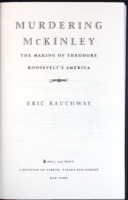 Murdering McKinley : the making of Theodore Roosevelt's America After President William McKinley was fatally shot at the Pan-American Exposition in Buffalo, New York, on September 6, 1901, Americans were bereaved and frightened. Eric Rauchway's brilliant Murdering McKinley re-creates Leon Czolgosz's hastily conducted trial and then traverses America as Dr. Vernon Briggs, a Boston alienist, sets out to discover why Czolgosz rose up to kill his President. While uncovering the answer that eluded Briggs and setting the historical record straight about Czolgosz, Rauchway also provides the finest portrait yet of Theodore Roosevelt at the moment of his sudden ascension to the White House.--BOOK JACKET.
 -
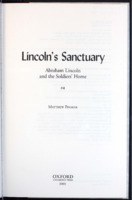 Lincoln's sanctuary : Abraham Lincoln and the Soldiers' Home After the heartbreaking death of his son Willie, Abraham Lincoln and his family fled the gloom that hung over the White House, moving into a small cottage outside Washington, on the grounds of the Soldiers' Home, a residence for disabled military veterans. In Lincoln's Sanctuary, historian Matthew Pinsker offers a fascinating portrait of Lincoln's stay in this cottage and tells the story of the president's remarkable growth as a national leader and a private man. "Lincoln lived at the Soldiers' Home for a quarter of his presidency, and for nearly half of the critical year of 1862, but most Americans (including many scholars) have not heard of the place. Indeed, this is the first volume to specifically connect this early "summer White House" to key wartime developments, including the Emancipation Proclamation, the firing of McClellan, the evolution of Lincoln's "Father Abraham" image, the election of 1864, and the assassination conspiracy. Through a series of striking vignettes, the reader discovers a more accessible Lincoln, demonstrating what one visitor to the Soldiers' Home described as his remarkable "elasticity of spirits." At his secluded cottage, the president complained to his closest aides, recited poetry to his friends, reconnected with his wife and family, conducted secret meetings with his political enemies, and narrowly avoided assassination attempts. Perhaps most important, he forged key friendships that helped renew his flagging spirits. The cottage became a refuge from the pressures of the White House, a place of tranquility where Lincoln could refresh his mind." "Based on research in rarely tapped sources, especially the letters and memoirs of people who lived or worked at the Soldiers' Home, Lincoln's Sanctuary offers the unexpected - a completely fresh view of Abraham Lincoln - through the window of a place that helped shape his presidency."--Jacket.
 -
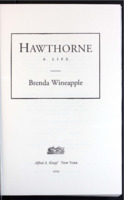 Hawthorne: a life. Brenda Wineapple's biographical work about Nathaniel Hawthorne.
 -
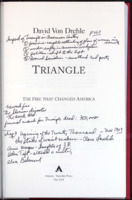 Triangle : the fire that changed America Describes the 1911 fire that destroyed the Triangle Shirtwaist factory in New York's Greenwich Village, the deaths of 146 workers in the fire, and the implications of the catastrophe for twentieth-century politics and labor relations.
 -
 Terrorism and tyranny : trampling freedom, justice, and peace to rid the world of evil "In Terrorism and Tyranny, Bovard casts yet another jaundiced eye on Washington and the motives behind protecting "the homeland" and starting a controversial, unprovoked war with Iraq. Do you think that you’re safer now that the Federal Government has a Homeland Security czar? Think that your civil liberties and privacy are still intact? Think again on both counts. For Bovard, the Bush administration’s war on terror all comes down to a trampling of personal liberty that is more effective in winning elections than it is in protecting Americans. From airport security follies that protect no one to increased surveillance of individuals in their public and private lives to the dishonest, abusive roundup of detainees, the war on terrorism is taking a toll on individual liberty, and no one tells the whole story better than James Bovard."--Jacket.
 -
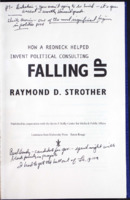 Falling up : how a redneck helped invent political consulting Growing Up in Texas "Get the Hell Out of Here. You Have a Future" The Louisiana Years A Short Sheriff and a Long Pistol The First Lessons Light Bulbs and Bookmarks Sunshine Rains on Me James Carville and Iceberg Lettuce The Awakening Season of Discontent The Kingfish Lends a Hand What Is It You Do, Sir? I Know Lloyd Bentsen, and He Is a Friend of Mine A Pretty Woman with a Smudge on Her Cheek The Clock Ticks The Wise Ones Stumble Again Bill, Hillary, Al, and the Gang Buddy Roemer and the Silver Bullet Where Dreams Go When They Die Marriage on the Rocks, Up with a Twist Kicking Ass and Taking Names Buying Friends and Influencing People Blue Chips, Dwarfs, and Survival The Sea Creatures Crawl to the Shore The Chill Winds of September. The political consultant describes his life and career, first in Louisiana politics and then advising such presidential candidates as Gary Hart and Bill Clinton.
 -
 The devil in the white city : murder, magic, and madness at the fair that changed America Two men, each handsome and unusually adept at his chosen work, embodied an element of the great dynamic that characterized America's rush toward the twentieth century. The architect was Daniel Hudson Burnham, the fair's brilliant director of works and the builder of many of the country's most important structures, including the Flatiron Building in New York and Union Station in Washington, D.C. The murderer was Henry H. Holmes, a young doctor who, in a malign parody of the White City, built his "World's Fair Hotel" just west of the fairgrounds₇a torture palace complete with dissection table, gas chamber, and 3,000-degree crematorium. Burnham overcame tremendous obstacles and tragedies as he organized the talents of Frederick Law Olmsted, Charles McKim, Louis Sullivan, and others to transform swampy Jackson Park into the White City, while Holmes used the attraction of the great fair and his own satanic charms to lure scores of young women to their deaths. What makes the story all the more chilling is that Holmes really lived, walking the grounds of that dream city by the lake. The Devil in the White City draws the reader into a time of magic and majesty, made all the more appealing by a supporting cast of real-life characters, including Buffalo Bill, Theodore Dreiser, Susan B. Anthony, Thomas Edison, Archduke Francis Ferdinand, and others. In this book the smoke, romance, and mystery of the Gilded Age come alive as never before. Erik Larson's gifts as a storyteller are magnificently displayed in this rich narrative of the master builder, the killer, and the great fair that obsessed them both.
 -
 Terror in the name of God : why religious militants kill For four years, the author interviewed extremist members of three religions around the world: Christians, Jews, and Muslims. Traveling extensively to refugee camps in Lebanon, to religious schools in Pakistan, to prisons in Amman, Asqelon, and Pensacola, she discovered that the Islamic jihadi in the mountains of Pakistan and the Christian fundamentalist bomber in Oklahoma have much in common. Based on her vast research, she lucidly explains how terrorist organizations are formed by opportunistic leaders who, using religion as both motivation and justification, recruit the disenfranchised. She depicts how moral fervor is transformed into sophisticated organizations that strive for money, power, and attention. Her extensive interaction with the faces behind the terror provide unprecedented insight into acts of inexplicable horror, and enable her to suggest how terrorism can most effectively be countered.
 -
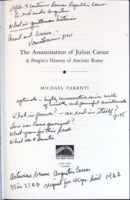 The assassination of Julius Caesar : a people's history of ancient Rome Most historians, both ancient and modern, have viewed the Late Republic of Rome through the eyes of its rich nobility. They regard Roman commoners as a parasitic mob, a rabble interested only in bread and circuses. They cast Caesar, who took up the popular cause, as a despot and demagogue, and treat his murder as the outcome of a personal feud or constitutional struggle, devoid of social content. In The Assassination of Julius Caesar, the author Michael Parenti subjects these assertions of gentlemen historians" to a bracing critique, and presents us with a compelling story of popular resistance against entrenched power and wealth. Parenti shows that Caesar was only the last in a line of reformers, dating back across the better part of a century, who were murdered by opulent conservatives. Caesar's assassination set in motion a protracted civil war, the demise of a five-hundred-year republic, and the emergence of an absolutist rule that would prevail over Western Europe for centuries to come." "Parenti reconstructs the social and political context of Caesar's murder, offering fascinating details about Roman society. In these pages we encounter money-driven elections, the struggle for economic democracy, the use of religious augury as an instrument of social control, the sexual abuse of slaves, and the political use of homophobic attacks. Here is a story of empire and corruption, patriarchs and subordinated women, self-enriching capitalists and plundered provinces, slumlords and urban rioters, death squads and political witch-hunts."--Jacket.
101–125 of 540