Booknotes Annotations
Item set
Items
-
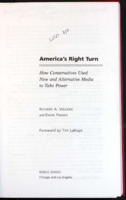 America's right turn: how Conservatives used new and alternative media to take power. Details the rise of political conservatism and its effect on the mass media.
 -
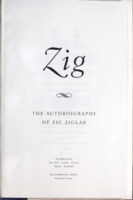 Zig: the autobiography of Zig Ziglar. The motivational speaker and trainer traces his early career as an unsuccessful salesman, the principles and values that marked his life, and his impact on professional, religious, and social organizations.
 -
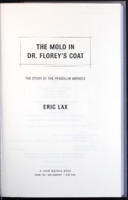 The mold in Dr. Florey's coat: the story of the penicillin miracle. The account of Alexander Fleming's discovery of penicillin in his London laboratory in 1928 and its eventual development as the first antibiotic by a team at Oxford University headed by Howard Florey and Ernst Chain.
 -
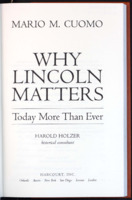 Why Lincoln matters: today more than ever. Mario Cuomo, former governor of New York, examines President Abraham Lincoln's words, speeches, and writings and how they pertain to twenty-first century issues.
 -
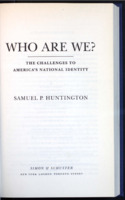 Who are we?: the challenges to America's national identity. Samuel Hintington's study of the erosion of American national identity.
 -
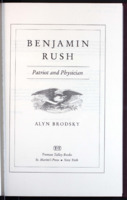 Benjamin Rush: patriot and physician. Biographical work on Benjamin Rush.
 -
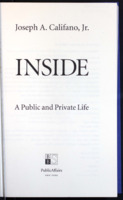 Inside: a public and private life. Political autobiography of Joseph A. Califano.
 -
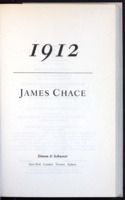 1912: Wilson, Roosevelt, Taft & Debs-- the election that changed the country. James Chace's account of the 1912 Presidential Election.
 -
 The essential America: our founders and the liberal tradition. Traces the roots of modern liberal ideas to the moral and spiritual foundations of America and suggests that liberalism is the right approach to guide America in the future.
 -
 Martin Luther. A biographical work on Martin Luther.
 -
 Shadow divers: the true adventure of two Americans who risked everything to solve one of the last mysteries of World War II. Kurson's account of the 1991 dive to examine a World War II German U-boat.
 -
 Stalin: the court of the red tsar. An account of Joseph Stalin's relationship with the men and women who ere his close associates.
 -
 Surprise, security, and the American experience. Historian John Lewis Gaddis' study of the concept of homeland security.
 -
 The Pentagon's new map: war and peace in the twenty-first century. Thomas Barnett's study of American military strategy in the 21st century.
 -
 Grant and Twain : the story of a friendship that changed America Explores the relationship between Mark Twain and Ulysses S. Grant and the influence each had on the other to complete their respective literary works--Grant's memoirs and Twain's novel on Huckleberry Finn.
 -
 The exception to the rulers : exposing oily politicians, war profiteers, and the media that love them A journalist takes a look at the corporate and political hypocrisy that is rampant in the United States, commenting on the corruption of media monopolies, the deceptions of the Bush administration, and corporate influence on government.
 -
 Why courage matters : the way to a braver life A reflection on courage presents a collection of stories of surpassing bravery and selfless devotion to duty and offers portraits of individuals--both famous and unheralded--who confronted adversity and triumphed.
 -
 Head to head : the coming economic battle among Japan, Europe, and America Discusses the three major world powers and the competition for world economic supremacy.
 -
 Perfectly legal : the covert campaign to rig our tax system to benefit the super rich-- and cheat everybody else Details the government's failure to reform tax policies and enforcement.
 -
 All deliberate speed : reflections on the first half century of Brown v. Board of Education A Harvard Law School professor examines the impact that Brown v. Board of Education has had on his family, citing historical figures, while revealing how the reforms promised by the case were systematically undermined.
 -
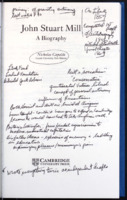 John Stuart Mill : a biography Nicholas Capaldi's biography (no competitor is currently in print) traces the ways in which Mill's many endeavors are related and explores the significance of Mill's contributions to metaphysics, epistemology, ethics, social and political philosophy, the philosophy of religion, and the philosophy of education. He shows how Mill was groomed for his role in life by both his father, James Mill, and Jeremy Bentham, the two most prominent philosophical radicals of the early nineteenth century. Yet Mill revolted against this education and developed friendships with Thomas Carlyle and Samuel Taylor Coleridge, who introduced him to Romanticism and political conservatism. "A special feature of this biography is the attention devoted to the relationship with Harriet Taylor. No one exerted a greater influence on Mill than the woman he was eventually to marry. Nicholas Capaldi reveals just how deep her impact was on Mill's thinking about the emancipation of women. Clarifying this relationship helps to explain why Mill was concerned not only with such issues as the franchise and representation, but also with a fundamental concept of personal autonomy that became pivotal to his thought." "There has never been a serious attempt to set out the interconnections of Mill's thought in this manner. Moreover, this biography presents the private life as both a reflection and an instantiation of ideas and values - a life so constructed as to be a Romantic work of art."--Jacket.
 -
 Saboteurs : the Nazi raid on America Publisher's description: Shortly after America's entry into World War II, Adolf Hitler ordered an extensive sabotage campaign against the United States to disrupt the production of tanks and airplanes and blow up bridges and railroads. Eight German saboteurs were dispatched across the Atlantic by U-boat, one team landing in Amagansett, Long Island, the other near Jacksonville, Florida. They brought with them enough money and explosives for a two-year operation and traveled inland to explore potential targets. The full story of this audacious endeavor is a remarkable account of a terrorist threat against America. Michael Dobbs describes the saboteurs' training in Nazi Germany, their claustrophobic three-week voyage in submarines, and their infiltration into American life. He explores the reasons each volunteered, and their links to a network of Nazi sympathizers in the United States. He paints a portrait of the group's leaders: George Dasch, a onetime waiter who dreamed of leaving his personal mark on history, and Edward Kerling, a fanatic Nazi caught between his love for his mistress and his love for his wife. And he shows how the FBI might never have captured the saboteurs had one of them not helped J. Edgar Hoover transform a hapless manhunt into one of his proudest accomplishments. A military tribunal, a historic Supreme Court session, and one of the largest mass executions in American history provide a stunning climax to a dangerous but failed mission.
 -
 The real thing : truth and power at the Coca-Cola Company Publisher's description: The Real Thing is a portrait of America's most famous product and the men who transformed it from mere soft drink to symbol of freedom. The story, starting with Coke's creation after the Civil War and continuing with its domination of the domestic and worldwide soft-drink business, is a uniquely American tale of opportunity, hope, teamwork, and love, as well as salesmanship, hubris, ambition, and greed. By 1920, the Coca-Cola Company's success depended on a unique partnership with a group of independent bottlers. Together, they had made Coke not just a soft drink but an element of our culture. But the company, intent on controlling everything about Coke, did all it could to dismantle that partnership. In its reach for power, it was more than willing to gamble the past. Constance L. Hays examines a century of Coca-Cola history through the charismatic, driven men who used luck, spin, and the open door of enterprise to turn a beverage with no nutritional value into a remedy, a refreshment, and the world's best-known brand. The story of Coke is also a catalog of carbonation, soda fountains, dynastic bottling businesses, global expansion, and outsize promotional campaigns, including New Coke, one of the greatest marketing debacles of all time. By examining relationships at all levels of the company, The Real Thing reveals the psyche of a great American corporation and how it shadows all business, for better or worse. This is as much a story about America as it is the tale of a great American product, one recognized all over the world. Under the leadership of Roberto Goizueta and Doug Ivester, Coca-Cola reinvented itself for investors, spearheading trends such as lavish executive salaries and the wooing of Wall Street, but when Coke's great global ambitions ran into trouble, it had difficulty getting back on track. The Real Thing is a journey through the soft-drink industry, from the corner office to the vending machine. It is also a social history in which sugared water becomes an international object of consumer desire--and the messages poured upon an eager public gradually obscure the truth.
 -
 An end to evil : how to win the war on terror Two foreign policy experts examine the continuing threat of terrorism, discussing the crisis with North Korea, the status of the intelligence community and military, and what the U.S. needs to do to protect itself.
 -
 The bubble of American supremacy : correcting the misuse of American power Presents an analysis of the Bush Administration's policy in Iraq, arguing that the Iraqi invasion has eroded the basic values of America at home and hurt its standing in the world.
76–100 of 540