Booknotes Annotations
Item set
Items
-
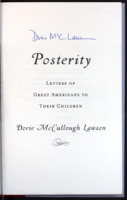 Posterity: letters of great Americans to their children. Edited collection of letters of notable Americans to their children.
 -
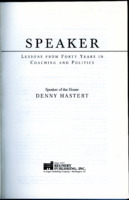 Speaker: lessons from forty years in coaching and politics. Denny Hastert is one of the most powerful men in America - and yet chances are you know little or nothing about him. And Denny Hastert likes it that way. Not because he has anything to hide, but because he doesn't care about who gets the credit. He just wants to get the job done for the American people.."In Speaker: Lessons from Forty Years of Coaching and Politics, Denny Hastert breaks his silence to tell a remarkable American story: how he grew up among the fields of Northern Illinois, made a name for himself as a high school and collegiate wrestler, became a high school wrestling and football coach and civics teacher...and eventually found himself teaching, and learning about, civics in the most important forum in the world - the United States Congress as Speaker of the House, the third most powerful man in government."--BOOK JACKET.
 -
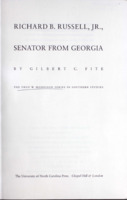 Richard B. Russell, Jr., senator from Georgia. Biography of Senator Richard B. Russell, Jr.
 -
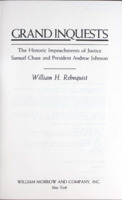 Grand inquests: the historic impeachments of Justice Samuel Chase and President Andrew Johnson. Dramatic accounts of the Supreme Court impeachments of Justice Samuel Chase and President Andrew Johnson.
 -
 Turning right: the making of the Rehnquist Supreme Court. Account of the gradual shift of the Supreme Court to a conservative ideology.
 -
 Hill rat: blowing the lid off Congress. Former congressional aide John Jackley's account of alleged corruption in the United States Congress.
 -
 The justice from Beacon Hill: the life and times of Oliver Wendell Holmes. Liva Baker's biography of judge and legal scholar, Oliver Wendell Holmes.
 -
 Almost a revolution. Biographical work about Chinese student Shen Tong, who was involved in the incidents in China's Tiananmen Square.
 -
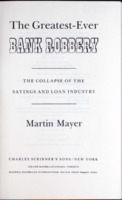 The greatest-ever bank robbery: the collapse of the savings and loan industry. An account of the savings-and-loan scandal of the 1980s describing its causes and results.
 -
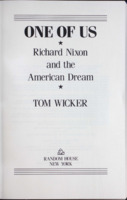 One of us: Richard Nixon and the American dream. A biographical work on Richard M. Nixon.
 -
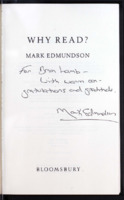 Why read? Argues that questions about the uses of literature are essential to a literary education and that reading not for only training and education, but also for pleasure, can change students' lives for the better.
 -
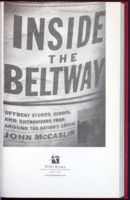 Inside the Beltway: offbeat stories, scoops, and shenanigans from around the nation's capital. Washington Times columnist Jon McCaslin's account of interesting Washington-related stories.
 -
 James K. Polk. In the summer of 1844, James K. Polk's political career was in ruins. As the Democratic National Convention approached, Polk had thought himself assured of the vice presidential nomination, but the presidential front-runner, former president Martin Van Buren, had made it clear that he had little interest in him. Van Buren was on a mission to regain the White House, which he had lost in 1840, and he needed a strong running mate. Polk had three strikes against him. First, Polk had been unable to deliver his and Andrew Jackson's home state of Tennessee in 1840, while Polk was governor. Second, he was fresh from having lost the governor's mansion - for a second time. And third, Van Buren - as well as the Whigs' candidate, Henry Clay - had just taken a stand against the annexation of Texas, whereas Polk had come out in its favor. "But as the delegates assembled in Baltimore, Polk perceived a wave of public sentiment in favor of bringing Texas into the Union, and he rode that wave all the way to the nomination and eventually the White House - the first "dark horse" candidate to do so. Congress soon annexed Texas, and Polk continued to look west, becoming the champion of what was known as "manifest destiny." He settled the disputed Oregon boundary with Great Britain, extending U.S. territory to the Pacific Ocean, and waged war on Mexico in hopes of winning California and New Mexico. The considerably smaller American army never lost a battle, and the southwest territories became part of the United States in 1848." "At home, however, Polk suffered a political firestorm of antiwar attacks, particularly from the Whigs. Despite tremendous accomplishments in just four years - from pushing the westward expansion to restoring an independent Treasury to ushering in an era of free trade - "Young Hickory" left office feeling the sting of criticism and suffering from a stressful presidency that had taken a heavy physical toll. He died within three months of departing Washington."--BOOK JACKET.
 -
 The approaching fury: voices of the storm, 1820-1861. Story of the coming of the American Civil War through the voices and from the viewpoints of thirteen principal players in the drama ... : [Thomas] Jefferson, [Henry] Clay, [Stephen A.] Douglas, [Jefferson] Davis, [Abraham] Lincoln, Nat Turner, William Lloyd Garrison, John C. Calhoun, Frederick Douglass, Harriet Beecher Stowe, George Fitzhugh, John Brown, and Mary Boykin Chesnut--Dust jacket.
 -
 Warren G. Harding. Biography of President Warren G. Harding by John Dean.
 -
 Character: profiles in presidential courage. Presents a detailed account of sixteen crises in American history, the responses of the men who were President at the time, and the influence that their decisions and actions had on the subsequent course of American history.
 -
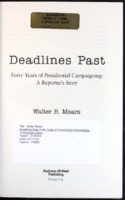 Deadlines past: forty years of presidential campaigning, a reporter's story. Journalist Walter Mears' account of previous presidential campaigns that he covered.
 -
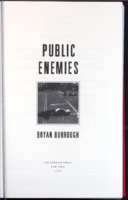 Public enemies: America's greatest crime wave and the birth of the FBI, 1933-34. The story of the most spectacular crime wave in American history, the two-year battle between the young J. Edgar Hoover, his FBI and an assortment of criminals who became national icons: John Dillinger, Machine Gun Kelly, Bonnie and Clyde, Baby Face Nelson, Pretty Boy Floyd, and the Barkers. Author Burrough strips away the myths to reveal a web of interconnections within the vast American underworld, and shows how Hoover's G-men overcame their early fumbles to secure the FBI's rise to power.--From publisher description.
 -
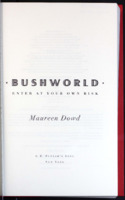 Bushworld: enter at your own risk. Columnist Maureen Dowd discusses the political clout of the Bush family and the people surrounding the administration, including Cheney, Ashcroft, Rumsfeld, Rice, Rove, Wolfowitz, and Perle.
 -
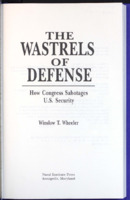 The wastrels of defense: how Congress sabotages U.S. security. In this expose, a veteran Senate defense adviser argues that since September 11, 2001, the conduct of the U.S. Congress has sunk to new depths and endangered the nation's security. Winslow T. Wheeler draws on three decades of work with four prominent senators to tell in detail how members of Congress divert money from essential war-fighting accounts to pay for pork in their home states and then run for cover when confronted with tough defense issues. With meticulous documentation to support his claims, Wheeler contends that this behavior is not confined to one party or one political philosophy. He also argues that the senators who promote themselves as reformers are not effective in their efforts to stop the pork and that journalists gloss over the damage.."Wheeler has filled this book with evidence of congressional wrongdoing, naming names and citing examples. Pointing to the extremes that have become routine in the legislative process, he focuses on defense appropriations and the willingness of those on Capitol Hill to load down defense bills with pork, in some cases with the Pentagon's help. On the question of deciding war, he accuses today's senators and representatives of lacking the character of their predecessors by positioning themselves on both sides of difficult questions, including the war against Iraq."."Wheeler concludes with a model for reform in which he proposes "twelve not-so-easy steps to a sober Congress," including his ideas for restoring both houses to their original roles and responsibilities."--BOOK JACKET.
 -
 Past imperfect: facts, fictions, and fraud: American history from Bancroft and Parkman to Ambrose, Bellesiles, Ellis, and Goodwin Woodrow Wilson, like many men of his generation, wanted to impose a version of America's founding identity: it was a land of the free and a home of the brave. But not the braves. Or the slaves. Or the disenfranchised women. So the history of Wilson's generation omitted a significant proportion of the population in favor of a perspective that was predominantly white, male, and Protestant. "That flaw would become a fissure and eventually a schism. A new history arose which, written in part by radicals and liberals, had little use for the noble and the heroic, and rankled many who wanted a celebratory rather than a critical history. To this combustible mixture of elements was added the flame of public debate. History in the 1990s was a minefield of competing passions, political views, and prejudices. It was dangerous ground, and, at the end of the decade, four of the nation's most respected and popular historians were almost destroyed on it: Michael Bellesiles, Doris Kearns Goodwin, Stephen Ambrose, and Joseph Ellis." "This is their story, set against the wider narrative of America's history. It may be, as Flaubert put it, that "Our ignorance of history makes us libel our own times." To which he could have added: falsify, plagiarize, and politicize, because that's the other story of America's history."--Book Jacket.
 -
 The mystery of Olga Chekhova. Looks at the life and career of Olga Chekhova, the niece of playwright Anton Chekhov, who fled Russia for Berlin in 1920, achieved fame as an actress and a position in Germany's Nazi party, and may have been an agent for the Soviet NKVD.
 -
 Adams vs. Jefferson: the tumultuous election of 1800. A history of the presidential campaign of 1800 follows the contest between the two candidates, Adams and Jefferson.
 -
 Will in the world: how Shakespeare became Shakespeare. A biography on English poet and playwright, William Shakespeare. Shakespeare is widely regarded as the greatest writer in the English language and the world's pre-eminent dramatist. In this work, the author attempts to provide a vivid and plausible version of the undocumented areas of Shakespeare's life. The author intends to demonstrate how an acutely sensitive and talented boy -- surrounded by the rich tapestry of Elizabethan life, full of drama and pageantry, and also cruelty and danger -- could have become the world's greatest playwright. He brings together little-known historical facts and little-noticed elements of Shakespeare's plays and makes connections between Shakespeare's life and his works.
 -
 Reagan and Gorbachev: how the Cold War ended. Describes Ronald Reagan's policies towards the Soviet Union, the summit meetings between Reagan and Soviet leader Mikhail Gorbachev, and how the two leaders reached agreements on missile and troop reductions that eventually led to the end of the cold war.
51–75 of 540