Booknotes Annotations
Item set
Items
-
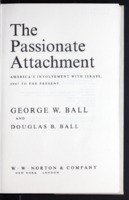 The passionate attachment : America's involvement with Israel, 1947 to the present In his Farewell Address, George Washington admonished his fellow citizens to steer clear of a "passionate attachment" to another nation, as such could create "the illusion of a common interest ... where no common interest exists." This warning echoes through the pages of this unflinching examination of our four-decade entanglement in the web of Middle East politics. The distinguished authors here trace the sequence of events that brought the United States into a relationship unique in its history, with its foreign policy often manipulated by another, much smaller nation. The costs have been financial: American aid to Israel well exceeds the total of U.S. payments to reconstruct postwar Europe. The costs have been political and moral: denouncing arms sales as destabilizing to the Middle East, the United States has poured weapons into Israel; while championing national self-determination, the United States has failed to do anything effective to halt Israel's colonization of the West Bank. Israeli forbearance from entering the Gulf War in 1991 and thereby undoing the coalition of Arab States put together by the Bush administration further intensified our passionate attachment. To achieve a durable settlement in an area beset by age-old disputes, the authors call for an end to our unquestioned acquiescence in Israeli action and a broadened role for collective security.
 -
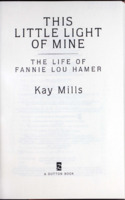 This little light of mine : the life of Fannie Lou Hamer Profiles the 1960s endeavors of dedicated civil rights activist Hamer. Awards: Christopher.
 -
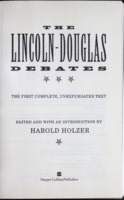 The Lincoln-Douglas Debates : The First Complete, Unexpurgated Text In the blistering summer of 1858, as America teetered on the brink of disunion, two Illinois politicians seized the nation's attention and gripped it for two extraordinary months. Through the sheer force of their words, personalities, and ideas, Abraham Lincoln and Stephen Douglas transformed a local contest for the U.S. Senate into a watershed national debate on the contentious issue of slavery and, indeed, on the principles upon which this country was founded. Yet what Lincoln and Douglas really said in those seminal debates has long been suppressed. At the time, newspapers were blatantly partisan, and though stenographers took down the speeches word for word, editors and transcribers subsequently "improved" their candidate's remarks while printing his opponent's words, warts and all. What has been reprinted ever since are the "improved," inaccurate versions. Harold Holzer has uncovered unedited texts of the debates, and this book will be the first ever to present all seven of them in their unexpurgated entirety. Besides the first true transcription of the debates, Holzer offers, through an Introduction and extensive notes, crystalline portraits of the combatants - their personalities and bearing, their quirks and foibles. Holzer also casts a brilliant light on the "house divided against itself," showing us an America at once exuberant and deeply uncertain about its future. He provides trenchant evocations of the physical and emotional stages on which the debates were set. We glimpse the feverishly enthusiastic audiences that mobbed the debates. We also witness the exceptional fervor with which the entire country followed them. Lincoln and Douglas galvanized a nation and permanently transformed our national consciousness with the speeches they gave during the summer and fall of 1858. To read the words these men actually spoke in their historic confrontation is an opportunity to witness the apex of American political discourse. Here - for the first time in more than 130 years - are those words. Here - at last - is that opportunity.
 -
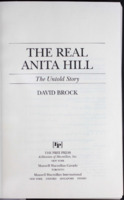 The real Anita Hill : the untold story More than a year and a half after the dramatic confrontation between Clarence Thomas and Anita Hill, opinions remain sharply divided on which one was telling the truth, and on the episode's significance and meaning for American society.Opinion polls conducted on the first anniversary of the hearings showed that public sentiment in Thomas' favor had weakened, while Anita Hill has become a national celebrity, a heroine credited with putting sexual harassment on the national agenda and thus a symbol of the feminist and civil rights movements who is said to have inspired a political "year of the woman." The press has characterized the Hill-Thomas confrontation as an impenetrable mystery whose truth can never be known - an American version of Rashomon. But journalist David Brock dissents from this conclusion. His investigation shows that while there may indeed be no way of knowing exactly what transpired between Thomas and Hill, a great many things can be known about Anita Hill that were not previously disclosed which sharply contradict her public image and raise serious doubts about her credibility. Brock corrects numerous misconceptions and introduces new factual evidence to answer many questions left open by a notably uninquisitive national press. In the course of his investigation, the official record of the Senate hearings is examined more carefully than the senators' histrionics and the distorting lights of national television cameras permitted at the time. Evidence is brought forth that has never before been made public, including sworn affidavits, confidential Senate interviews of witnesses, and sections of the FBI file on the Thomas nomination. Numerous details from the report of special investigator Peter Fleming on the leak of Hill's charges, veiled by a media blackout, are unsheathed. And new information gleaned from extensive interviews is reported. This book is not about whether Clarence Thomas should have been confirmed to the Supreme Court. Nor does it question whether sexual harassment is a genuine offense. Rather it seeks to determine whether sexual harassment occurred in this case. While partisans of Hill may remain unpersuaded, no matter what the weight of evidence suggests, Brock believes that after hearing all the facts, no reasonable reader will be able to conclude that it did.
 -
 The fifties The Fifties is a sweeping social, political, economic, and cultural history of the ten years that David Halberstam regards as seminal in determining what our nation is today. It is the decade of Joe McCarthy and the young Martin Luther King, the Korean War and Levittown, Jack Kerouac and Elvis Presley. "Halberstam not only gives us the titans of the age - Eisenhower, Dulles, Oppenheimer, MacArthur, Hoover, and Nixon - but also Harley Earl, who put fins on cars; Dick and Mac McDonald and Ray Kroc, who mass-produced the American hamburger; Kemmons Wilson, who placed his Holiday Inns along the nation's roadsides; U-2 pilot Francis Gary Powers; Grace Metalious, who wrote Peyton Place; and "Goody" Pincus, who led the team that invented the Pill. Here is a portrait of a time of conflict, at once an age of astonishing material affluence and a period of great political anxiety." "We follow, among other things, the quickening pace of American life and the powerful impact of national television, still in its infancy, on American society: from the Kefauver hearings to I Love Lucy to Charles Van Doren and the quiz-show scandals to the young John Chancellor of NBC covering the Little Rock riots and holding up a disturbing mirror to America."--Book jacket.
 -
 Turmoil and triumph : my years as secretary of state Autobiography of former Secretary of State, George Shultz.
 -
 The five myths of television power, or, Why the medium is not the message The Five Myths of Television Power is a provocative and controversial book. It challenges the conventional assumption, repeated every day, that television dominates American life - if not the life of the entire world. Douglas Davis takes on this belief with arguments that will change the way we all view television. Is TV-as-we-know-it dying? Douglas Davis contends that television's perceived power is just that - only perception, not fact, grossly exaggerated, and damaging to our national life. In The Five Myths of Television Power, Davis shatters the following myths: TV controls our voting. TV destroys our students. TV is (our) reality. TV pacifies us and keeps us at home. We love TV. Davis analyzes many of television's most famous "events," from the home tapes that recorded the beating of Rodney King and, later, the Los Angeles riots, to the Gulf War, to the Clarence Thomas hearings, to Murphy Brown's illegitimate child and the surprising 1992 elections. Throughout he proves that the medium is hardly omnipotent, crushing all resistance in the viewers who turn it on. Rather, it is "a fat-bellied emperor unclothed, ready to succumb to leaner, looser, more invigorating competition." He warns that "traditional" television, if it remains complacent and unwilling to change, will self-destruct before a host of media and print challengers. The Five Myths of Television Power will stir debate within the TV networks, the new cable TV empires, and among editors, publishers, students of media and the arts, and liberated TV viewers everywhere. Americans are tired of being told that they cannot think for themselves - the hidden message of Marshall McLuhan's books. The Five Myths of Television Power refutes McLuhan. It recasts the relationship of the viewer to television in an entirely new direction - one that empowers the viewer, and one that television executives should heed.
 -
 Preparing for the twenty-first century Human history has always been shaped by the growth and migration of populations, by the opportunities and constraints provided by the environment, and by the rise of new technologies. Today, these forces are enmeshed in a state of unprecedented turbulence. World population has more than doubled in the past forty years to reach its current level of 5.5 billion, and it will exceed 8 billion and perhaps even 10 billion early in the next century. How will these vast numbers reshape the world's borders, strain an already fragile ecosystem, and remake politics? New technologies are even now replacing traditional work with radically new systems of production and communication, promising enormous changes in both industrial and traditional agricultural societies. Will potential developments in biotechnology render traditional food producers obsolete? What is the role of robotics in a world where millions of new jobs are needed each year to absorb the fast-growing population? And what will the roles of women be? How will the spread of AIDS affect the rapid growth of population in countries like India or those of central Africa? And how will all these complex, mutually dependent changes affect individual nations as they struggle with their own ethnic and economic pressures, including the inevitability of ever larger migrations from poorer to richer parts of the world as populations explode in less developed regions and decline in such areas as Japan, parts of North America, and the European continent? Given their historic behavior, how will Japan, the United States, and Europe - as well as the countries of Asia, Africa, and Latin America - be likely to respond to these unprecedented circumstances? What is the role of education in a two- or three-tier world? Professor Kennedy's classic The Rise and Fall of the Great Powers considered the forces within nations that led to their rise and fall. In Preparing for the Twenty-first Century Kennedy addresses a larger and uniquely modern question: how will transnational forces in a world of scarce resources, instant communications, and exploding population affect the nations of the world and the people who inhabit them as the new century dawns?
 -
 The mortal presidency : illness and anguish in the White House Robert Gilbert's account of death and illness in the White House.
 -
 Generations : the history of America's future, 1584 to 2069 The book that challenges forever your view of our national legacy and our destiny--Jacket subtitle.
 -
 The outlaw state : Saddam Hussein's quest for power and the Gulf crisis The story of Saddam Hussein and his fierce determination to turn Iraq into a regional superpower in the Middle East which lead to the Persian Gulf War.
 -
 Lone star rising : Lyndon Johnson and his times, 1908-1960 Volume one of a two-volume biography follows Johnson's life from his childhood on the banks of the Pedernales to his election as vice president under Kennedy.
 -
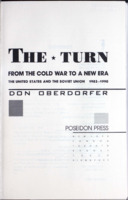 The turn : from the cold war to a new era : the United States and the Soviet Union, 1983-1990 Don Oberdorfer's account of U.S.- Soviet relations at the end of the Cold War.
 -
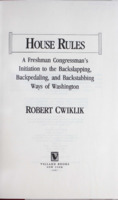 House rules : a freshman Congressman's initiation to the backslapping, backpedaling, and backstabbing ways of Washington Robert Cwiklik's account of a first-year member of Congress.
 -
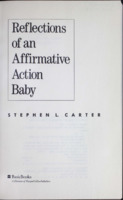 Reflections of an affirmative action baby Steven L. Carter's work on racial preference as told from his own personal experience.
 -
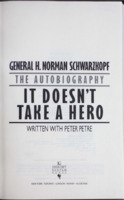 It doesn't take a hero : General H. Norman Schwarzkopf, the autobiography In this candid, eagerly awaited autobiography General H. Norman Schwarzkopf reveals the story of his remarkable life and career. Here is the story of his boyhood years during World War II and a unique adolescence spent in the Middle East and Europe that would later prove invaluable to his understanding of the Gulf. Here, too, is a frank account of the West Point graduate's early disillusionment with the real" Army - a disappointment that nearly prompted him to leave the military." "General Schwarzkopf speaks openly about his two tours of duty in Vietnam. He recounts the "dark years" that followed, and his own role in the struggle to reform the military." "For the first time ever General Schwarzkopf provides his personal, behind-the-scenes account of Desert Shield/Desert Storm, including candid portraits of such major figures as Colin Powell, Richard Cheney and President George Bush. From the general's unique perspective we experience firsthand the complexities of coordinating the campaign in a country deeply suspicious of foreigners; of maintaining strategic secrecy during America's first internationally televised war; and of ensuring that this war would not be another Vietnam." "Thoughtful and provocative, It Doesn't Take a Hero is an intensely personal portrait of an American life, the triumphant journey of a soldier who set his star by a simple but timeless motto: duty, honor, and country."--Book jacket.
 -
 The business of May next : James Madison and the founding Good fortune offered this nation an unusual chance at ideal nation-forming and... some honorable leaders seized that chance, writes William Lee Miller in The Business of May Next, and none among the founders made more of the opportunity than did James Madison, subject of this engaging work. Madison is depicted during the critical years between 1784 and 1791, when he was so active in articulating the governmental aims of the fledgling nation that he sometimes found himself in official dialogue with himself. More than simply a historical and biographical account, the book traces Madison's political and theoretical development as a means of illuminating its larger theme, the moral and intellectual underpinnings of the American nation. With a sound grasp of his material and a refreshing style Miller reveals how Madison's research into republics and his influence on the writing of the Constitution are central to the values for which the nation stands. From an examination of Madison's notes, Miller traces Madison's early research into other republics and their weaknesses. He reveals how Madison's thinking shaped the Virginia Plan, which, in turn, shaped the United States Constitution and the nation's institutions. The author writes that Madison sought the strands of Republicanism in history and gave republican ideals new and lasting institutional expression. He shows how the making of republican institutions became a collaboration, and how the newly created institutions contained within themselves provision for their own continuing alteration and for the involvement and influence of collective humanity down through the years. Miller follows Madison through the Constitutional Convention ("the business of May next") to the great national argument on behalf of the Constitution, notably through the Federalist papers. Of particular interest are his discussions of the constitutional deliberations over religious freedom and the institution of slavery.
 -
 Restoration : Congress, term limits, and the recovery of deliberative democracy The world's oldest democracy - ours - has an old tradition of skepticism about government. However, the degree of dismay about government today is perhaps unprecedented in our history. Americans are particularly convinced that Congress has become irresponsible, either unwilling or incapable of addressing the nation's problems - while it spends its time and our money on extending its members' careers. Many Americans have come to believe fundamental reform is needed, specifically limits on the number of terms legislators can serve. In Restoration, George Will makes a compelling case, drawn from our history and his close observance of Congress, that term limits are now necessary to revive the traditional values of classical republican government, to achieve the Founders' goal of deliberative democracy, and to restore Congress to competence and its rightful dignity as the First Branch of government. At stake, Will says, is the vitality of America's great promise self-government under representative institutions. At issue is the meaning of representation. The morality of representative government, Will argues, does not merely permit, it requires representatives to exercise independent judgment rather than merely execute instructions given by constituents. However, careerism, which is a consequence of the professionalization of politics, has made legislators servile and has made the national legislature incapable of rational, responsible behavior. Term limits would restore the constitutional space intended by the Founders, the healthy distance between the electors and the elected that is necessary for genuine deliberation about the public interest. Blending the political philosophy of the Founders with alarming facts about the behavior of legislative careerists, Restoration demonstrates how term limits, by altering the motives of legislators, can narrow the gap between the theory and the practice of American democracy.
 -
 Kissinger : a biography Walter Isaacson's biographical work on former Secretary of State, Henry Kissinger.
 -
 Adam Clayton Powell, Jr. : the political biography of an American dilemma Traces the career of the congressman from Harlem who became an early spokesman for civil rights but ended his career in political disgrace.
 -
 Follow the leader : opinion polls and the modern presidents Paul Brace's account of how presidents, from Truman to Bush, have been shaped by changes in opinion polls.
 -
 Faces at the bottom of the well : the permanence of racism The message of Bell's book is that "racism is an integral, permanent, and indestructible component of this society." He contends that blacks "are doomed to fail as long as the majority of whites do not see their own well-being threatened by the status quo."--Cover.
 -
 Hollywood vs. America : popular culture and the war on traditional values Film critic Michael Medved examines how Hollywood has broken faith with its public, creating movies, television, and popular music that exacerbate every serious social problem we face, from teenage pregnancies to violence in the streets. Michael Medved powerfully argues that the entertainment business follows its own dark obsessions, rather than giving the public what it wants: In fact, the audience for feature films and network television has demonstrated its profound disillusionment in recent years, with disastrous consequences for many entertainment companies. Meanwhile, overwhelming numbers of our fellow citizens complain about the wretched quality of our popular culture - describing the offerings of the mass media as the worst ever. Medved asserts that Hollywood ignores - and assaults - the values of ordinary American families, pursuing a self-destructive and alienated ideological agenda that is harmful to the nation at large and to the industry's own interests. In hard-hitting chapters on "The Attack on Religion," "The Addiction to Violence," "Promoting Promiscuity," "The Infatuation with Foul Language," "Kids Know Best," "Motivations for Madness," and other subjects, Medved outlines the underlying themes that turn up again and again in our popular culture. He also offers conclusive evidence of the frightening real-world impact of these messages on our society and our children. Finally, Medved shows where and how Hollywood took a disastrous wrong turn toward its current crisis, and he outlines promising efforts both in and outside the industry to restore a measure of sanity and restraint to our media of mass entertainment. Sure to elicit strong response, whether it takes the form of cheers of support or howls of enraged dissent, Hollywood vs. America confronts head-on one of the most significant issues of our times.
 -
 Populism and elitism : politics in the age of equality Jeffrey's Bell's commentary on political hegemony.
 -
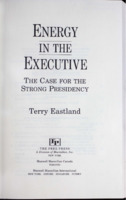 Energy in the executive : the case for the strong presidency Every four years the race for the presidency absorbs the nation's attention. But what does it take for a President to actually govern - especially to govern well? Terry Eastland, the noted political writer who studied the presidency up close during his service in President Reagan's administration, challenges the widely held view of the presidency as an office where canny personal skills take precedence over the knowledgeable and proper use of constitutional power. In this deeply informed, unconventional, and persuasive interpretation of the nation's highest office, Eastland makes a timely case for the strong presidency, not one based on charisma or the "bully pulpit," but instead on the proper exercise of the constitutional expectations of the office, thus recovering and restating for our time the wisdom of the American founders - that "energy in the executive" is essential to good government. Eastland examines the presidency in its work with Congress, through the executive brand, and in the courts. Analyzing a wide variety of governing episodes from the Reagan and Bush years - tax reform, Iran-Contra, civil rights, Saddam Hussein, the infamous Bush "budget summit," the Supreme Court nominations of Robert Bork and Clarence Thomas - Eastland shows just what a strong presidency is, and what it is not. Focusing on the selective use of presidential rhetoric in seeking legislation, the responsibility a President has for pressing policies into the day-to-day administration of the government, and the jurisprudential legacy a President can build through well-considered judicial appointments, Eastland maintains that the strong presidency is possible only when the tools of governance are properly understood and energetically used. Eastland points the way for a new generation of politicians and government officials, arguing that the key to effective government - conservative or liberal - is understanding and carrying out the executive role in accordance with its constitutional design. Energy in the Executive is that rare political book which offers fresh insights into the much-discussed subject of governing - which is, after all, what Presidents are elected to do.
501–525 of 540