Booknotes Annotations
Item set
Items
-
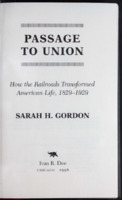 Passage to Union: how the railroads transformed American life, 1829-1929. In Passage to Union, Sarah Gordon has written a richly informed narrative history of the growth of the railroads, an American icon. But her conclusions are surprising. Where the railroads and their entrepreneurs are ordinarily celebrated for their accomplishments, Ms. Gordon finds that the cost of their achievements was high. Conflicts of interest - at local, state, and regional levels - characterized railroad growth at every stage. Despite the stated aims of government.and the railroad corporations to promote settlement and commerce, Ms. Gordon shows that the states lost control of these enterprises and lost the economic benefits of their traffic. Smaller towns withered as people and money flowed to larger cities. By 1900 the union that had emerged reflected the worst fears of railroad critics. The South and West had been settled, but wealth had flowed so heavily to the cities that rural life had lost its attraction. Passage to Union.is compelling reading because Ms. Gordon has drawn from diaries, memoirs, literature, advertisements, newspapers and magazines, public records, and railroad history to construct her narrative. The impact of the railroads on people and their communities is powerfully illustrated in this absorbing story of apparent triumph and real loss.
 -
 Crusader: the hell-raising police career of Detective David Durk. James Lardner's biographical work on David Durk
 -
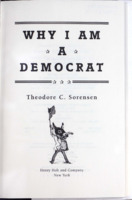 Why I am a democrat . For those Americans who have questioned or forgotten the aims and strengths of the Democratic Party, a well-known Democrat from the Kennedy era has written a thoughtful reminder. Ted Sorensen was the principal counsel, policy adviser, and speechwriter for President Kennedy and has experienced more than four decades of political activity. Here he articulates the fundamental reasons and principles behind proclaiming oneself a Democrat. In Why I Am a Democrat, Sorensen defines himself in terms of the major themes on which Democrats and Republicans divide - their differing approaches to government and the free market, to national and individual distress and discrimination, to privacy and public service. Outlining his own vision and ruminating about the roots of that vision, he provides a skeleton key for the Democratic impulse.Neither defense nor apologia, but rather an explanation of basic Democratic thought regarding public-policy issues - as well as personal memoir of belief in a set of values - Why I Am a Democrat provides hope, reason, and intellectual ammunition for despairing Democrats now wandering the political wilderness.
 -
 Think a second time. Journalist Dennis Prager's collection of 43 essays drawn from his quarterly journal entitled Ultimate Issues.
 -
 Divided lives: the public and private struggles of three accomplished women. An intimate look at the lives of three contemporary women--television journalist Meredith Vieira, conductor Rachael Worby, and breast surgeon Dr. Alison Estabrook--portrays their conflicts as they struggle to balance their own needs with the needs of those around them.
 -
 Common cents: a retiring six-term congressman reveals how Congress really works-- and what we must do to fix it. Drawing on twelve years of experience in Congress to explain what is wrong and how to fix it, a former congressman from Minnesota reveals the hypocrisy, double-dealing, and power plays that have rendered Congress impotent.
 -
 Rogue states and nuclear outlaws: America's search for a new foreign policy. Michael T. Klare's book is a critical analysis of Pentagon strategy in the post-Cold War era and shows how the Pentagon's planners have created a new agenda that will justify Cold War levels of spending.
 -
 The Tragedy of American compassion. Dr. Marvin Olasky's work regarding poverty and government programs.
 -
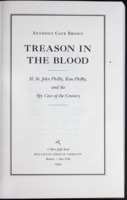 Treason in the blood: H. St. John Philby, Kim Philby, and the spy case of the century. Kim Philby has been called "one of the most remarkable double-agents to have been exposed in our time." Harry St. John Bridger Philby, Kim Philby's father and mentor, was one of the most intriguing intellectuals and adventurers of our time, a manipulator who played a key role in establishing the modern Middle East. In this dual biography, Anthony Cave Brown, tells the extraordinary story of two men whose lives were directly opposed to the establishment into which they were born and for which they were bred. St. John, the brilliant Arabist, became a Moslem and political adviser to King Ibn Saud. He was the middleman in the U.S. acquisition of the Saudi oil concession, called by the State Department "the greatest commercial prize in the history of the planet." And as St. John turned to Mecca, Kim turned to the Kremlin, serving as a secret agent against the Anglo-American intelligence services for fifty-three years.
 -
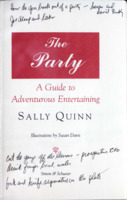 The party : a guide to adventurous entertaining. Author Sally Quinn's book about entertaining.
 -
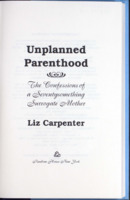 Unplanned parenthood: the confessions of a seventysomething surrogate mother. A journalist and author describes what it is like as a septuagenarian to suddenly take on the task of raising three teenagers, offering a witty look at raising youngsters in the 1990s.
 -
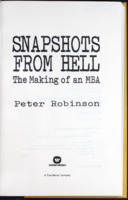 Snapshots from hell: the making of an MBA. Each year tens of thousands of America's best, brightest, and most ambitious consider going to business school. The enticement is the chance to earn an impressive credential, the highly touted MBA degree. To be crass, they all want to make money. And if they don't flunk out, go crazy, or otherwise crash, some of them may even get their heart's desire. As his thirtieth birthday loomed and his friends began to acquire such grown-up possessions as homes and European cars, Peter Robinson, then a presidential speechwriter, decided the time had come to embark on a different, and more lucrative, career path. To this end, he applied and was accepted into Stanford business school's prestigious MBA program. What he quickly discovered was that business school was a more confusing and overwhelming experience than he had expected.During his first year at Stanford, Robinson began keeping the journal of day-to-day impressions and experiences that evolved into this book, the writing of which he began to see as "a simple act of decency, like going back to the last calm bend in the river and nailing up a sign that reads 'Waterfall Ahead!'" Unlike any previous book or glossy catalogue, it dares to answer, honestly and insightfully, the paramount question of every prospective student, the only question that matters: What is business school really like? In Snapshots from Hell, we follow Robinson from his first harrowing days at "math camp" through his valiant, sometimes triumphant, sometimes futile attempts to navigate his way through a dizzying phalanx of core courses. We experience the horror of a "cold call," the frenzy of exam week, the challenges of learning the language of a strange new world, and the pitfalls and triumphs of the interview process. We see what business school does to Robinson's up-and-down, long-distance romance. We are also introduced to a remarkable cast of characters, ranging from Robinson's fellow "poets," students who lack a business background, to "jocks," such as the 25-year-old future Captain of Industry who has entered business school to "position himself for a quantum leap in financial services." We see Robinson not only survive business school, but go on to be wined and dined by some of the biggest and most prestigious companies in the world. We experience Robinson's unforgettable vignettes from the phenomenon of corporate recruiting, including an almost surreal interview he had in London with the late media baron Robert Maxwell. Raising fundamental questions about the true value of a degree in business administration, Peter Robinson's soul-searching, no-holds-barred adventure does for business school what Scott Turow's classic One L did for Harvard Law. It is, in short, everything you wanted to know - and need to know - about how to succeed in business by succeeding as an MBA.
 -
 Standing firm: a vice-presidential memoir. Standing Firm leaves no doubt that Dan Quayle is the most misjudged figure in modern political history. Prior to 1988, Quayle had never lost an election. Not for Congress. Not even for the Senate. Heading into that year's Republican Convention, Quayle was considered one of the party's brightest young stars - a man of unusual political instincts who, when it came to campaigning, had a reputation as a giant killer. He would become the first in his generation to hold national office, but only after a tumultuous contest that frequently put him on the defensive.With gritty honesty and admirable self-deprecation, Quayle describes what it was like to weather that 1988 media storm, and the other squalls that followed. Poignantly, he also talks of the self-confidence and Christian faith that gave him the courage to stand firm and record some of the most noteworthy contributions of any Vice President ever. Among the high points: his coordination of America's response to a coup attempt in the Philippines, the details of which have never been reported; his bringing the family-values issue to the fore with the Murphy Brown speech - a call for action that, one year later, would even draw support from Democratic President Bill Clinton; his use of the White House Competitiveness Council to curtail harmful "overregulation"; his unreported diplomacy with Latin American leaders; and his championing of legal reform, which would earn him the strongest praise of his vice-presidency. Quayle pulls no punches when it comes to assessing himself and other players in the Bush administration - the men and women who were his allies, and sometimes his opponents, in helping George Bush spread democracy around the world. He shares entries from his diary of the Persian Gulf crisis, offers a surprising snapshot of what the typical Bush cabinet meeting was like, describes intramural battles waged by White House power brokers, and reveals his special relationship with the President. Quayle, a former journalist, interviewed several members of the press for this book, and their contributions form a vital part of its fabric. Standing Firm is perhaps most intriguing in its analysis of what went wrong in the 1992 election. Quayle does not hesitate to place blame where it is deserved - in fact, he reserves some of the strongest criticism for himself. Throughout, the portrait that emerges of the former Vice President is that of a man whose good humor is exceeded only by a competence for which he has never been fully credited.
 -
 The things that matter most. Thomas traces current current social problems to the cultural changes of the 1960s.
 -
 My Times: adventures in the news trade. Newspaperman John Corry's recollection of his career with the New York Times.
 -
 Herblock: a cartoonist's life. Herblock: a cartoonist's life tells of the remarkable career that has spanned the era from Roosevelt to Clinton. Herb Block opposed isolationism before World War II; warned of nuclear hazards in the '40s; opposed McCarthyism in the '50s and racism in the '50s and '60s; and zeroed in on Watergate in the '70s and Iran-contra and other Reagan-Bush scandals in the '80s...first-hand account of the life and times of the foremost American political cartoonist of this century. It includes autobiographical anecdotes written with humor, notes on personalities and strong opinions by 'The Washington Post's' widely syndicated cartoon commentator. -- Book Jacket.
 -
 First, do no harm. Account of the inner workings of Hermann Hospital in Houston, Texas.
 -
 Strom Thurmond and the politics of Southern change. A biography on the career of the late Senator Strom Thurmond.
 -
 Serbs and Croats: the struggle in Yugoslavia. For Yugoslavia, the triumph of independent statehood following World War I became a tragedy seventy years later. "Yugoslavia was born in 1918 as the Kingdom of the Serbs, Croats, and Slovenes, with King Alexander its sovereign. In 1929 the country was renamed the Kingdom of Yugoslavia. After the Nazi invasion in World War II, Slovenia became part of Greater Germany, Croatia a Fascist state ruled by the Ustashi. Mass killings by the Ustashi followed, in concentration camps, churches, and homes, of Serbs, Jews, Gypsies. Killings of Serbs by Croats - both Slavic peoples and neighbors, speaking the same language but divided by religion and cultural allegiances." "In this highly informative and lucid account, Professor Dragnich discusses the ideals and hopes that the South Slavs brought to Yugoslavia, their tortured attempt to create a workable political system, and the reasons behind the chaos and violence of recent months."--BOOK JACKET.
 -
 Adventures in Porkland: how Washington wastes your money and why they won't stop. An account by Brian Kelly describing wasteful spending in the United States government.
 -
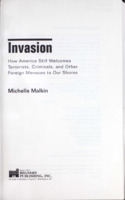 Invasion: how America still welcomes terrorists, criminals, and other foreign menaces to our shores. Michelle Malkin argues that America's border policies welcome criminals, terrorists, and other "undesirables," leading to an abuse of the system and other disastrous effects.
 -
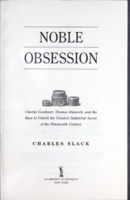 Noble obsession: Charles Goodyear, Thomas Hancock, and the race to unlock the greatest industrial secret of the nineteenth century. Traces the 1830s endeavors of Charles Goodyear to reinvent rubber into a usable substance.
 -
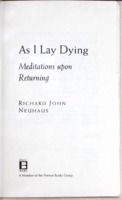 As I lay dying: meditations upon returning. Book by Richard John Neuhaus about his own encounter with death.
 -
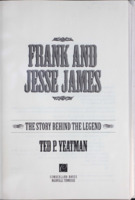 Frank and Jesse James: the story behind the legend. Biography of Frank and Jesse James.
 -
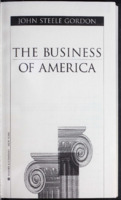 The business of America. For more than ten years, John Steele Gordon has written the widely read The Business of America" column in American Heritage magazine. Marked by a combination of erudition, wit, and eloquence, Gordon's stories have celebrated the high points, and occasional low points, in the history of business in this country, from colonial days to the present. Now, the best of his mini-histories have been gathered in one volume. As much as each stands on its own, together they gain in significance as they go beyond mere business to present an intriguing lens on the broad sweep of American history."--BOOK JACKET.
26–50 of 540