Booknotes Annotations
Item set
Items
-
 Robert E. Lee : a biography The life of Robert E. Lee is a story of triumph - triumph in clearing his family name, triumph in marrying properly, triumph over the mighty Mississippi in his work as an engineer, and triumph over all other military men to become the towering figure who commanded the Confederate army in the American Civil War. But late in life Lee wrote what may be his most revealing phrase. He confessed that he "was always wanting something." This from perhaps the South's greatest hero, the man whose demeanor and presence in war were sufficient to inspire thousands to march to near-certain death. In this probing and personal biography, Emory Thomas's thorough examination of Lee's life reveals more than the man did himself, allowing us to find meaning in Lee's successes and failures. From his struggles as a youth with his father's humiliation, to his frustrating marriage into a proper and prominent family, and his lively relationships with young female friends and relatives, Lee - the uncertain scion, skilled engineer, consummate warrior, and college president - was actually an enigmatic person of latent passions. He lived in limbo between the self-control to which he aspired and the freedom for which he longed.
 -
 Okinawa : the last battle of World War II Describes the efforts to seize the island of Okinawa, a decisive battle for the U.S. military that led to the final victory over Japan.
 -
 Salmon P. Chase : a biography Salmon P. Chase was one of the preeminent men of nineteenth-century America. A majestic figure, tall and stately, Chase was a leader in the fight to end slavery, a brilliant administrator who as Lincoln's Secretary of the Treasury provided crucial funding for a vastly expensive war. The Chief Justice of the Supreme Court during the turmoil of Reconstruction, he was the presiding officer of the impeachment trial of President Andrew Johnson. Yet he was also a complex figure. As John Niven reveals in this magisterial biography, Chase was a paradoxical blend of idealism and ambition. If he stood for the highest moral purposes - the freedom and equality of all mankind - these lofty motives failed to mask a thirst for power so deeply ingrained in his character that it drove away many who shared his principles, but invariably mistrusted his motives. What emerges is a portrait of a tragic figure, whose high qualities of heart and mind and whose many achievements were ultimately tarnished by an often unseemly quest for power. It is a striking look at an eminent statesman as well as a revealing glimpse into political life of nineteenth-century America, all set against a background of the antislavery movement, the Civil War, and the turmoil of Reconstruction.
 -
 John Marshall Harlan : great dissenter of the Warren Court Tinsley Yarborough's biography of Suprem Court Justice, John Marshall Harlan.
 -
 To renew America Responding to the concerns Americans feel for their safety, their value systems, and their children's future, Newt Gingrich calls for a return to mainstream American civilization and the basic principles upon which our country was founded. Citing the Six Challenges that we must face as a nation, he reveals commonsense solutions to the issues we care about most, such as welfare, balancing the federal budget, shifting power from the bureaucracy to the citizenry, and confirming America's leadership in the Information Age. With characteristic bluntness, Newt Gingrich describes his political allies and adversaries as he shares personal recollections of his historic first hundred days as Speaker. He also delivers practical approaches to issues as diverse as bilingualism, illegal immigration, multiculturalism, and health care.For months, worldwide media attention has swirled around Speaker Gingrich as he has reawakened American political debate. To Renew America is, finally, the opportunity to encounter the man himself and his dramatic vision of our nation's future.
 -
 In the time of the Americans : FDR, Truman, Eisenhower, Marshall, MacArthur--the generation that changed America's role in the world A group of men who led America away from isolationism to preeminence in international affairs.
 -
 Oswald's tale : an American mystery Reconstructs the life of Lee Harvey Oswald including the Minsk years, childhood, time in the Marine Corps and the events from 1961-1963.
 -
 Alien nation : common sense about America's immigration disaster The United States is being engulfed by the greatest wave of immigration it has ever faced. The latest immigrants are different from those who came before. These newcomers are less educated, less skilled, more prone to trouble with the law, less inclined to share American culture and values, and altogether less likely to become Americans in name or spirit. Brimelow believes that we cannot continue to admit millions of legal and illegal immigrants if we wish to maintain our standard of living and our national identity. Unless we restore immigration to its more traditional role, he says, the United States risks being turned into an alien nation. According to Brimelow, our problems began with the enactment of the 1965 Immigration Act, a well-meant reform that has gone demonstrably wrong. Nobody anticipated that it would rob us of the power to determine who can and cannot enter our national family and that it would trigger an ethnic and racial transformation without precedent in history. It was an astonishing social experiment launched with no particular reason to expect success. As Brimelow points out, there is no example of a multicultural society that has lasted; many have disintegrated into racial and linguistic enclaves. Brimelow explodes all the myths about immigration. He explains why the current flood of immigrants does not benefit the economy. He shows how they are a drain on our social infrastructure and the environment. Conventional wisdom dictates that it is un-American to be against immigration, but we have repeatedly restricted immigration throughout our history. George Washington, Alexander Hamilton, and Thomas Jefferson were all wary of letting in too many newcomers. The United States is a lifeboat. Taking in so many unskilled workers and so many millions with no desire to share our American identity, we risk capsizing and sinking. Peter Brimelow's persuasive call for reform boldly defines one of the most important and sensitive issues of the decade.
 -
 Walt Whitman's America : a cultural biography Exploring the full range of writings by and about Whitman - not just his most famous work but also his earliest poems and stories, his conversations, letters, journals, newspaper writings, and daybooks - Reynolds gives us a full, rounded picture of the man, of his creative blending of disparate ideas and images, and his contradictory stances on race, class, and gender. Whitman's uniqueness is shown to spring primarily from his closeness to and absorption of his contemporary culture. We see how the social convulsions of Jacksonian America were mirrored in the tribulations of the poet's family, and how Whitman's private anguish, which can be felt in his early poems, was swept up in his growing alarm for a nation riven by sectional controversies, political corruption, and class division. Into the vacuum created by the social and political crises rushed Whitman's gargantuan poetic "I," gathering images from every facet of American life in a hopeful gesture of unity: the cocky defiance of the Bowery b'hoys, the rhythms and inflections of actors and orators, the bloodcurdling sensationalism of penny papers, the incandescent images of luminist painters, the zany visions of popular mystics. We see Whitman in a society rampant with illicit sexual activity, which it refused to acknowledge. We see him aligning his passion for young men with the psychological and behavioral customs of a century in which same-sex love was actually common.
 -
 Emerson : the mind on fire : a biography A portrait of Emerson drawn from newly available material, including correspondence between the Emerson brothers.
 -
 In retrospect : the tragedy and lessons of Vietnam Secretary of Defense in the Kennedy and Johnson administrations, McNamara analyzes the Vietnam War and his role in it.
 -
 Middle class dreams : the politics and power of the new American majority Nearly ten years ago Stanley B. Greenberg was the first observer to identify the depth of the middle class's disaffection with the two political parties, which today we take for granted. In Middle Class Dreams, Greenberg reveals how our nation has found itself in a political environment where voters are poised to shoot first and ask questions later. He examines how the two major parties have historically wooed the middle class - sometimes successfully, sometimes not - and how the traditional party strategies have imploded during the past thirty years. In a powerful analysis he shows how Democratic support for "the little guy" became identified in the 1960s and 1970s with welfare for the "undeserving poor," eroding the middle-class majority who had supported Kennedy and Johnson; likewise, in the 1980s, Republican belief in free-market prosperity deteriorated into an endorsement for greed, breaking the back of the Reagan-Bush majority. These dual betrayals, Greenberg argues, set the stage for the middle class's abandonment of the traditional party system in 1992. Drawing on original polling data, Greenberg lays out the pitfalls facing both major parties if they fail to recognize the new rules of political life, including the role played by the followers of Ross Perot, loyal to neither party and suspicious of both. He is brutally honest about the challenges facing the Democrats and the Republicans, and he backs up his arguments with the raw data he has gleaned from focus groups coast to coast.
 -
 Black judges on justice : perspectives from the bench The views of leading African American jurists from around the country on the way our judicial system works. Included is an interview with Abigail R. Rogers, South Carolina's first female African American judge.
 -
 Rutherford B. Hayes : warrior and president Biographical work on President Rutherford B. Hayes.
 -
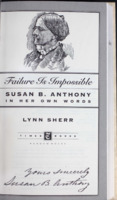 Failure is impossible : Susan B. Anthony in her own words Compilation of quotes from Susan B. Anthony.
 -
 The death of common sense : how law is suffocating America Distressing, disturbing, devastatingly detailed--this examination of how modern laws are diminishing America exposes the drawbacks of rule-bound government, tells why nothing gets done, reveals the phony pretensions of law, and shows why well-intentioned laws have actually devalued rights. In short, this book demonstrates how the buck never stops and how well-meaning laws are creating a nation of enemies.--From publisher description.
 -
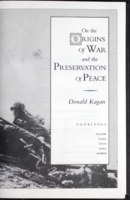 On the origins of war and the preservation of peace Professor Kagan reveals the common threads that connect the ancient confrontations between Athens and Sparta and between Rome and Carthage with the two calamitous world wars of our own century.
 -
 The bill : how the adventures of Clinton's National Service bill reveal what is corrupt, comic, cynical, and noble, about Washington Offers a detailed and sometimes humourous account of the political process of trying to revamp the college loan system and create the the program now known as AmeriCorps.
 -
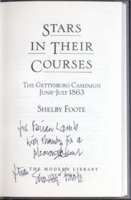 Stars in their courses : the Gettysburg campaign, June-July 1863 Recreates the Battle of Gettysburg from both the Confederate and Union perspectives.
 -
 Creating a new civilization : the politics of the Third Wave Alvin Toffler's work on the "Knowledge Revolution" in which he describes the effects of the Information Age.
 -
 On the edge : the Clinton presidency Elizabeth Drew's On the Edge is the first inside, full-spectrum report on the Clinton Presidency. Since he came to office, Clinton has been hard to read - ambitious and uncertain, looking toward the future and hounded by the past. From the first days of the administration, Drew has been speaking with and learning from the President's top advisers, key Cabinet officers, and well-placed members of Congress, as she has watched - up close, behind the scenes - as plans are hammered out, policies set, and problems confronted. Drew tells the remarkable story of this turbulent term - and deciphers what it means.Clinton's far-reaching domestic proposals and considerable achievements are recounted, as well as the distracting and corrosive personal struggles, especially Whitewater. Drew portrays his legislative gambles - from health care to NAFTA - and his costly inattention to foreign policy - the confused policymaking on Somalia, Bosnia, Haiti. She reveals the struggles within the President's foreign policy team. She traces how controversies over such a wide range of issues and events - gays in the military, the mishandling of Zoe Baird's and Lani Guinier's nominations, the $200 haircut, the travel office, and the death of Vincent Foster - have undermined confidence in Clinton's Presidency and fanned the flames of "the character issue." She shows sides of Clinton never seen before and explores the critical and little-understood role of Hillary Rodham Clinton - both as a power and as a personality - and measures the truly unprecedented influence of Vice President Al Gore.On the Edge answers the questions of who Bill Clinton is, and what his Presidency means for this country.
 -
 The road to serfdom Work by Friedrich Hayek on political philosophy, intellectual and cultural history, and economics.
 -
 China wakes : the struggle for the soul of a rising power Nicholas Kristof's work on China's transformation into an economic and political superpower.
 -
 John C. Calhoun : a biography In this important and highly readable biography of John C. Calhoun, Irving Bartlett sees a man almost unique in American history, a lifelong politician who was also a profound political philosopher. Born on the South Carolina frontier, Calhoun grew up in a postrevolutionary culture which valued both African slavery and the republican ideology of the Founding Fathers. He was orphaned in his teens and, with almost no formal education, suddenly became a man. In less than ten years he had become a Yale graduate, a lawyer, a former state legislator, and a congressman-elect prepared to help James Madison lead the country into the War of 1812. As a congressman and later as James Monroe's secretary of war Calhoun articulated the nationalism of the new nation as cogently as any other American leader. Calhoun was ambitious beyond his years. He was an unsuccessful candidate in the disputed presidential election of 1824 but was easily elected vice president under John Quincy Adams and Andrew Jackson. Determined to avoid the obscurity of that office, Calhoun managed to get into monumental public disputes with both presidents and resigned in the last days of Jackson's first administration to become senator from South Carolina and champion his state's right to nullify the Tariff of 1832. Along with his famous contemporaries Henry Clay and Daniel Webster, Calhoun dominated the Senate of the United States in the 1830s and 1840s. Serving briefly as secretary of state in the beleaguered Tyler administration, he played a key role in the annexation of Texas and created a furor on both sides of the Atlantic with his strident defense of American slavery and his denunciation of what he perceived as the pseudophilanthropy of British abolitionism. Returning to the Senate, he acted as peacemaker in helping avoid a near war with Britain over the Oregon boundary dispute, and he persistently opposed the popular Mexican War. Long before his death in 1850 Calhoun had become known as the cast-iron leader of the South, who never curried to popular opinion, spurned party loyalty, and defended slavery and states' rights with a vigor and intelligence that even leading abolitionists had to respect. In this major new biography Irving Bartlett goes behind the cast-iron image to explain the cultural and psychological forces that shaped Calhoun's political career and thought; he maintains that however wrong Calhoun was about slavery, many of his ideas still speak to us today.
 -
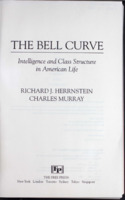 The bell curve : intelligence and class structure in American life Cognitive class and education, 1900-1990 -- Cognitive partitioning by occupation -- The economic pressure to partition -- Steeper ladders, narrower gates -- Poverty -- Schooling -- Unemployment, idleness, and injury -- Family matters -- Welfare dependency -- Parenting -- Crime -- Civility and citizenship -- Ethnic differences in cognitive ability -- Ethnic inequalities in relation to IQ -- The demography of intelligence -- Social behavior and the prevalence of low cognitive ability -- Raising cognitive ability -- The leveling of American education -- Affirmative action in higher education -- Affirmative action in the workplace -- The way we are headed -- A place for everyone.
426–450 of 540