Booknotes Annotations
Item set
Items
-
 Mothers of invention : women of the slaveholding South in the American Civil War When Confederate men marched off to battle, white women across the South confronted unaccustomed and unsought responsibilities: directing farms and plantations, providing for families, and supervising increasingly restive slaves. As southern women struggled "to do a man's business," they found themselves compelled to reconsider their most fundamental assumptions about their identities and about the larger meaning of womanhood. Drew Faust offers a compelling picture of the more than half-million women who belonged to the slaveholding families of the Confederacy during this period of acute crisis.According to Faust, the most privileged of southern women experienced the destruction of war as both a social and a personal upheaval: the prerogatives of whiteness and the protections of ladyhood began to dissolve as the Confederacy weakened and crumbled. Faust draws on the eloquent diaries, letters, essays, memoirs, fiction, and poetry of more than 500 of the Confederacy's elite women to show that with the disintegration of slavery and the disappearance of prewar prosperity, every part of these women's lives became vexed and uncertain. But it was not just females who worried about the changing nature of gender relations in the wartime South; Confederate political discourse and popular culture - plays, novels, songs, and paintings - also negotiated the changed meanings of womanhood.Exploring elite Confederate women's wartime experiences as wives, mothers, nurses, teachers, slave managers, authors, readers, and survivors, this book chronicles the clash of the old and the new within a group that was at once the beneficiary and the victim of the social order of the Old South. Mothers of Invention show how people managed both to change and not to change and how their personal transformations related to a larger world of society and politics. Beautifully written and eminently readable, this study of women and war is a pathbreaking and definitive study of the forgotten half of the Confederacy's master class.
 -
 War without bloodshed : the art of politics Eleanor Clift and Tom Brazatis' book on the everyday work of politicians.
 -
 Kennedy & Nixon : the rivalry that shaped postwar America John Kennedy and Richard Nixon shared a dream of being the great young leader of their age. Starting as congressmen in the class of 1946, the two men developed a friendship and admiration for each other that would last for more than a decade. But what drove history, Matthews shows, was the enmity between these two towering figures whose 1960 presidential contest would set the nation's bitter course for years to come.In this startling dual portrait - a modern-day Amadeus, with Nixon as the talented, frustrated, always outdone Salieri to Kennedy's Mozart, the charismatic genius - Matthews shows how the early fondness between the two men (Kennedy told a trusted friend that if he didn't receive the Democratic nomination in 1960, he would vote for Nixon) degenerated into distrust and paranoia, the same emotions that, in the early 1970s, ravaged the nation.Christopher Matthews's revealing book sheds new light on this complicated relationship and the role that it played in shaping America's history.
 -
 Union of words : a history of presidential eloquence The pursuit of E pluribus unum - "from many, one" - the motto on which the United States was founded, has continually posed one of the greatest challenges our presidents have faced throughout history. How does the presidency foster a spirit of unity among all Americans despite so many divergent interests and backgrounds? In this singular study, accomplished storyteller and professor of English Wayne Fields examines this rhetorical tug-of-war through the historical lens of presidential speechmaking. Beginning with George Washington's inaugural and continuing to the present day, Fields traces the vital role of our presidents in fulfilling the constitutional imperative of a "more perfect union." Following the calendar of presidential life, he examines individual speeches from the announcement of candidacy and the acceptance of nomination to the State of the Union address, the call for war or peace, and the farewell address, recounting with a wealth of historical detail the events surrounding each formal and informal speech. Through these orations, Fields provides a fascinating depiction of our presidents as individuals struggling to assert their principles, exercise leadership, and unite diverse Americans while simultaneously contending with the prejudices and circumstances of their time. But an even greater account emerges, one that resonates just as strongly in the issues of our own time: it is the story of a nation and a people constantly recreating themselves to try to build a shared identity within a country of endless change.
 -
 The blue devils of Nada : a contemporary American approach to aesthetic statement An exploration of the blues aesthetic in writing, music, and art, as "stylized expressions of transcendence through sheer style, always informed by an awareness of the vicissitudes of life."
 -
 Once upon a distant war A study of young war correspondents and the early Vietnam battles.
 -
 A gentle madness : bibliophiles, bibliomanes, and the eternal passion for books Notes and underlinings: Basbane's family, acknowledgment of collectors, librarians, booksellers. Stephen Blumberg stole from 268 libraries, worth $20 million. Stole to keep, not sell. Gentlest of infirmities, bibliomania. Oral histories, parts 1 and 2, Huntington Library, Folger, Library of Congress, Lilly Library. Gutenberg's Bible. LOC, Rosenwald, dealers. Bought lot 553 Jews and a 2 yr. old boy had Dr. A.S. Rosenbach purchase, sent to American Jewish Historical Society, sealed for 50 years, Book-Fool. Shakespeare 52, died 1616. $2.1 million 1989 first four folios of Shakespeare's dramas. Book madness, Don Quixote, Peter Kien, Fahrenheit 451, Ray Bradbury., Name of the Rose, Umberto Eco. E.M Forester, falling books in 5 of his works. Ian Fleming, Charles Darwin, Marie Curie on radium, Alexander Graham Bell on the telephone, Ivan Petrovich Pavlov, 1,000 books. Book Collector. Faulkner, Cerf, Knopf--"only sign books for my friends." James A. Michener; Reynolds Price, John Milton. Robert Hoe, 15,00 volumes. Grolier Club. J. Pierpont Morgan. Henry E. Huntington. "ownership of a fine library is the surest and swiftest way to immortality."Huntington Library= library of libraries or collection of collections. Grenville Kane collection of George Washington, at least one item for each of year of GW's adult life. Martin Shoyen, incunabula. Rosenbach sold materials to Henry C. and Emily Jordan Folger for the Folger Library. American Golden Age of Book Collecting ended with Crash of 1929. Carrie Estelle Betzold Doheny, Edward Laurence Doheny Memorial Library. Collectors: Haven O'More, claimed to have 3 Ph.D.s--no record. Information on "amateur collectors" and their collections. Stephen Blumberg stole 23,600 books from 268 libraries in 45 states, two Canadian provinces and the District of Columbia. Partner Kenneth J. Rhodes turned him in. Describes preparing books to steal, and ways of getting into secure areas; the trial; thought he was rescuing books. Book concludes with an over extended collector, Raymond Epstein, selling off his collection.
 -
 All God's children : the Bosket family and the American tradition of violence A history of violence in America as experienced by one family, from slavery in Edgefield, S.C., to prison in the urban North.
 -
 The sacred fire of liberty : James Madison and the founding of the federal republic James Madison was the finest democratic theorist that the United States has ever produced. His was the pivotal philosophical role in framing the Constitution and establishing the principles on which a wholly new form of government was to be based. Yet this widely informed and profoundly original thinker has been considered by most scholars to be an intellectual pragmatist who reacted variably and inconsistently to the changing circumstances of the Revolution and the Confederation. Lance Banning's powerful and persuasive reexamination of Madison's thought at the critical early and central stages of his career now changes that presumption, and provides a new base from which thinking about Madison and the Founding must start. The Sacred Fire of Liberty follows Madison from his appearance on the national stage (in Congress in 1780) through the end of 1792. By the end of this period, he had achieved his mature understanding of the Constitution, and his collision with many of the other Federalists of 1788 had made him a leader of the opposition to the administration of George Washington. Banning convinces the reader, through his meticulous research and deeply contextualized presentation of the shifting issues of the period, that Madison indeed held to consistent principles: he was at once a more committed democrat and a less eager nationalist than usually has been thought. The thinking that had underpinned his actions at the great convention, his numbers of The Federalist, and the supposed reversal of positions represented by his joining with Thomas Jefferson to form the first Republican party had firmed by 1792 into the understandings that would guide the rest of his career.
 -
 The very best men : four who dared : the early years of the CIA Research from CIA archives and interviews relate the early history of the CIA and focus on four of the first spymasters--Frank Wisner, Richard Bissell, Tracy Barnes, and Desmond FitzGerald.
 -
 Call the briefing! : Bush and Reagan, Sam and Helen : a decade with presidents and the press The White House spokesman for both President Reagan and President Bush presents his memoirs along with an account of the power of the press and its influence on the presidency in setting the national agenda.
 -
 Charles Kuralt's America A television journalist chronicles his travels and memoirs--the people, places, and events encountered in his life.
 -
 David Brinkley : 11 presidents, 4 wars, 22 political conventions, 1 moon landing, 3 assassinations, 2,000 weeks of news and other stuff on television and 18 years of growing up in North Carolina The television journalist for a half-century tells his story, public and private, and takes aim at some of the things Americans love to hate.
 -
 A good life : newspapering and other adventures This is the witty, candid story of a daring young man who made his own way to the heights of American journalism and public life, of the great adventure that took him at only twenty years old straight from Harvard to almost four years in the shooting war in the South Pacific, and back, from a maverick New Hampshire weekly to an apprenticeship for Newsweek in postwar Paris, then to the Washington Bureau chief's desk, and finally to the apex of his career at The Washington Post. "Bradlee took the helm of The Washington Post in 1965. He and his reporters transformed it into one of the most influential and respected news publications in the world, reinvented modern investigative journalism, and redefined the way news is reported, published, and read. Under his direction, the paper won eighteen Pulitzer prizes. His leadership and investigative drive following the break-in at the Democratic National Committee led to the downfall of a president, and kept every president afterward on his toes." "Bradlee, backed every step of the way by the Graham family, challenged the federal government over the right to publish the Pentagon Papers - and won. His ingenuity, and the spirited reporting of Sally Quinn, now his wife, led to the creation of the Style Section, a revolutionary newspaper feature in its time, now copied by just about every paper in the country."--BOOK JACKET.
 -
 P.S., a memoir Autobiographical work by Pierre Salinger.
 -
 Neoconservatism : the autobiography of an idea Neoconservatism is the movement that has provided the intellectual foundation for the resurgence of American conservatism in our time. And if neoconservatism can be said to have a father or an architect, that person is Irving Kristol. Neoconservatism is the most comprehensive selection of Kristol's influential writings on politics and economics, as well as the best of his now-famous essays on society, religion, culture, literature, education, and - above all - the "values" issues that have come to define the neo-conservative critique of contemporary life.These essays provide an unparalleled insight into the 50-year development of Kristol's social and political ideas, from an uneasy socialism tempered with religious orthodoxy, to a vigilant optimism about the future of the American experiment. Those already familiar with Kristol's work will especially enjoy the new autobiographical essay that introduces this volume; it is sprinkled with personal recollections about such luminaries as Lionel Trilling, Leo Strauss, Saul Bellow, Sidney Hook, Daniel Patrick Moynihan, and historian Gertrude Himmelfarb (who is also Mrs. Kristol). Those relatively new to Kristol's writings will be treated to some of the most lucid, insightful, entertaining, and intellectually challenging essays of our time.
 -
 My American journey Colin Powell is the embodiment of the American dream. He was born in Harlem to immigrant parents from Jamaica. He knew the rough life of the streets. He overcame a barely average start at school. Then he joined the Army. The rest is history--Vietnam, the Pentagon, Panama, Desert Storm--but a history that until now has been known only on the surface. Here, for the first time, Colin Powell himself tells us how it happened, in a memoir distinguished by a heartfelt love of country and family, warm good humor, and a soldier's directness. MY AMERICAN JOURNEY is the powerful story of a life well lived and well told. It is also a view from the mountaintop of the political landscape of America. At a time when Americans feel disenchanted with their leaders, General Powell's passionate views on family, personal responsibility, and, in his own words, "the greatness of America and the opportunities it offers" inspire hope and present a blueprint for the future. An utterly absorbing account, it is history with a vision. "The stirring, only-in-America story of one determined man's journey from the South Bronx to directing the mightiest of military forces.
 -
 Moving violations : war zones, wheelchairs, and declarations of independence The memoir of a paraplegic journalist, describing his experiences as a reporter for National Public Radio in exotic locations, and the challenges of living in a wheelchair.
 -
 Lincoln. David Donald's biography of Abraham Lincoln.
 -
 The nightingale's song How the legacy of the Vietnam War changed the lives of five Naval Academy graduates: John McCain, Oliver North, Robert McFarlane, John Poindexter and James Webb.
 -
 After the wall : Germany, the Germans and the burdens of history The reunited Germany that emerged from the euphoria of 1989 - that miraculous moment when the Wall fell and all the world cheered - is neither a power to be feared nor a rich, stable democracy to be admired. Far from freeing the Germans from the burdens of history, the fall of the Wall has exacerbated the traumas of the past, leaving Germany divided - against itself, east from west: against the "other," its own six million foreign residents as well as hundreds of thousands of new immigrants who arrive each year; and most of all, against the continuing legacy of the Nazi and communist eras. The readmission of sixteen million East German residents has uncovered old wounds and lifted half a century of taboos. Blending essay and reportage and drawing on countless interviews with people from all sides, Marc Fisher tells stories that reveal a seething and chaotic nation handicapped by its past and struggling to define its role at home and abroad. These personal stories touch on the lingering fear of a mighty Germany, memories of the Holocaust, Germany's economic role as the engine of Europe, and its diplomatic role as the strongest nation at the border of the troubled former Soviet Bloc.
 -
 Breaking free : a memoir of love and revolution Memoir by Susan Eisenhower, grand daughter of President Dwight D. Eisenhower.
 -
 The de-moralization of society : from Victorian virtues to modern values Gertrude Himmelfarb, like so many Americans, is appalled by crime, drug addiction, illiteracy, juvenile delinquency, illegitimacy and welfare dependency. The solution she proposes, in this follow-up to her much-praised On Looking into the Abyss, is as simple as it is radical - and has the further advantage of solid historical substantiation. We must look back on the Victorians with open minds; they must cease to irk us. And then, Himmelfarb hopes, we can begin to learn from them.
 -
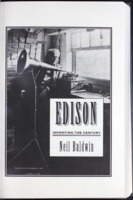 Edison, inventing the century Neil Baldwin's Edison: Inventing the Century is the first biography of one of the seminal figures in our history to examine him as both myth and man, assessing his remarkable accomplishments while taking thorough measure of the paradoxes of his character. Drawing upon unprecedented access to Edison family papers and years of research at the Edison corporate archives, Baldwin offers a revealing portrait of the inventor, in which we discover a man whose life epitomized the American dream as fully as he became a victim of its darker side.From his years as a fragile boy hawking newspapers on trains throughout the Midwest to his arrival in New York City as an itinerant telegrapher seeking his fortune; from his development of the light bulb to his spectacular electrification of lower Manhattan; from his struggles to create the phonograph and motion picture and bring them to market to his obsessive search for a source of natural rubber even as he was dying, Edison: Inventing the Century is an enthralling chronicle of the most revered figure of his time.Alongside the esteemed scientist stands the fiercely self-aggrandizing manufacturer of his own myth; the man possessed by a virtually incessant flow of ideas, who often fights brutally to protect those ideas in the marketplace; the man who publicly preaches the values of home life while his own family is plagued by clinical depression and alcoholism, and while his six neglected, aimless children from two marriages try to step from his massive shadow, yet prove, almost inevitably, to be a disappointment.
401–425 of 540