Booknotes Annotations
Item set
Items
-
 Beyond blame : how we can succeed by breaking the dependency barrier Armstrong Williams work on using personal development and responsibility to help solve crime and other urban problems.
 -
 Hoover's FBI : the inside story by Hoover's trusted lieutenant Cartha DeLoach's work on the Federal Bureau of Investigation during the directorship of J. Edgar Hoover.
 -
 Big babies A collection of Michael Kinsley's writings pertaining to policy issues, presidential politics, the culture of Washington, the media, film, television, and book publishing.
 -
 Maverick's progress : an autobiography Autobiography of historian and art critic, James T. Flexner.
 -
 Dossier : the secret history of Armand Hammer Edward Jay Epstein's investigation into the life of Armand Hammer exposes a tale of fraud, corruption, and personal betrayal that was carried out on such a grand scale and over such a long period of time that it is surely unique. Hammer was ninety-two when he died in 1990. A lengthy front-page obituary in The New York Times lauded him as a successful businessman "who long sought peace between the United States and the Soviet Union and financed research for a cancer cure." His philanthropy was noted, along with his vast art collection and his elevated social connections. But the official version of Hammer's life, which incorporated many of the major figures and key events of the twentieth century, was in fact a myth, carefully nurtured and embellished for nearly seventy years.Aided by newly available sources, Epstein has put together a gripping portrait of a ruthless, audaciously manipulative opportunist whose self-inventions have until now been widely accepted. Epstein gained unprecedented access to FBI files, SEC documents, and files on the Hammer family kept by Soviet intelligence agencies since the 1920's. He interviewed Hammer's mistresses, family, and close friends as well as the shadowy figures who assisted him in business deals. During his investigation, Epstein discovered that for many years Hammer had, like Richard Nixon, secretly taped conversations, many of them dealing with illegal activity. These tapes give an intimate view of a master con man at work.
 -
 Lafayette in two worlds : public cultures and personal identities in an age of revolutions Kramer examines how Lafayette influenced the politics and culture of his day.
 -
 A reporter's life. Autobiography of Walter Cronkite.
 -
 Original meanings : politics and ideas in the making of the Constitution What did the U.S. Constitution originally mean, and who has understood its meaning best? Do we look to the intentions of its framers at the Federal Convention of 1787, or to those of its ratifiers in the states? Or should we trust our own judgment in deciding whether the original meaning of the Constitution should still guide its later interpretation? These are the recurring questions in the ongoing process of analyzing and resolving constitutional issues, but they are also questions about the distant events of the eighteenth century. In this book, Jack Rakove approaches the debates surrounding the framing and ratification of the Constitution from the vantage point of history, examining the range of concerns that shaped the politics of constitution-making in the late 1780s, and which illuminate the debate about the role that "originalism" should play in constitutional interpretation.In answering these questions, Rakove reexamines the classic issues that the framers of the Constitution had to solve: federalism, representation, executive power, rights, and the idea that a constitution somehow embodied supreme law. In each of these cases, Original Meanings suggests that Americans of the early Republic held a spectrum of positions, some drawn from the controversial legacy of Anglo-American politics, others reflecting the course of events since 1776, the politics of the Federal Convention, or the spirited public debate that followed.
 -
 Great books : my adventures with Homer, Rousseau, Woolf, and other indestructible writers of the Western world In Great Books, Denby lives the common adult fantasy of returning to school with some worldly knowledge and experience of life. A gifted story-teller, he leads us on a glorious tour - by turns eloquent, witty, and moving - through the works themselves and through his experiences as a middle-aged man among freshmen. He recounts his failures and triumphs as a reader and student (taking an exam led to a hilarious near-breakdown). He celebrates his rediscovery or new appreciation of such authors as Homer, Plato, the biblical writers, Augustine, Boccaccio, Hegel, Austen, Marx, Nietzsche, and Virginia Woolf. He re-creates the atmosphere of the classroom - the strategies used by a remarkable group of teachers and the strengths and weaknesses of media-age students as they grapple with these difficult, sometimes frightening works. And all year long he watches the students grow and his own life and memories break out of hiding.
 -
 Slouching towards Gomorrah : modern liberalism and American decline In Robert H. Bork's Slouching Towards Gomorrah, one of our nation's most distinguished conservative scholars offers a prophetic and unprecedented view of a culture in decline, a nation in such serious moral trouble that its very foundation is crumbling. Of our own President, Bork writes: "Thirty years ago, Clinton's behavior would have been absolutely disqualifying. Since the 1992 election, the public has learned far more about what is known, euphemistically, as the 'character issue.' Yet none of this appears to affect Clinton's popularity. It is difficult not to conclude that something about our moral perceptions and reactions has changed profoundly. If that change is permanent, the implication for our future is bleak.".The root of our decline, Bork argues, is the rise of modern liberalism, which stresses the dual forces of radical egalitarianism (the equality of outcomes rather than opportunities) and radical individualism (the drastic reduction of limits to personal gratification). The roots of modern liberalism are deeply embedded in the past two and a half centuries - and perhaps - arise from the very nature of Western civilization itself. From the collapse of popular culture to the general weakening of intellect, from the role of the Supreme Court as an agent of modern liberalism to the trouble in religion, from the assault of radical feminism on American institutions and freedoms to the "killing for convenience" of abortion and euthanasia, Bork has brilliantly encapsulated a nation and a culture on the brink. He courageously sounds an alarm for all Americans.To understand our current plight and the direction in which we are moving, Bork believes we must look to the Sixties, a decade in which the moral integrity of our nation came under full-blown assault. We have never recovered from that attack because the radicals of the Sixties have taken over or heavily modified the cultural institutions they once sought to destroy.
 -
 Democracy's discontent : America in search of a public philosophy Despite the success of American life in the last half-century - unprecedented affluence, greater social justice for women and minorities, the end of the Cold War - our politics is rife with discontent. Americans are frustrated with government. We fear we are losing control of the forces that govern our lives, and that the moral fabric of community - from neighborhood to nation - is unraveling around us. What ails democracy in America today, and what can be done about it? Democracy's Discontent traces our political predicament to a defect in the public philosophy by which we live. In a searching account of current controversies over the role of government, the scope of rights and entitlements, and the place of morality in politics, Michael Sandel identifies the dominant public philosophy of our time and finds it flawed.The defect, Sandel maintains, lies in the impoverished vision of citizenship and community shared by Democrats and Republicans alike. American politics has lost its civic voice, leaving both liberals and conservatives unable to inspire the sense of community and civic engagement that self-government requires. In search of a public philosophy adequate to our time, Sandel ranges across the American political experience, recalling the arguments of Jefferson and Hamilton, Lincoln and Douglas, Holmes and Brandeis, FDR and Reagan. He relates epic debates over slavery and industrial capitalism to contemporary controversies over the welfare state, religion, abortion, gay rights, and hate speech.
 -
 The reckless decade : America in the 1890s A period every bit as turbulent as our own age, the 1890s saw vast changes in the economy, politics, and society of the United States, while giving birth to a technological revolution that would profoundly alter the lives of all Americans. Those who knew how to exploit this new world - Carnegie, Morgan, Rockefeller - prospered handsomely; those who did not became icons of how the other half lives. The chilling violence of the Homestead steelworkers' strike and other labor conflicts underscored the tension that such disparity produced. The economic elite ensured that the currency of capital would remain gold and not free silver, yet technology transformed everyday life as alternating current began to light the nation. That new frontier came just when the Western one on which America prided itself closed. No longer could America expand internally; imperialism was the way of the future. But even as the United States became a colonial power, Jim Crow laws ensured that only whites could reap the harvest of empire. In The Reckless Decade, Brands captures the essence - whimsical, tragic, and intrinsically contradictory - of the 1890s, when for the first time America turned its face outward to the world and geared up for the "American Century." Evocative and fascinating, this remarkable book looks back over that amazing time and, in the telling, teaches us much about ourselves and our own reckless decade.
 -
 Radio priest : Charles Coughlin, the father of hate radio Warren Donald's biography of Father Charles Coughlin.
 -
 Profiles in character : hubris and heroism in the U.S. Senate, 1789-1990 Taking the position that some of the lesser-known or unknown U.S. senators deserve renown more than some of the better-known ones, each chronological chapter contrasts the lives of two senators. Included are: Rufus King, James Monroe, Thomas Hart Benton, John C. Calhoun, William Pitt Fessenden, Charles Sumner, George Frisbie Hoar, John Sherman, Henry Cabot Lodge, Thomas J. Walsh, William E. Borah, George W. Norris, Robert A. Taft, Arthur H. Vandenberg, Hubert H. Humphrey, and Strom Thurmond.
 -
 The day before yesterday : reconsidering America's past, rediscovering the present Michael Elliott's survey and commentary on the the United States since World War Two.
 -
 Memoirs. Memoirs of Mikhail Gorbachev.
 -
 D-Day, June 6, 1944 : the climactic battle of World War II On the basis of 1,400 oral histories from the men who were there, Eisenhower biographer and World War II historian Stephen E. Ambrose reveals for the first time anywhere that the intricate plan for the invasion of France in June 1944, had to be abandoned before the first shot was fired. The true story of D-Day, as Ambrose relates it, is about the citizen soldiers - junior officers and enlisted men - taking the initiative to act on their own to break through Hitler's Atlantic Wall when they realized that nothing was as they had been told it would be. This is a brilliant telling of the battles of Omaha and Utah beaches, based on information only now available, from American, British, Canadian, French, and German veterans, from government and private archives, from never before utilized sources on the home front, gathered and analyzed by the author, who has made D-Day his life work. Ambrose's first interview was with General Eisenhower in 1964, his last with paratroopers from the 101st Airborne in 1993. Called the premier American narrative and military historian, Ambrose explains the most important day of the twentieth century. The action begins at midnight, June 5/6, when the first British and American airborne troops jumped into France to launch the invasion. It ends at midnight, June 6/7. Focusing on those pivotal twenty-four hours, this is the story of individuals rather than units. It moves from the level of Supreme Commander to that of a French child, from General Omar Bradley to an American paratrooper, from Field Marshal Montgomery to a British private, from Field Marshal Rommel to a German sergeant. Ambrose covers the politics of D-Day, from Churchill's resistance to the operation to Stalin's impatience and Roosevelt's concern. On the other side were Hitler's command structure, German policy, and the plot against the Fuhrer. This is the epic victory of democracy in winner-take-all combat. When Hitler declared war on the United States, he bet that the young men brought up in the Hitler Youth would outfight the Boy Scouts. Ambrose shows how wrong he was.
 -
 Rosa Lee : a mother and her family in urban America For four years, reporter Leon Dash followed the lives of Rosa Lee Cunningham, her eight children, and five of her grandchildren, in an effort to capture the stark reality of life in the growing black underclass. As a black journalist troubled by the crisis in urban America, he wanted readers to share his discomfort and alarm. Dash's reports in the Washington Post touched a powerful nerve - 4,600 readers called the paper in response - and received critical acclaim as.well, winning both the Pulitzer Prize and the Robert F. Kennedy Journalism Award. (The Kennedy prize board called his series a "tour de force" that "sets the standard for reporting about poverty.") Dash continued reporting even after his articles were published, and in this book he provides the complete, unvarnished family portrait. But Leon Dash does more than simply report facts; he becomes an integral part of Rosa Lee's daily life, driving her to the methadone clinic, helping her read her mail, visiting her in the hospital. While maintaining his journalistic distance - he never lends her money or intervenes with the city bureaucracy - Dash can't help forging a powerful bond with Rosa Lee. Once, after uncharacteristically losing his temper, Dash offers an apology, which she waves aside. "That lets me know that you're really concerned about me," she says. "That means a lot to a woman like me, who has been used and misused. People don't.give a damn about me!" Rosa Lee's life story challenges the pieties of left and right: she has made choices that were often unwise and has paid the price for her actions, but through it all she cares about doing the right thing, even if she cannot always find the inner strength to do so. When she agreed to let Dash chronicle her life, she said simply, "Maybe I can help somebody not follow in my footsteps." Those who read this poignant and provocative portrait will find.that Rosa Lee's voice is one than cannot be ignored, and through her experiences we see the magnitude of the problems facing urban America today.
 -
 Angela's ashes : a memoir When I look back on my childhood I wonder how I managed to survive at all. It was, of course, a miserable childhood: the happy childhood is hardly worth your while. Worse than the ordinary miserable childhood is the miserable Irish childhood, and worse yet is the miserable Irish Catholic childhood. So begins the luminous memoir of Frank McCourt, born in Depression-era Brooklyn to recent Irish immigrants and raised in the slums of Limerick, Ireland. Frank's mother, Angela, has no money to feed the children since Frank's father, Malachy, rarely works, and when he does he drinks his wages. Yet Malachy, exasperating, irresponsible and beguiling, does nurture in Frank an appetite for the one thing he can provide: a story. Frank lives for his father's tales of Cuchulain, who saved Ireland, and of the Angel on the Seventh Step, who brings his mother babies.
 -
 Between hope and history : meeting America's challenges for the 21st century Between Hope and History is President Clinton's credo, a concise statement of the fundamental principles that have guided his administration and its policies since its inception nearly four years ago. It continues, he writes, "the conversation I have had with the American people about our destiny as a nation." In the three main sections of the book - Opportunity, Responsibility, Community - the President explores the most important challenges we face today: making the American Dream available to every citizen willing to work for it; ensuring that individuals, families, businesses, and government shoulder their fair share of responsibility for themselves and one another; and seeking strength through diversity in a community of citizens united in a democracy whose achievements and glory are unrivaled.America, the President observes, stands at a pivotal moment in its history. At the edge of a new century, we must decide between two visions of America. One vision foresees an "every man for himself" society that seems calculated to divide our people rather than unite us, to weaken rather than strengthen the bonds of community, to pay lip service to the importance of families without assuring the tools by which families can succeed. It is, the President declares, "a vision that is bereft of the simple understanding that in America we must go forward together, and we don't have a single person to waste."
 -
 Lies my teacher told me : everything your American history textbook got wrong Criticizes the way history is presented in current textbooks, and suggests a fresh and more accurate approach to teaching American history.
 -
 Perot and his people : disrupting the balance of political power An analysis of H. Ross Perot and his supporters.
 -
 Touched by fire : the life, death, and mythic afterlife of George Armstrong Custer For more than a century, Americans have been captivated by the legend of General George Armstrong Custer. Since the end of the long afternoon of June 25, 1876, when his small band of 267 men faced some 3,000 Sioux and Cheyenne warriors in a remote corner of Montana, Custer has held a place in the pantheon of America's great figures, and the Last Stand has endured as one of the primary images of American expansion into the western frontier.Alternately invoked as the personification of absolute folly and pure bravery, Custer resonates in our national imagination yet eludes simple definition - each generation recasts the man and his death according to its need for a particular vision of America.Touched by Fire undertakes the search for, as one historian put it, "a man waiting to be discovered" between the extremes of his experience. Renowned for his love of pranks at West Point, where he graduated last in his class, Custer had a flair for heroic achievement that brought him phenomenal glory in the Civil War as one of the Union's youngest generals, but left him mostly frustrated on the lonely plains.Author Louise Barnett traces all the complexities of this erratic personality, fully incorporating into her account his wife, Elizabeth Bacon Custer - "Libbie" - whose unusual spousal devotion endured through fifty-seven years of widowhood.Bringing a new racial perspective to Custer's legend and including new material that surfaced in archaeological excavations of the battlefields in the 1980s, Barnett attempts to understand how a man famed for brilliant military performance came to wage an impossible attack near a small stream called the Little Bighorn. Beyond the transfixing moment of the Last Stand, Barnett shows us another Custer who equally seizes the imagination.
 -
 Dirty little secrets : the persistence of corruption in American politics Fact: The Christian Coalition's 1994 voter guides appear to have been skewed to favor Republican candidates in key congressional races across the country, in direct contravention of federal election law. The truth is, the politicians couldn't be happier dickering over the remains of the welfare state. Because, as you'll learn in Dirty Little Secrets, there is probably not a politician in America who does not benefit directly, personally, and continually from the status quo.Fact: On the eve of the 1994 elections, mock "pollsters" called up thousands of voters in one Wisconsin congressional district to ask whether their electoral decisions would be influenced if they knew one of the candidates was a lesbian.Most politicians want to do the right thing. But they also want to be reelected, and the system is far stronger than any honest man or woman. The influence of money and the intricacies of the levers of power make it easier for politicians to ignore the law than to obey it. In Dirty Little Secrets you will read of the conservative movement's hidden manipulations in 1994, and learn the truth about Newt Gingrich's twenty-year program of political destabilization.The history of the corrupt House the Democrats built with the help of liberal interest groups stands revealed. And Larry J. Sabato and Glenn R. Simpson expose the corrupt and illegal tactics both parties have used for decades to protect and promote their own power.. Fact: In 1994, in Alabama, one local election was decided by fewer than three hundred votes. Seventeen hundred ballots cast in that election were illegally admitted absentee ballots, some of them submitted by dead people.Sabato and Simpson's fresh reporting and thousands of hours of background research include interviews with influential politicians, consultants, and political operatives, Freedom of Information Act requests, and thousands of pages of obscure campaign reports. They prove corruption is not about bad apples or colorful local traditions. And they offer a completely original plan for reform - Deregulation Plus - that will frighten both parties and make the American electorate smile for the first time in years.Dirty Little Secrets pulls together the corruption story from all parts of the country so overwhelmingly that no one - from the White House to your house - will be able to deny that political reform must be one of the key issues of the 1996 election campaign.
 -
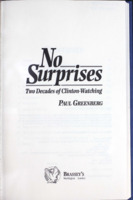 No surprises : two decades of Clinton-watching Paul Greenberg's analysis of the career of William Jefferson Clinton.
376–400 of 540