Booknotes Annotations
Item set
Items
-
 Empire express : building the first transcontinental railroad Chronicles the events that took place in the thirty years it took to complete the first transcontinental railroad, profiling the key players in its development, the major setbacks the workers faced, and the public objections to the railroad's completion.
 -
 A great wall : six presidents and China : an investigative history Studies how America's relationship with China has changed from 1969 to 1999, focusing on how American presidents have dealt with China's rulers.
 -
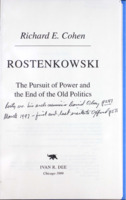 Rostenkowski : the pursuit of power and the end of the old politics For thirteen years, during a time of Democratic congressional dominance in Washington, Dan Rostenkowski became one of the most influential American legislators of the twentieth century. As chairman of the powerful House Ways and Means Committee, the congressman from Illinois left his mark on the nation's tax laws, international trade, Social Security, health care, welfare programs, and a good many other policies that affected most Americans. He practiced old-school politics; he passed out political favors liberally; he could be gruff and abrupt. But the route for important legislation ran through Rostenkowski's office.--BOOK JACKET."Richard Cohen's scrupulous political biography of Rostenkowski follows his rise to power from modest origins in the Democratic ward politics of Chicago's Polish northwest side, through his national legislative triumphs, and ultimately to his criminal conviction and imprisonment for abuses of House practice."--BOOK JACKET. "Mr. Cohen's story offers much more than Rostenkowski's personal tragedy; it is a tale of the transformation of American political life. Because he served so many years in Congress (1959-1995), Rostenkowski's career illuminates the changing nature of both the institution and the Democratic party."--BOOK JACKET.
 -
 The great shame : and the triumph of the Irish in the English-speaking world In the nineteenth century, Ireland lost half of its population to famine, emigration to the United States and Canada, and the forced transportation of convicts to Australia. The forebears of Thomas Keneally, author of Schindler's List, were victims of that tragedy, and in The Great Shame Keneally has written the full story of the Irish diaspora with the narrative grip and flair of a novel. Based on unique research among little-known sources, this book surveys eighty years of Irish history through the eyes of political prisoners - including Keneally's ancestors - who left Ireland in chains and eventually found glory, in one form or another, in Australia and America.--BOOK JACKET.
 -
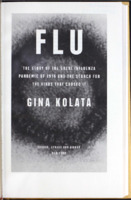 Flu : the story of the great influenza pandemic of 1918 and the search for the virus that caused it Unravels the mystery of this lethal virus with the high drama of a great adventure story. Kolata tracks the race to recover the live pathogen and probes the fear that has impelled government policy. She delves into the history of the flu and previous epidemics, profiles the experts hot on the trail and the amateurs woefully misguided, and details the science and the latest understanding of this mortal disease. -- Jacket.
 -
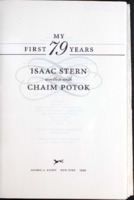 My first 79 years For sixty-four years, Isaac Stern has been a great - and greatly loved - performing artist, famous for his profound music-making, his gusto for life, his passionate dedication to sharing his knowledge and wisdom with younger musicians, and his determination in a good cause. "Brought to America from Russia when he was ten months old, Stern grew up in San Francisco and was quickly recognized as an extraordinary talent. He began performing publicly while still very young, and was soon touring across the country and around the world. His fame escalated when he led the fight to save Carnegie Hall, and again when he was the subject of the Academy Award-winning documentary film From Mao to Mozart." "In this book he shares with us both his personal and his artistic experiences: the story of his rise to eminence; his feelings about music and the violin; his rich emotional life; his great friendships and collaborations with colleagues such as Leonard Bernstein and Pablo Casals; his background as an ardent supporter of Israel; his ideas and beliefs about art, life, love, and the world we live in."--Book Jacket.
 -
 All souls : a family story from Southie The anti-busing riots of 1974 forever changed Southie, Boston's working class Irish community, branding it as a violent, racist enclave. Michael Patrick MacDonald grew up in Southie's Old Colony housing project. He describes the way this world within a world felt to the troubled yet keenly gifted observer he was even as a child: [as if] we were protected, as if the whole neighborhood was watching our backs for threats, watching for all the enemies we could never really define.""--BOOK JACKET."But the threats - poverty, drugs, a shadowy gangster world - were real. MacDonald lost four of his siblings to violence and poverty. All Souls is heart-breaking testimony to lives lost too early, and the story of how a place so filled with pain could still be "the best place in the world.""--BOOK JACKET.
 -
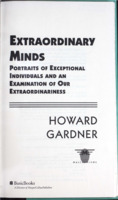 Extraordinary minds : portraits of exceptional individuals and an examination of our extraordinariness In Extraordinary Minds, a book as riveting as it is new, Gardner poses an important question: Is there a set of traits shared by all truly great achievers - those we deem extraordinary - no matter their field or the time period within which they did their important work? "In an attempt to answer this question, Gardner first examines how most of us mature into more or less competent adults. He then examines closely four persons who lived unquestionably extraordinary lives - Mozart, Freud, Woolf, and Gandhi - using each as an exemplar of a different kind of extraordinariness: Mozart as the master of a discipline, Freud as the innovative founder of a new discipline, Woolf as the great introspector, and Gandhi as the influencer." "What can we learn about ourselves from the experiences of the extraordinary? Interestingly, Gardner finds that an excess of raw power is not the most impressive characteristic shared by superachievers; rather, these extraordinary individuals all have had a special talent for identifying their own strengths and weaknesses, for accurately analyzing the events of their own lives, and for converting into future successes those inevitable setbacks that mark every life." "Gardner provides answers to a number of provocative questions, among them: How do we explain extraordinary times - Athens in the fifth century B.C., the T'ang Dynasty in the eighth century, Islamic Society in the late Middle Ages, and New York at the middle of the century? What is the relation among genius, creativity, fame, success, and moral extraordinariness? Does extraordinariness make for a happier, more fulfilling life, or does it simply create a special onus?"--BOOK JACKET.
 -
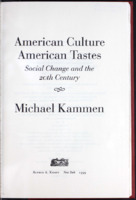 American culture, American tastes : social change and the 20th century Americans have a long history of public arguments about taste, the uses of leisure, and what is culturally appropriate in a democracy that has a strong work ethic. Michael Kammen surveys these debates as well as our changing taste preferences, especially in the past century, and the shifting perceptions that have accompanied them. "Focusing on our own time, Kammen discusses the use of the fluid nature of cultural taste to enlarge audiences and increase revenues, and reveals how the public role of intellectuals and cultural critics has declined as the power of corporate sponsors and promoters has risen. As a result of this diminution of cultural authority, he says, definitive pronouncements have been replaced by divergent points of view, and there is, as well, a tendency to blur fact and fiction, reality and illusion."--BOOK JACKET.
 -
 A history of the American people Paul Johnson's work is a reinterpretation of American history spanning from the first colonial settlements to the Clinton administration.
 -
 America in so many words : words that have shaped America In chronological order, Barnhart and Metcalf give the history and usage of words and phrases that Americans have added to the English language, from canoe and skunk in the 1500s to soccer mom, Ebonics, and millennium bug in the 1990s.
 -
 Reflections on a ravaged century The main responsibility for our century's cataclysms, Conquest maintains, lies not so much in impersonal economic and social forces as in the huge mental distortions produced by ideologies like revolutionary Marxism and National Socialism. The final, sobering chapters of Reflections on a Ravaged Century concern themselves with some coming storms, notably that of the European Union, which Conquest believes is an economic, cultural, and geographical misconception divisive of the West and doomed to failure.--Jacket.
 -
 Uncommon grounds : the history of coffee and how it transformed our world Mark Penergrast's history of coffee from its discovery to modern day.
 -
 Coal to cream : a black man's journey beyond color to an affirmation of race Robinson, an editor with the Washington Post, compares race relations and racial identity in the United States and Brazil.
 -
 Honor bound : American prisoners of war in Southeast Asia, 1961-1973 With this book, two respected scholars in the field offer a comprehensive, balanced, and authoritative account of what happened to the nearly eight hundred Americans captured in Southeast Asia. The authors were granted unprecedented access to previously unreleased materials and interviewed more than one hundred former POWs, enabling them to meticulously reconstruct the captivity record as well as produce an evocative narrative of a once sketchy and misunderstood yet key chapter of the war. "Giving due praise but never shirking from criticism, the authors describe in detail dozens of cases of individual courage and resistance, from celebrated heroes like Jim Stockdale, Robinson Risner, Jeremiah Denton, Bud Day, and Nick Rowe to lesser-known legends like Ray Schrump and Medal of Honor recipient Donald Cook."--BOOK JACKET.
 -
 The Roosevelt women Draws from letters, memoirs, and interviews to chronicle the lives of nine women from the Roosevelt clan, covering a period of 150 years; discussing their activities as wives, mothers, authors, campaigners, and socialites.
 -
 Winston and Clementine : the personal letters of the Churchills In a moving commemoration of the 125th anniversary of Winston Churchill's birth, Soames, his last surviving child (Family Album, 1982; Clementine Churchill, 1979), presents a large selection of the intimate letters of Churchill and his wife, Clementine, from 1909 to 1964. Soames presents the letters both chronologically and topically, starting with the courtship and marriage of the Churchills in 1909 and swiftly moving into Churchill's long career in Parliament and the government.
 -
 Freedom from fear : the American people in depression and war, 1929-1945 Between 1929 and 1945, two great travails were visited upon the American people: the Great Depression and World War II. Freedom from Fear tells the story of how Americans endured, and eventually prevailed, in the face of those unprecedented calamities.--Jacket.
 -
 The shoemaker and the tea party : memory and the American Revolution Award-winning historian Alfred F. Young unearths a rich story of the American Revolution with this account of George Robert Twelves Hewes, a Boston shoemaker who took part in such key events as the Boston Massacre and the Tea Party, and then served in the militia and as a seaman.Young pieces together this extraordinary tale and adds to it poignant reflections on the historical value of oral testimony and memory, and explores key questions about a time crucial in the shaping of national identity: What did it mean for the Tea Party to be claimed as an American symbol by both Boston Brahmins and the first trade unions? How do the memories of ordinary people pass into history? How should their stories be recognized by keepers of the past? Young's search leads us on an exciting journey and offers a provocative reading of American history.
 -
 The System : the American way of politics at the breaking point In this remarkable book, two of America's best-known journalists use their unparalleled access to the major players to examine The System, specifically as it operated during the ferocious battle over the Clinton effort to provide universal health insurance for Americans - and they come to some startling conclusions about America's future.From the beginning of the struggle, Johnson and Broder gained the confidence of more than one hundred of the participants, including the President and the First Lady; key congressional leaders like Bob Dole, Newt Gingrich, Ted Kennedy, and George Mitchell; the many competing special interests; and, outside the Beltway, ordinary citizens and workers on the battlefront of medical care. The authors have written a brilliant chronicle of the battle - of lost opportunities in the White House and of the savage determination and cunning tactics of the Gingrich forces, who plotted secretly for more than a year in advance to kill health care reform in an attempt to regain control of Congress and lead a conservative Republican Revolution that would fundamentally alter American government, privatize public function, and dismantle progressive programs and policies established over the last sixty years.Filled with stunning disclosures about the President and his supporters and adversaries, The System is an extraordinary portrait of democracy under siege, providing one of the most candid looks at American politics and government ever written. It is a book of vital importance to every American and is certain to become a classic in years to come.
 -
 Agent of destiny : the life and times of General Winfield Scott Historian John S.D. Eisenhower, author of So Far From God and The Bitter Woods, explores the facets of Scott's career and the ways he shaped - and was shaped by - the goals and ambitions of a young republic. As Eisenhower vividly demonstrates, American history cannot be fully understood without an appreciation of Scott's life and influence.He not only presided over America's territorial expansion and, reluctantly, over the relocation of American Indians during the episode known as the Trail of Tears, but also played a leading role in the development of the United States Army from a tiny, loosely organized, politics-dominated establishment to a disciplined professional force capable of effective and sustained campaigning.Scott's career was not an uninterrupted series of successes. He was the hero of two major wars and the diplomat who prevented at least three other potential wars with Britain. Yet during his fifty years of service, Scott was placed before a military court three times and once even convicted, incurring a year's suspension from the army. He was roundly defeated when he ran for president in 1852. As Eisenhower's careful study discloses, some of Scott's troubles were created by his own political ambitions.But Scott the General was a person of monumental proportions and the key agent of America's Manifest Destiny.
 -
 Honor's voice : the transformation of Abraham Lincoln Examines certain aspects of the life of Abraham Lincoln in the years between 1831 and 1842, presenting him as a stubborn youth, partial to off-color jokes, and prone to depression; and traces the process by which he rose from unskilled laborer to a position of prominence in the Illinois legislature.
 -
 Betrayal : how the Clinton administration undermined American security No reporter has done more than Bill Gertz to expose the threat the Clinton administration poses to American national security. Now, using his unrivaled access to confidential documents and sources at the Pentagon, the State Department, and the White House, Gertz tells the whole sordid story of how the Clinton administration has weakened our military, given comfort to our enemies, and endangered American safety.
 -
 Beyond the narrow gate : the journey of four Chinese women from the Middle Kingdom to Middle America The author tells the intertwining stories of her mother and three classmates who, having already left China for Taiwan in the wake of the invasion of the Red Army, immigrated to the U.S. in the 1950s and 1960s, a time in which the Chinese were very much a minority in America.
276–300 of 540