Booknotes Annotations
Item set
Items
-
 Glory denied : the saga of Jim Thompson, America's longest-held prisoner of war He was born in New Jersey in 1933 & only dreamed of being a military man. Marrying shortly after high school, he joined the army in 1956 & was dispatched to Vietnam in 1963 when America still seemed still innocent. Jim Thompson would have led a perfectly ordinary, undistinguished life had he not been captured four months later, becoming the first American prisoner in Vietnam and, ultimately, the longest-held prisoner of war in American history. Forgotten Soldier is Thompson's epic story, a remarkable reconstruction of one man's life & a searing account that questions who is a real American hero. Examining the lives of Thompson's family on the home front, as well as his brutal treatment & five escape attempts in Vietnam, military journalist Tom Philpott weaves an extraordinary tale, showing how the American government intentionally suppressed Thompson's story. "Jim's story, as movingly portrayed in Tom Philpott's oral history, is in many ways America's own."--Senator John McCain. Thompson was captured March 1964, three months after arriving in Vietnam, and was held until 1973. Philpott, author of the weekly column Military Update, recounts his childhood, marriage, early days in the army, years as a prisoner of war, release and return, and the family and personal problems that awaited him after so long.
 -
 Ghost soldiers : the forgotten epic story of World War II's most dramatic mission A narration of the 1945 march to rescue 513 POWs, including the last survivors of the Bataan Death March, from a prison in the Philippines.
 -
 Body of secrets : anatomy of the ultra-secret National Security Agency : from the Cold War through the dawn of a new century This scrupulously documented account of the NSA's tireless hunt for intelligence dissects an organization that monitors enemies and allies alike--a leviathan whose influence has both prevented and provoked world conflict. Relying on testimony and documents never meant for the public eye, Bamford reveals espionage activities and profiles the commanders and the soldiers responsible for the covert activities performed by this clandestine agency. A major work of history and investigative journalism, Body of secrets is a riveting analysis of this powerful agency's history and its future.
 -
 The New Dealers' war : Franklin D. Roosevelt and the war within World War II Solidly challenging the idea that World War II was a good war," The New Dealers' War offers a drastically new look at the conflict that has dominated the history of the twentieth century. For many Americans, Franklin Delano Roosevelt's role in leading the United States throughout most of World War II has made him one of America's most venerated presidents. Biographers have all but lionized FDR for his war leadership, a tendency that has been reinforced lately as Americans celebrate the riches of memory by saluting the generation that won that titanic global conflict with blockbuster movies and best-selling books. But, as Thomas Fleming reminds us, memory is not history, and in The New Dealers' War, he reveals an entirely different Roosevelt from the one that most people like to remember." "Unquestionably, The New Dealers' War is one of those rare books that will force readers to rethink what they think they know about one of the most pivotal events in the American past. It will surely spark debate about FDR's role in shaping the course of history in the twentieth century."--BOOK JACKET.
 -
 The abolition of Britain : from Winston Churchill to Princess Diana Writing with passion and flair, Hitchens targets the pernicious effects of TV culture, the corruption and decay" of the English language, the loss of politeness, and the "syrupy confessional mood" brought on by the death of Diana, which Hitchens contrasts with the somber national response to the death of Winston Churchill. If there is a term that summarizes everything that has gone wrong in Britain, it is "Tony Blairism," which Hitchens sees as having rewritten England's history, trivialized its journalism, subverted its educational system and cultural standards, and overthrown accepted notions of patriotism, faith, and morality.The New Britain is government by focus group in which people are told what to feel as a way of preventing them from asking how they want to be governed."--BOOK JACKET.
 -
 American exceptionalism : a double-edged sword Work by Seymour Martin Lipset on American exceptionalism.
 -
 Before the storm : Barry Goldwater and the unmaking of the American consensus Before the Storm begins in a time very much like the present - the tail end of the 1950s, with America affluent, confident, and convinced that political ideology was a thing of the past. "But when John F. Kennedy was elected President in 1960, conservatives - Midewestern businessmen, Sun Belt suburbanites, Southern segregationists, and thousands of college students - formed a movement to challenge the center-left consensus. They chose as their hero Barry Goldwater - a rich, handsome Arizona Republican who hated liberalism even mor than he did Moscow - and they grew determined to see him elected President." "Goldwater was trounced by Lyndon Johnson in 1964. The pundits left conservatism for dead. But by the campaign's end, the consensus found itself squeezed from the left and from the right. As early as 1967 Johnson's Great Society programs were blocked by conservatives in Congress, and the movement had arrived; by 1980 a new conservative standard-bearer, Ronald Reagan, was elected President. Today many of Goldwater's ideas are conventional wisdom for Republications and Democrats alike." "Rick Perlstein's original account of the 1960s as the cradle of the conservative movement is also about a revolution in political culture; fears of threats abroad giving way to concerns of disorder at home; campaigns plotted in back rooms giving way to those staged for television; Americans beginning to think of their nation as divided, not united. Filled with portraits of figures from George Wallace to Nelson Rockefeller to Bill Moyers, Before the Storm is a narrative history that adds greatly to our understanding of that controversial era - and of our own."--Jacket.
 -
 Empire statesman : the rise and redemption of Al Smith Franklin Roosevelt is said to have explained Al Smith, and his own New Deal, with these words; Practically all the things we've done in the federal government are the things Al Smith did as governor of New York." Smith, who ran for president in 1928, not only set the model for FDR, he also taught America that the promise of the country extends to everyone and no one should be left behind." "The story of this trailblazer is the story of America in the twentieth century. A child of second-generation immigrants, a boy self-educated on the streets of the nation's largest city, he went on to become the greatest governor in the history of New York; a national leader and symbol to immigrants, Catholics, and the Irish; and in 1928 the first Catholic major-party candidate for president. He was the man who championed safe working conditions in the wake of the Triangle Shirtwaist fire. He helped build the Empire State Building. Above all, he was a national model, both for his time and for ours."--Jacket.
 -
 Passion for truth : from finding JFK's single bullet to questioning Anita Hill to impeaching Clinton The senator tells the story of his life, "naming names, identifying where the system worked and where it failed--and even admits to his own mistakes."--Jacket.
 -
 Carry me home : Birmingham, Alabama, the climactic battle of the civil rights revolution McWhorter's magisterial narrative tells the story of the civil rights movement in Birmingham, from the '50s through the '60s. In the tradition of such histories as Parting the Water and Walking in the Wind, Carry Me Home" documents the real story of integrating the South. It tells the story of the city called Bombingham, from the fifties through the sixties. It focuses on the black freedom fighters as well as those who resisted them--country-club elite, police, vigilantes.
 -
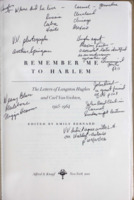 Remember me to Harlem : the letters of Langston Hughes and Carl Van Vechten, 1925-1964 An edited collection of letters between Langston Hughes and Carl Van Vechten, 1925-1964.
 -
 Me and Ted against the world : the unauthorized story of the founding of CNN From the creator of CNN comes an inside, unauthorized look at one of the great adventure tales of modern media. the tumultuous launch of CNN, the world's first 24-hour, all-news network of photos.
 -
 America's jubilee On July 4, 1826, the United States celebrated its fiftieth birthday with parades and speeches across the country. But what ultimately sanctified the national jubilee in the minds of the celebrants was an extraordinary coincidence: the nearly simultaneous deaths of Thomas Jefferson and John Adams, the last pillars of the original republic, already venerated as legends in their own time. It was a watershed in the nation's history, a bright moment when the successors to the Revolutionary dream examined their own lives as they took inspiration from and found nostalgia in the accomplishments of the founders. "In this book, the distinguished historian Andrew Burstein explores what it was to be an American in 1826. Drawing on private diaries and letters, daily newspapers, and long-buried publications, he shows us the personal lives behind the pageantry and reveals an acutely self-conscious nation - anxiously optimistic about its future, eager to romanticize the Revolutionary past." "In this portrait of the United States in its jubilee year, Burstein shows how 1826 marked an unforgettable time in the republic's history, when a generation embraced the legacy of its predecessors and sought to enlarge its role in America's story."--BOOK JACKET.
 -
 Reagan, in his own hand Consists largely of radio addresses written from 1975-1979.
 -
 Niccolò's smile : a biography of Machiavelli In Niccolo's Smile, Maurizio Viroli brings to life the fascinating writer who was the founder of modern political thought. Niccolo Machiavelli's works on the theory and practice of statecraft are classics, but Viroli suggests that his greatest accomplishment is his robust philosophy of life - his deep beliefs about how one should conduct oneself as a modern citizen in a republic, as a responsible family member, as a good person. On these subjects Machiavelli wrote no books; the text of his philosophy is his life itself, a life that was filled with paradox, uncertainty, and tragic drama.--BOOK JACKET.
 -
 Jefferson Davis, American West Point graduate, secretary of war under President Pierce, U.S. senator from Mississippi - how was it that this statesman and patriot came to be president of the Confederacy, leading the struggle to destroy the United States? This is the question at the center of William Cooper's biography of Jefferson Davis. Basing his account on the massive archival record left by Davis and his family and associates, Cooper delves not only into the events of Davis's public and personal life but also into the ideas that shaped and compelled him.--BOOK JACKET.
 -
 America afire : Jefferson, Adams, and the revolutionary election of 1800 Narrates the presidential election of 1800 and its impact on American history, drawing in elements such as the friendship between Adams and Jefferson, the beginnings of government under the Constitution, and partisan warfare.
 -
 Orwell : wintry conscience of a generation Biography of George Orwell by Jeffrey Myers.
 -
 The inextinguishable symphony : a true story of music and love in Nazi Germany Set amid the growing tyranny of German's Third Reich, here is the riveting and emotional tale of Gunther Goldschmidt and Rosemarie Gumpert, two courageous Jewish musicians who strugged to perform under unimaginable circumstances - and found themselves falling in love in a country bent on destroying them.
 -
 Ho Chi Minh Describes Ho Chi Minh's poverty-stricken youth, his expatriate years in the U.S., France, and the Soviet Union, and his commitment to the Vietnamese revolution and reunification of Vietnam under Communist rule.
 -
 The informant : a true story Chronicles the FBI's attempts to infiltrate one of America's most powerful corporations, using information supplied to them by one of the company's employees.
 -
 Beer and circus : how big-time college sports is crippling undergraduate education Murray Sperber takes us beyond the headlines and the public controversies to explore the profound and tragic impact of big-time intercollegiate athletics on undergraduate education. Sperber explodes cherished myths about college sports, particularly at Big-time U's," the large public research universities with high-profile men's football and basketball teams playing at the top level of the NCAA."."Using research culled from students, faculty, and administrators around the country, Sperber proves that many schools, because of their emphasis on research and graduate programs, no longer give the majority of their undergraduates a meaningful education. What they offer instead is a meager and dangerous substitute: the party scene surrounding college sports that Sperber calls "beer and circus" and which serves to keep the students happy while tuition dollars keep rolling in."."Sperber explains how this beer-and-circus scene has evolved over many generations. He details the pernicious roles of the media and corporations looking to tap into the lucrative student market, raising the particular concern of the current epidemic of student binge drinking, which in many ways results from these complex factors."--BOOK JACKET.
 -
 Boundaries Work by Maya Lin which explores her personal strategy for achieving balance in her work and life.
 -
 The virtue of prosperity : finding values in an age of techno-affluence Discusses the potential problems of technological advancement in America, such as class conflict and transformation of the human race due to life-span lengthening and parents' choosing children's genetic makeups, and proposes ways of using technology to promote overall prosperity while preserving values.
 -
 Tip O'Neill and the Democratic century The towering figure of the postwar Democratic Party, Thomas Tip" O'Neill was one of the last of the great political warhorses, a man who cared as much about his family and friends as he did about the issues, someone who knew how to have a good time and do a good deed. Now, based on previously untapped records, interviews, and private correspondence, prizewinning journalist John A. Farrell gives us the first full-scale biography of this legendary American: a garrulous legislative titan who fought with Richard Nixon, Ronald Reagan, and Newt Gingrich and prevailed because he never forgot where he came from." "In Tip O'Neill and the Democratic Century John Farrell has crafted an epic biography, not just of a person, but of politics. Full of larger-than-life personalities and historic moments, it is a grand waltz through the corridors and back rooms of American power. And like Tip himself, Farrell's dazzling book is majestic, powerful, important, and utterly winning."--BOOK JACKET.
226–250 of 540