Booknotes
Item set
Items
-
 Empires of light : Edison, Tesla, Westinghouse, and the race to electrify the world. A chronicle of scientific history recounts the race among inventor Thomas Edison, eccentric genius Nikola Tesla and George Westinghouse, a tough entrepreneur and powerful empire builder, to bring electricity to the world.
 -
 Dark horse : the surprise election and political murder of President James A. Garfield. In this book Kenneth Ackerman re-creates an American political landscape where fierce battles for power unfolded against a chivalrous code of honor in a country struggling to emerge from the long shadow of recent war. He casts familiar Civil War figures like Ulysses S. Grant and Winfield Scott Hancock in unfamiliar roles as politicos alongside feuding machine bosses like senators Roscoe Conkling and James G. Blaine and backroom string-puller Chester A. Arthur, Garfield's unlikely vice-presidential running mate. The journey through political backrooms, dazzling convention floors, and intrigue-filled congressional and White House chambers, reveals the era's decency and humanity as well as the sharp partisanship that exploded in the pistol shots of assassin Charles Guiteau, the weak-minded political camp follower and patronage seeker eager to replace the elected commander-in-chief with one of his own choosing. Garfield's path from a seat in the House of Representatives to the White House to martyred hero changed the tone of politics for generations to come.
 -
 Ghost light: a memoir. Rich grew up in the small-townish Washington, D.C., of the 1950s and early '60s, a place where conformity seemed the key to happiness for a young boy who always felt different. When Rich was seven years old, his parents separated. Bouncing from school to school and increasingly lonely, Rich became terrified of the dark and the uncertainty of his future. But there was one thing in his life that made him sublimely happy; the Broadway theater. -- Jacket.
 -
 Robert E. Lee on leadership: executive lessons in character, courage, and vision. H.W. Crocker's work describing General Robert E; Lee's skills as a leader.
 -
 Another life: a memoir of other people. The editor of Simon & Schuster recalls the greats of the publishing industry and famous writers, politicians, and actors he has encountered.
 -
 The last innocent year, America in 1964: the beginning of the "sixties". Begins the day after the Kennedy assassination & leads up to Lyndon Johnson's defeat of Barry Goldwater a year later. A former political reporter for the "Chicago Tribune" remembers the year John Kennedy was killed, Lyndon Johnson began the Great Society, young men started burning their draft cards, blacks burned whole neighborhoods, women began wondering if they were being oppressed, Congress passed the Tonkin Gulf Resolution, and three civil rights workers were murdered in Mississippi.
 -
 Letters of a nation : a collection of extraordinary American letters. Collection of over two hundred letters on a variety of subjects by Americans from all walks of life, spanning more than 350 years of American culture and history.
 -
 Great souls: six who changed the century. Personal character profiles of Billy Graham, Mother Teresa, Aleksandr Solzhenitsyn, Pope John Paul II, Elie Wiesel, Nelson Mandela.
 -
 The Hitler of history. Since 1945 there have been more than one hundred biographies of Hitler, and countless other books on him and the Third Reich. What happens when so many people reinterpret the life of a single individual? Dangerously, the cumulative portrait that begins to emerge can suggest the face of a mythic antihero whose crimes and errors blur behind an aura of power and conquest. By reversing the process, by making Hitler's biographers - rather than Hitler himself - the subject of inquiry, Lukacs reveals the contradictions that take us back to the true Hitler of history. Like an attorney, Lukacs puts the biographies on trial. He gives a masterly account of all the major works and of the personalities, methods, and careers of the biographers (one cannot separate the historian from his history, particularly in this arena); he looks at what is still not known (and probably never will be) about Hitler; he considers various crucial aspects of the real Hitler; and he shows how different biographers have either advanced our understanding or gone off track.
 -
 East to the dawn: the life of Amelia Earhart. Susan Butler's biographical work on aviator Amelia Earhart.
 -
 The words we live by: the creeds, mottoes, and pledges that have shaped America. Brian Burrell's splendid collection shows that many of the phrases we once lived by can still have resonance today. A comprehensive, fascinating treasure trove of American common sense and whimsy, The Words We Live By presents a sentimental rediscovery of a lost era in American history.Burrell's work was inspired by his father, an obsessive collector of words and a chronic nostalgia buff who traveled widely with his family, introducing them to the landmarks, monuments, and other symbols of America's past. Throughout his life, he clipped or wrote down memorable phrases, quotes, mottoes, and quips, both the silly and the profound, the playful and the maudlin. Burrell has lovingly compiled his father's collection of scrapbooks, complementing them with extraordinary research into the origins of America's civic ethics, to produce a truly memorable and inspirational work of historical reference. More than just a compendium of classic American wit and wisdom, The Words We Live By brings this material to life with poignantly told stories, forgotten anecdotes, and deeply considered meditations on the meaning of the words that have shaped the American nation.
 -
 Confessions of a White House ghostwriter: five presidents and other political adventures. White House speechwriter James C. Humes put words into the mouths of five presidents - Eisenhower, Nixon, Ford, Reagan, and Bush. In the process, he got to know these prominent leaders as few ordinary staffers could, while observing the inner workings of the White House. Now, in this frank and witty memoir, Humes reveals how vital political decisions and great political speeches were made. And he underlines the importance of character in a politician - something no.speechwriter can hide. Humes shares what he learned in his 25-year career as a presidential speechwriter. Page after page crackles with such fascinating disclosures as Nixon's suspicions about the identity of "Deep Throat", the real reason behind Ford's pardon of Nixon, why Reagan was his own best speechwriter, and why Bush lost. Humes reveals the secrets of the speechwriting trade, and spins marvelous anecdotes including sending Eisenhower to the Ladies' Room, writing.the plaque that was planted on the moon by Neil Armstrong and Edwin Aldrin, dancing with the Queen of England, and discussing nuclear disarmament over dinner with Churchill and Eisenhower.
 -
 My years with Gorbachev and Shevardnadze: the memoir of a Soviet interpreter. As the principal English interpreter for Mikhail Gorbachev and his foreign minister, Eduard Shevardnadze, in the critical period of 1985-1991, Pavel Palazchenko participated in all U.S.-Soviet summit talks leading to the end of the Cold War. This personal and political memoir sheds new light on Soviet-American relations and personalities during that time.Palazchenko focuses on what he saw with his own eyes during important negotiating sessions with world leaders such as Presidents Ronald Reagan and George Bush, Secretaries of State George Shultz and James Baker, and Prime Minister Margaret Thatcher. He shares his impressions and opinions about these leaders as well as their Soviet counterparts and gives a firsthand account of the phase of preparation leading up to important international events, including the process of hammering out positions on sensitive arms control issues. Palazchenko describes the events themselves, such as the summits in Reykjavik, Malta, and Moscow, adding many fascinating details to previous accounts.
 -
 Passage to Union: how the railroads transformed American life, 1829-1929. In Passage to Union, Sarah Gordon has written a richly informed narrative history of the growth of the railroads, an American icon. But her conclusions are surprising. Where the railroads and their entrepreneurs are ordinarily celebrated for their accomplishments, Ms. Gordon finds that the cost of their achievements was high. Conflicts of interest - at local, state, and regional levels - characterized railroad growth at every stage. Despite the stated aims of government.and the railroad corporations to promote settlement and commerce, Ms. Gordon shows that the states lost control of these enterprises and lost the economic benefits of their traffic. Smaller towns withered as people and money flowed to larger cities. By 1900 the union that had emerged reflected the worst fears of railroad critics. The South and West had been settled, but wealth had flowed so heavily to the cities that rural life had lost its attraction. Passage to Union.is compelling reading because Ms. Gordon has drawn from diaries, memoirs, literature, advertisements, newspapers and magazines, public records, and railroad history to construct her narrative. The impact of the railroads on people and their communities is powerfully illustrated in this absorbing story of apparent triumph and real loss.
 -
 Crusader: the hell-raising police career of Detective David Durk. James Lardner's biographical work on David Durk
 -
 Why I am a democrat . For those Americans who have questioned or forgotten the aims and strengths of the Democratic Party, a well-known Democrat from the Kennedy era has written a thoughtful reminder. Ted Sorensen was the principal counsel, policy adviser, and speechwriter for President Kennedy and has experienced more than four decades of political activity. Here he articulates the fundamental reasons and principles behind proclaiming oneself a Democrat. In Why I Am a Democrat, Sorensen defines himself in terms of the major themes on which Democrats and Republicans divide - their differing approaches to government and the free market, to national and individual distress and discrimination, to privacy and public service. Outlining his own vision and ruminating about the roots of that vision, he provides a skeleton key for the Democratic impulse.Neither defense nor apologia, but rather an explanation of basic Democratic thought regarding public-policy issues - as well as personal memoir of belief in a set of values - Why I Am a Democrat provides hope, reason, and intellectual ammunition for despairing Democrats now wandering the political wilderness.
 -
 Think a second time. Journalist Dennis Prager's collection of 43 essays drawn from his quarterly journal entitled Ultimate Issues.
 -
 Divided lives: the public and private struggles of three accomplished women. An intimate look at the lives of three contemporary women--television journalist Meredith Vieira, conductor Rachael Worby, and breast surgeon Dr. Alison Estabrook--portrays their conflicts as they struggle to balance their own needs with the needs of those around them.
 -
 Common cents: a retiring six-term congressman reveals how Congress really works-- and what we must do to fix it. Drawing on twelve years of experience in Congress to explain what is wrong and how to fix it, a former congressman from Minnesota reveals the hypocrisy, double-dealing, and power plays that have rendered Congress impotent.
 -
 Rogue states and nuclear outlaws: America's search for a new foreign policy. Michael T. Klare's book is a critical analysis of Pentagon strategy in the post-Cold War era and shows how the Pentagon's planners have created a new agenda that will justify Cold War levels of spending.
 -
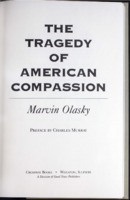 The Tragedy of American compassion. Dr. Marvin Olasky's work regarding poverty and government programs.
 -
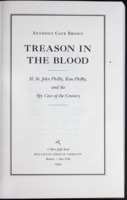 Treason in the blood: H. St. John Philby, Kim Philby, and the spy case of the century. Kim Philby has been called "one of the most remarkable double-agents to have been exposed in our time." Harry St. John Bridger Philby, Kim Philby's father and mentor, was one of the most intriguing intellectuals and adventurers of our time, a manipulator who played a key role in establishing the modern Middle East. In this dual biography, Anthony Cave Brown, tells the extraordinary story of two men whose lives were directly opposed to the establishment into which they were born and for which they were bred. St. John, the brilliant Arabist, became a Moslem and political adviser to King Ibn Saud. He was the middleman in the U.S. acquisition of the Saudi oil concession, called by the State Department "the greatest commercial prize in the history of the planet." And as St. John turned to Mecca, Kim turned to the Kremlin, serving as a secret agent against the Anglo-American intelligence services for fifty-three years.
 -
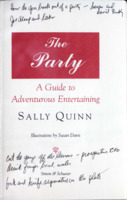 The party : a guide to adventurous entertaining. Author Sally Quinn's book about entertaining.
 -
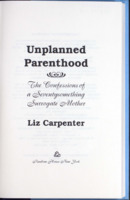 Unplanned parenthood: the confessions of a seventysomething surrogate mother. A journalist and author describes what it is like as a septuagenarian to suddenly take on the task of raising three teenagers, offering a witty look at raising youngsters in the 1990s.
 -
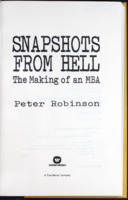 Snapshots from hell: the making of an MBA. Each year tens of thousands of America's best, brightest, and most ambitious consider going to business school. The enticement is the chance to earn an impressive credential, the highly touted MBA degree. To be crass, they all want to make money. And if they don't flunk out, go crazy, or otherwise crash, some of them may even get their heart's desire. As his thirtieth birthday loomed and his friends began to acquire such grown-up possessions as homes and European cars, Peter Robinson, then a presidential speechwriter, decided the time had come to embark on a different, and more lucrative, career path. To this end, he applied and was accepted into Stanford business school's prestigious MBA program. What he quickly discovered was that business school was a more confusing and overwhelming experience than he had expected.During his first year at Stanford, Robinson began keeping the journal of day-to-day impressions and experiences that evolved into this book, the writing of which he began to see as "a simple act of decency, like going back to the last calm bend in the river and nailing up a sign that reads 'Waterfall Ahead!'" Unlike any previous book or glossy catalogue, it dares to answer, honestly and insightfully, the paramount question of every prospective student, the only question that matters: What is business school really like? In Snapshots from Hell, we follow Robinson from his first harrowing days at "math camp" through his valiant, sometimes triumphant, sometimes futile attempts to navigate his way through a dizzying phalanx of core courses. We experience the horror of a "cold call," the frenzy of exam week, the challenges of learning the language of a strange new world, and the pitfalls and triumphs of the interview process. We see what business school does to Robinson's up-and-down, long-distance romance. We are also introduced to a remarkable cast of characters, ranging from Robinson's fellow "poets," students who lack a business background, to "jocks," such as the 25-year-old future Captain of Industry who has entered business school to "position himself for a quantum leap in financial services." We see Robinson not only survive business school, but go on to be wined and dined by some of the biggest and most prestigious companies in the world. We experience Robinson's unforgettable vignettes from the phenomenon of corporate recruiting, including an almost surreal interview he had in London with the late media baron Robert Maxwell. Raising fundamental questions about the true value of a degree in business administration, Peter Robinson's soul-searching, no-holds-barred adventure does for business school what Scott Turow's classic One L did for Harvard Law. It is, in short, everything you wanted to know - and need to know - about how to succeed in business by succeeding as an MBA.
201–225 of 728