Booknotes
Item set
Items
-
 Black judges on justice : perspectives from the bench The views of leading African American jurists from around the country on the way our judicial system works. Included is an interview with Abigail R. Rogers, South Carolina's first female African American judge.
 -
 Rutherford B. Hayes : warrior and president Biographical work on President Rutherford B. Hayes.
 -
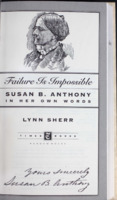 Failure is impossible : Susan B. Anthony in her own words Compilation of quotes from Susan B. Anthony.
 -
 The death of common sense : how law is suffocating America Distressing, disturbing, devastatingly detailed--this examination of how modern laws are diminishing America exposes the drawbacks of rule-bound government, tells why nothing gets done, reveals the phony pretensions of law, and shows why well-intentioned laws have actually devalued rights. In short, this book demonstrates how the buck never stops and how well-meaning laws are creating a nation of enemies.--From publisher description.
 -
 On the origins of war and the preservation of peace Professor Kagan reveals the common threads that connect the ancient confrontations between Athens and Sparta and between Rome and Carthage with the two calamitous world wars of our own century.
 -
 The bill : how the adventures of Clinton's National Service bill reveal what is corrupt, comic, cynical, and noble, about Washington Offers a detailed and sometimes humourous account of the political process of trying to revamp the college loan system and create the the program now known as AmeriCorps.
 -
 Stars in their courses : the Gettysburg campaign, June-July 1863 Recreates the Battle of Gettysburg from both the Confederate and Union perspectives.
 -
 Creating a new civilization : the politics of the Third Wave Alvin Toffler's work on the "Knowledge Revolution" in which he describes the effects of the Information Age.
 -
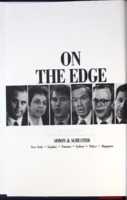 On the edge : the Clinton presidency Elizabeth Drew's On the Edge is the first inside, full-spectrum report on the Clinton Presidency. Since he came to office, Clinton has been hard to read - ambitious and uncertain, looking toward the future and hounded by the past. From the first days of the administration, Drew has been speaking with and learning from the President's top advisers, key Cabinet officers, and well-placed members of Congress, as she has watched - up close, behind the scenes - as plans are hammered out, policies set, and problems confronted. Drew tells the remarkable story of this turbulent term - and deciphers what it means.Clinton's far-reaching domestic proposals and considerable achievements are recounted, as well as the distracting and corrosive personal struggles, especially Whitewater. Drew portrays his legislative gambles - from health care to NAFTA - and his costly inattention to foreign policy - the confused policymaking on Somalia, Bosnia, Haiti. She reveals the struggles within the President's foreign policy team. She traces how controversies over such a wide range of issues and events - gays in the military, the mishandling of Zoe Baird's and Lani Guinier's nominations, the $200 haircut, the travel office, and the death of Vincent Foster - have undermined confidence in Clinton's Presidency and fanned the flames of "the character issue." She shows sides of Clinton never seen before and explores the critical and little-understood role of Hillary Rodham Clinton - both as a power and as a personality - and measures the truly unprecedented influence of Vice President Al Gore.On the Edge answers the questions of who Bill Clinton is, and what his Presidency means for this country.
 -
 The road to serfdom Work by Friedrich Hayek on political philosophy, intellectual and cultural history, and economics.
 -
 China wakes : the struggle for the soul of a rising power Nicholas Kristof's work on China's transformation into an economic and political superpower.
 -
 John C. Calhoun : a biography In this important and highly readable biography of John C. Calhoun, Irving Bartlett sees a man almost unique in American history, a lifelong politician who was also a profound political philosopher. Born on the South Carolina frontier, Calhoun grew up in a postrevolutionary culture which valued both African slavery and the republican ideology of the Founding Fathers. He was orphaned in his teens and, with almost no formal education, suddenly became a man. In less than ten years he had become a Yale graduate, a lawyer, a former state legislator, and a congressman-elect prepared to help James Madison lead the country into the War of 1812. As a congressman and later as James Monroe's secretary of war Calhoun articulated the nationalism of the new nation as cogently as any other American leader. Calhoun was ambitious beyond his years. He was an unsuccessful candidate in the disputed presidential election of 1824 but was easily elected vice president under John Quincy Adams and Andrew Jackson. Determined to avoid the obscurity of that office, Calhoun managed to get into monumental public disputes with both presidents and resigned in the last days of Jackson's first administration to become senator from South Carolina and champion his state's right to nullify the Tariff of 1832. Along with his famous contemporaries Henry Clay and Daniel Webster, Calhoun dominated the Senate of the United States in the 1830s and 1840s. Serving briefly as secretary of state in the beleaguered Tyler administration, he played a key role in the annexation of Texas and created a furor on both sides of the Atlantic with his strident defense of American slavery and his denunciation of what he perceived as the pseudophilanthropy of British abolitionism. Returning to the Senate, he acted as peacemaker in helping avoid a near war with Britain over the Oregon boundary dispute, and he persistently opposed the popular Mexican War. Long before his death in 1850 Calhoun had become known as the cast-iron leader of the South, who never curried to popular opinion, spurned party loyalty, and defended slavery and states' rights with a vigor and intelligence that even leading abolitionists had to respect. In this major new biography Irving Bartlett goes behind the cast-iron image to explain the cultural and psychological forces that shaped Calhoun's political career and thought; he maintains that however wrong Calhoun was about slavery, many of his ideas still speak to us today.
 -
 The bell curve : intelligence and class structure in American life Cognitive class and education, 1900-1990 -- Cognitive partitioning by occupation -- The economic pressure to partition -- Steeper ladders, narrower gates -- Poverty -- Schooling -- Unemployment, idleness, and injury -- Family matters -- Welfare dependency -- Parenting -- Crime -- Civility and citizenship -- Ethnic differences in cognitive ability -- Ethnic inequalities in relation to IQ -- The demography of intelligence -- Social behavior and the prevalence of low cognitive ability -- Raising cognitive ability -- The leveling of American education -- Affirmative action in higher education -- Affirmative action in the workplace -- The way we are headed -- A place for everyone.
 -
 Beyond the promised land : Jews and Arabs on the hard road to a new Israel Glenn Frankel's work on the status of government, politics, the economy, and relations between jews and arabs in the modern state of Israel.
 -
 Paul Revere's ride David Hackett Fischer's account of Paul Revere's ride from the perspective of both Revere and British General Thomas Gage.
 -
 Lincoln in American memory Lincoln's death, like his life, was an event of epic proportions. When the president was struck down at his moment of triumph, writes Merrill Peterson, "sorrow - indescribable sorrow" swept the nation. After lying in state in Washington, Lincoln's body was carried by a special funeral train to Springfield, Illinois, stopping in major cities along the way; perhaps a million people viewed the remains as memorial orations rang out and the world chorused its praise. It was the apotheosis of the martyred president - the beginning of the transformation of a man into a mythic hero. In Lincoln in American Memory, historian Merrill Peterson provides a fascinating history of Lincoln's place in American thought and imagination from the hour of his death to the present. In tracing the changing image of Lincoln through time, this wide-ranging account offers insight into the evolution and the struggles of American politics and society - and into the character of Lincoln himself. Westerners, Easterners, even Southerners were caught up in the idealization of the late president, reshaping his memory and laying claim to his mantle, as his widow, son, memorial builders, and memorabilia collectors fought over his visible legacy. Peterson also looks at the complex responses of blacks to the memory of Lincoln, as they moved from exultation at the end of slavery to the harsh reality of free life amid deep poverty and segregation; at more than one memorial event for the great emancipator, the author notes, blacks were excluded. He makes an engaging examination of the flood of reminiscences and biographies, from Lincoln's old law partner William H. Herndon to the poet Carl Sandburg and beyond. Serious historians were late in coming to the topic; for decades the myth-makers sought to shape the image of the hero president to suit their own agendas. He was made a voice of prohibition, a saloon-keeper, an infidel, a devout Christian, the first Bull Moose Progressive, a military blunderer and (after the First World War) a military genius, a white supremacist (according to D.W. Griffith and other Southern admirers), and a touchstone for the civil rights movement. Through it all, Peterson traces five principal images of Lincoln: the savior of the Union, the great emancipator, man of the people, first American, and self-made man. In identifying these archetypes, he tells us much not only of Lincoln but of our own identity as a people. This absorbing book leads us on a revealing tour through our changing image of our greatest president - and our changing image of ourselves.
 -
 Never stop running : Allard Lowenstein and the struggle to save American liberalism Lowenstein became famous for the "dump Johnson" movement in 1968, Robert Kennedy's campaign for the presidential nomination and for being on Nixon's infamous "enemies list."
 -
 No ordinary time : Franklin and Eleanor Roosevelt : the home front in World War II. Biographical work on Eleanor Roosevelt by Doris Kearns Goodwin
 -
 Dead right David Frum's work on the conservative movement during the Reagan-Bush years.
 -
 Dream city : race, power, and the decline of Washington, D.C. Harry Jaffe's work on the city of Washington, D.C.
 -
 Colored people : a memoir Memoir by Henry Louis Gates.
 -
 The shadow of the panther : Huey Newton and the price of Black power in America In the early morning of August 22, 1989, on the corner of Ninth and Center Streets in Oakland, Huey Newton faced Tyrone Robinson and two other drug dealers, asking them for crack. Robinson refused, took a 9-mm automatic from one of his companions and pointed it at Newton's head. Huey stood still and said, "You can kill my body, but you can't kill my soul. My soul will live forever!" Robinson shot him three times in the head. Huey Newton, once considered the nation's premier symbol of black resistance to the entire American power structure, was pronounced dead at 6:12 a.m. The Shadow of the Panther is the most ambitious, engaging, and balanced history of the Black Panthers to date. It is also an unflinchingly honest account of what amounts to human tragedy. Hugh Pearson's account of Huey Newton's rise to power and descent into addiction and powerlessness is set against a century-long quest for civil rights and empowerment. Beginning with the formation of the Brotherhood of Sleeping-Car Porters in the 1920s, Hugh Pearson then traces the development of civil-rights activism through a series of "Premier Negro Leaders" from Booker T. Washington, W. E. B. Du Bois, and Adam Clayton Powell, Jr., to Martin Luther King, Jr., Stokely Carmichael, and Malcolm X. The extraordinary progress and crushing defeats of the early- and mid-1960s set the stage for the rise of the Black Power Movement and its offspring, the Black Panther Party. The details of this evolution from nonviolence to violence, and, finally, to militarism, are presented here with clarity and insight, showing clearly how Black Power spelled the beginning of the end of the Civil Rights Movement, and paved the way for the emergence of the Panthers as the nation's primary symbol of black disenchantment. Through meticulous research and exclusive cooperation from many of those close to Newton, Pearson paints a detailed portrait of life in the Party. Newton's own opposing tendencies - the intellectual who earned a Ph.D. and the street thug - had parallels in the structure and activities of the Party: while creating positive change through political organization and community programs, the Party also had all the characteristics of a violent, repressive, gangster mob. Persistent problems with internal conflicts, the wide gap between Newton's elite corps and rank-and-file members, sexual abuse and mistreatment of women, and the abandonment, torture, and frequent murder of members and ex-members all contributed to the ultimate demise of the Party. The result is a fine-grained portrait of the complex and evolving relationship of revolutionary blacks and white leftist college students in the face of growing black militancy and the Vietnam War, and a vivid and varied cast of characters that includes Stokely Carmichael, James Forman, Bob Scheer, Elaine Brown, and David Horowitz. A powerful and undeniably bold take on an era both pivotal and persistent in the American consciousness, The Shadow of the Panther will no doubt be the benchmark for all future books on Huey Newton and the Black Panther Party.
 -
 News and the culture of lying Paul Weaver's commentary on the news media.
 -
 The tyranny of the majority : fundamental fairness in representative democracy Jurist Lani Guanier's commentary on the state on American Democracy.
 -
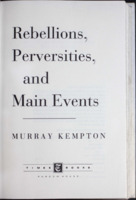 Rebellions, perversities, and main events In today's society, the model citizen is too often one with neither memory nor traditions. Murray Kempton's refusal to relinquish either is among his greatest achievements. He knows that the chaos of daily events can only be understood through the prism of the past. He is a man suffused with a seemingly inexhaustible appetite for the life of the mind. He is that rare reporter whose skepticism has never succumbed to cynicism.
626–650 of 728