Booknotes
Item set
Items
-
 Radio priest : Charles Coughlin, the father of hate radio Warren Donald's biography of Father Charles Coughlin.
 -
 Profiles in character : hubris and heroism in the U.S. Senate, 1789-1990 Taking the position that some of the lesser-known or unknown U.S. senators deserve renown more than some of the better-known ones, each chronological chapter contrasts the lives of two senators. Included are: Rufus King, James Monroe, Thomas Hart Benton, John C. Calhoun, William Pitt Fessenden, Charles Sumner, George Frisbie Hoar, John Sherman, Henry Cabot Lodge, Thomas J. Walsh, William E. Borah, George W. Norris, Robert A. Taft, Arthur H. Vandenberg, Hubert H. Humphrey, and Strom Thurmond.
 -
 The day before yesterday : reconsidering America's past, rediscovering the present Michael Elliott's survey and commentary on the the United States since World War Two.
 -
 Memoirs. Memoirs of Mikhail Gorbachev.
 -
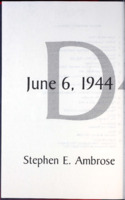 D-Day, June 6, 1944 : the climactic battle of World War II On the basis of 1,400 oral histories from the men who were there, Eisenhower biographer and World War II historian Stephen E. Ambrose reveals for the first time anywhere that the intricate plan for the invasion of France in June 1944, had to be abandoned before the first shot was fired. The true story of D-Day, as Ambrose relates it, is about the citizen soldiers - junior officers and enlisted men - taking the initiative to act on their own to break through Hitler's Atlantic Wall when they realized that nothing was as they had been told it would be. This is a brilliant telling of the battles of Omaha and Utah beaches, based on information only now available, from American, British, Canadian, French, and German veterans, from government and private archives, from never before utilized sources on the home front, gathered and analyzed by the author, who has made D-Day his life work. Ambrose's first interview was with General Eisenhower in 1964, his last with paratroopers from the 101st Airborne in 1993. Called the premier American narrative and military historian, Ambrose explains the most important day of the twentieth century. The action begins at midnight, June 5/6, when the first British and American airborne troops jumped into France to launch the invasion. It ends at midnight, June 6/7. Focusing on those pivotal twenty-four hours, this is the story of individuals rather than units. It moves from the level of Supreme Commander to that of a French child, from General Omar Bradley to an American paratrooper, from Field Marshal Montgomery to a British private, from Field Marshal Rommel to a German sergeant. Ambrose covers the politics of D-Day, from Churchill's resistance to the operation to Stalin's impatience and Roosevelt's concern. On the other side were Hitler's command structure, German policy, and the plot against the Fuhrer. This is the epic victory of democracy in winner-take-all combat. When Hitler declared war on the United States, he bet that the young men brought up in the Hitler Youth would outfight the Boy Scouts. Ambrose shows how wrong he was.
 -
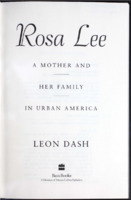 Rosa Lee : a mother and her family in urban America For four years, reporter Leon Dash followed the lives of Rosa Lee Cunningham, her eight children, and five of her grandchildren, in an effort to capture the stark reality of life in the growing black underclass. As a black journalist troubled by the crisis in urban America, he wanted readers to share his discomfort and alarm. Dash's reports in the Washington Post touched a powerful nerve - 4,600 readers called the paper in response - and received critical acclaim as.well, winning both the Pulitzer Prize and the Robert F. Kennedy Journalism Award. (The Kennedy prize board called his series a "tour de force" that "sets the standard for reporting about poverty.") Dash continued reporting even after his articles were published, and in this book he provides the complete, unvarnished family portrait. But Leon Dash does more than simply report facts; he becomes an integral part of Rosa Lee's daily life, driving her to the methadone clinic, helping her read her mail, visiting her in the hospital. While maintaining his journalistic distance - he never lends her money or intervenes with the city bureaucracy - Dash can't help forging a powerful bond with Rosa Lee. Once, after uncharacteristically losing his temper, Dash offers an apology, which she waves aside. "That lets me know that you're really concerned about me," she says. "That means a lot to a woman like me, who has been used and misused. People don't.give a damn about me!" Rosa Lee's life story challenges the pieties of left and right: she has made choices that were often unwise and has paid the price for her actions, but through it all she cares about doing the right thing, even if she cannot always find the inner strength to do so. When she agreed to let Dash chronicle her life, she said simply, "Maybe I can help somebody not follow in my footsteps." Those who read this poignant and provocative portrait will find.that Rosa Lee's voice is one than cannot be ignored, and through her experiences we see the magnitude of the problems facing urban America today.
 -
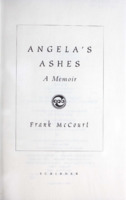 Angela's ashes : a memoir When I look back on my childhood I wonder how I managed to survive at all. It was, of course, a miserable childhood: the happy childhood is hardly worth your while. Worse than the ordinary miserable childhood is the miserable Irish childhood, and worse yet is the miserable Irish Catholic childhood. So begins the luminous memoir of Frank McCourt, born in Depression-era Brooklyn to recent Irish immigrants and raised in the slums of Limerick, Ireland. Frank's mother, Angela, has no money to feed the children since Frank's father, Malachy, rarely works, and when he does he drinks his wages. Yet Malachy, exasperating, irresponsible and beguiling, does nurture in Frank an appetite for the one thing he can provide: a story. Frank lives for his father's tales of Cuchulain, who saved Ireland, and of the Angel on the Seventh Step, who brings his mother babies.
 -
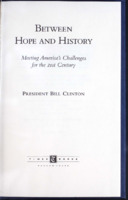 Between hope and history : meeting America's challenges for the 21st century Between Hope and History is President Clinton's credo, a concise statement of the fundamental principles that have guided his administration and its policies since its inception nearly four years ago. It continues, he writes, "the conversation I have had with the American people about our destiny as a nation." In the three main sections of the book - Opportunity, Responsibility, Community - the President explores the most important challenges we face today: making the American Dream available to every citizen willing to work for it; ensuring that individuals, families, businesses, and government shoulder their fair share of responsibility for themselves and one another; and seeking strength through diversity in a community of citizens united in a democracy whose achievements and glory are unrivaled.America, the President observes, stands at a pivotal moment in its history. At the edge of a new century, we must decide between two visions of America. One vision foresees an "every man for himself" society that seems calculated to divide our people rather than unite us, to weaken rather than strengthen the bonds of community, to pay lip service to the importance of families without assuring the tools by which families can succeed. It is, the President declares, "a vision that is bereft of the simple understanding that in America we must go forward together, and we don't have a single person to waste."
 -
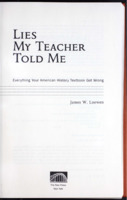 Lies my teacher told me : everything your American history textbook got wrong Criticizes the way history is presented in current textbooks, and suggests a fresh and more accurate approach to teaching American history.
 -
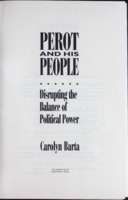 Perot and his people : disrupting the balance of political power An analysis of H. Ross Perot and his supporters.
 -
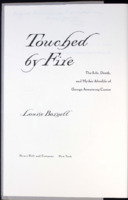 Touched by fire : the life, death, and mythic afterlife of George Armstrong Custer For more than a century, Americans have been captivated by the legend of General George Armstrong Custer. Since the end of the long afternoon of June 25, 1876, when his small band of 267 men faced some 3,000 Sioux and Cheyenne warriors in a remote corner of Montana, Custer has held a place in the pantheon of America's great figures, and the Last Stand has endured as one of the primary images of American expansion into the western frontier.Alternately invoked as the personification of absolute folly and pure bravery, Custer resonates in our national imagination yet eludes simple definition - each generation recasts the man and his death according to its need for a particular vision of America.Touched by Fire undertakes the search for, as one historian put it, "a man waiting to be discovered" between the extremes of his experience. Renowned for his love of pranks at West Point, where he graduated last in his class, Custer had a flair for heroic achievement that brought him phenomenal glory in the Civil War as one of the Union's youngest generals, but left him mostly frustrated on the lonely plains.Author Louise Barnett traces all the complexities of this erratic personality, fully incorporating into her account his wife, Elizabeth Bacon Custer - "Libbie" - whose unusual spousal devotion endured through fifty-seven years of widowhood.Bringing a new racial perspective to Custer's legend and including new material that surfaced in archaeological excavations of the battlefields in the 1980s, Barnett attempts to understand how a man famed for brilliant military performance came to wage an impossible attack near a small stream called the Little Bighorn. Beyond the transfixing moment of the Last Stand, Barnett shows us another Custer who equally seizes the imagination.
 -
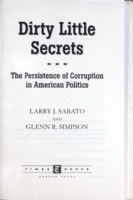 Dirty little secrets : the persistence of corruption in American politics Fact: The Christian Coalition's 1994 voter guides appear to have been skewed to favor Republican candidates in key congressional races across the country, in direct contravention of federal election law. The truth is, the politicians couldn't be happier dickering over the remains of the welfare state. Because, as you'll learn in Dirty Little Secrets, there is probably not a politician in America who does not benefit directly, personally, and continually from the status quo.Fact: On the eve of the 1994 elections, mock "pollsters" called up thousands of voters in one Wisconsin congressional district to ask whether their electoral decisions would be influenced if they knew one of the candidates was a lesbian.Most politicians want to do the right thing. But they also want to be reelected, and the system is far stronger than any honest man or woman. The influence of money and the intricacies of the levers of power make it easier for politicians to ignore the law than to obey it. In Dirty Little Secrets you will read of the conservative movement's hidden manipulations in 1994, and learn the truth about Newt Gingrich's twenty-year program of political destabilization.The history of the corrupt House the Democrats built with the help of liberal interest groups stands revealed. And Larry J. Sabato and Glenn R. Simpson expose the corrupt and illegal tactics both parties have used for decades to protect and promote their own power.. Fact: In 1994, in Alabama, one local election was decided by fewer than three hundred votes. Seventeen hundred ballots cast in that election were illegally admitted absentee ballots, some of them submitted by dead people.Sabato and Simpson's fresh reporting and thousands of hours of background research include interviews with influential politicians, consultants, and political operatives, Freedom of Information Act requests, and thousands of pages of obscure campaign reports. They prove corruption is not about bad apples or colorful local traditions. And they offer a completely original plan for reform - Deregulation Plus - that will frighten both parties and make the American electorate smile for the first time in years.Dirty Little Secrets pulls together the corruption story from all parts of the country so overwhelmingly that no one - from the White House to your house - will be able to deny that political reform must be one of the key issues of the 1996 election campaign.
 -
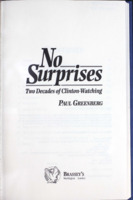 No surprises : two decades of Clinton-watching Paul Greenberg's analysis of the career of William Jefferson Clinton.
 -
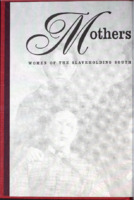 Mothers of invention : women of the slaveholding South in the American Civil War When Confederate men marched off to battle, white women across the South confronted unaccustomed and unsought responsibilities: directing farms and plantations, providing for families, and supervising increasingly restive slaves. As southern women struggled "to do a man's business," they found themselves compelled to reconsider their most fundamental assumptions about their identities and about the larger meaning of womanhood. Drew Faust offers a compelling picture of the more than half-million women who belonged to the slaveholding families of the Confederacy during this period of acute crisis.According to Faust, the most privileged of southern women experienced the destruction of war as both a social and a personal upheaval: the prerogatives of whiteness and the protections of ladyhood began to dissolve as the Confederacy weakened and crumbled. Faust draws on the eloquent diaries, letters, essays, memoirs, fiction, and poetry of more than 500 of the Confederacy's elite women to show that with the disintegration of slavery and the disappearance of prewar prosperity, every part of these women's lives became vexed and uncertain. But it was not just females who worried about the changing nature of gender relations in the wartime South; Confederate political discourse and popular culture - plays, novels, songs, and paintings - also negotiated the changed meanings of womanhood.Exploring elite Confederate women's wartime experiences as wives, mothers, nurses, teachers, slave managers, authors, readers, and survivors, this book chronicles the clash of the old and the new within a group that was at once the beneficiary and the victim of the social order of the Old South. Mothers of Invention show how people managed both to change and not to change and how their personal transformations related to a larger world of society and politics. Beautifully written and eminently readable, this study of women and war is a pathbreaking and definitive study of the forgotten half of the Confederacy's master class.
 -
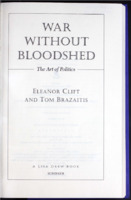 War without bloodshed : the art of politics Eleanor Clift and Tom Brazatis' book on the everyday work of politicians.
 -
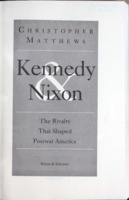 Kennedy & Nixon : the rivalry that shaped postwar America John Kennedy and Richard Nixon shared a dream of being the great young leader of their age. Starting as congressmen in the class of 1946, the two men developed a friendship and admiration for each other that would last for more than a decade. But what drove history, Matthews shows, was the enmity between these two towering figures whose 1960 presidential contest would set the nation's bitter course for years to come.In this startling dual portrait - a modern-day Amadeus, with Nixon as the talented, frustrated, always outdone Salieri to Kennedy's Mozart, the charismatic genius - Matthews shows how the early fondness between the two men (Kennedy told a trusted friend that if he didn't receive the Democratic nomination in 1960, he would vote for Nixon) degenerated into distrust and paranoia, the same emotions that, in the early 1970s, ravaged the nation.Christopher Matthews's revealing book sheds new light on this complicated relationship and the role that it played in shaping America's history.
 -
 Union of words : a history of presidential eloquence The pursuit of E pluribus unum - "from many, one" - the motto on which the United States was founded, has continually posed one of the greatest challenges our presidents have faced throughout history. How does the presidency foster a spirit of unity among all Americans despite so many divergent interests and backgrounds? In this singular study, accomplished storyteller and professor of English Wayne Fields examines this rhetorical tug-of-war through the historical lens of presidential speechmaking. Beginning with George Washington's inaugural and continuing to the present day, Fields traces the vital role of our presidents in fulfilling the constitutional imperative of a "more perfect union." Following the calendar of presidential life, he examines individual speeches from the announcement of candidacy and the acceptance of nomination to the State of the Union address, the call for war or peace, and the farewell address, recounting with a wealth of historical detail the events surrounding each formal and informal speech. Through these orations, Fields provides a fascinating depiction of our presidents as individuals struggling to assert their principles, exercise leadership, and unite diverse Americans while simultaneously contending with the prejudices and circumstances of their time. But an even greater account emerges, one that resonates just as strongly in the issues of our own time: it is the story of a nation and a people constantly recreating themselves to try to build a shared identity within a country of endless change.
 -
 The blue devils of Nada : a contemporary American approach to aesthetic statement An exploration of the blues aesthetic in writing, music, and art, as "stylized expressions of transcendence through sheer style, always informed by an awareness of the vicissitudes of life."
 -
 Once upon a distant war A study of young war correspondents and the early Vietnam battles.
 -
 A gentle madness : bibliophiles, bibliomanes, and the eternal passion for books Notes and underlinings: Basbane's family, acknowledgment of collectors, librarians, booksellers. Stephen Blumberg stole from 268 libraries, worth $20 million. Stole to keep, not sell. Gentlest of infirmities, bibliomania. Oral histories, parts 1 and 2, Huntington Library, Folger, Library of Congress, Lilly Library. Gutenberg's Bible. LOC, Rosenwald, dealers. Bought lot 553 Jews and a 2 yr. old boy had Dr. A.S. Rosenbach purchase, sent to American Jewish Historical Society, sealed for 50 years, Book-Fool. Shakespeare 52, died 1616. $2.1 million 1989 first four folios of Shakespeare's dramas. Book madness, Don Quixote, Peter Kien, Fahrenheit 451, Ray Bradbury., Name of the Rose, Umberto Eco. E.M Forester, falling books in 5 of his works. Ian Fleming, Charles Darwin, Marie Curie on radium, Alexander Graham Bell on the telephone, Ivan Petrovich Pavlov, 1,000 books. Book Collector. Faulkner, Cerf, Knopf--"only sign books for my friends." James A. Michener; Reynolds Price, John Milton. Robert Hoe, 15,00 volumes. Grolier Club. J. Pierpont Morgan. Henry E. Huntington. "ownership of a fine library is the surest and swiftest way to immortality."Huntington Library= library of libraries or collection of collections. Grenville Kane collection of George Washington, at least one item for each of year of GW's adult life. Martin Shoyen, incunabula. Rosenbach sold materials to Henry C. and Emily Jordan Folger for the Folger Library. American Golden Age of Book Collecting ended with Crash of 1929. Carrie Estelle Betzold Doheny, Edward Laurence Doheny Memorial Library. Collectors: Haven O'More, claimed to have 3 Ph.D.s--no record. Information on "amateur collectors" and their collections. Stephen Blumberg stole 23,600 books from 268 libraries in 45 states, two Canadian provinces and the District of Columbia. Partner Kenneth J. Rhodes turned him in. Describes preparing books to steal, and ways of getting into secure areas; the trial; thought he was rescuing books. Book concludes with an over extended collector, Raymond Epstein, selling off his collection.
 -
 All God's children : the Bosket family and the American tradition of violence A history of violence in America as experienced by one family, from slavery in Edgefield, S.C., to prison in the urban North.
 -
 The sacred fire of liberty : James Madison and the founding of the federal republic James Madison was the finest democratic theorist that the United States has ever produced. His was the pivotal philosophical role in framing the Constitution and establishing the principles on which a wholly new form of government was to be based. Yet this widely informed and profoundly original thinker has been considered by most scholars to be an intellectual pragmatist who reacted variably and inconsistently to the changing circumstances of the Revolution and the Confederation. Lance Banning's powerful and persuasive reexamination of Madison's thought at the critical early and central stages of his career now changes that presumption, and provides a new base from which thinking about Madison and the Founding must start. The Sacred Fire of Liberty follows Madison from his appearance on the national stage (in Congress in 1780) through the end of 1792. By the end of this period, he had achieved his mature understanding of the Constitution, and his collision with many of the other Federalists of 1788 had made him a leader of the opposition to the administration of George Washington. Banning convinces the reader, through his meticulous research and deeply contextualized presentation of the shifting issues of the period, that Madison indeed held to consistent principles: he was at once a more committed democrat and a less eager nationalist than usually has been thought. The thinking that had underpinned his actions at the great convention, his numbers of The Federalist, and the supposed reversal of positions represented by his joining with Thomas Jefferson to form the first Republican party had firmed by 1792 into the understandings that would guide the rest of his career.
 -
 The very best men : four who dared : the early years of the CIA Research from CIA archives and interviews relate the early history of the CIA and focus on four of the first spymasters--Frank Wisner, Richard Bissell, Tracy Barnes, and Desmond FitzGerald.
 -
 Call the briefing! : Bush and Reagan, Sam and Helen : a decade with presidents and the press The White House spokesman for both President Reagan and President Bush presents his memoirs along with an account of the power of the press and its influence on the presidency in setting the national agenda.
576–600 of 728