Booknotes
Item set
Items
-
 Abraham : a journey to the heart of three faiths In this timely, provocative, and uplifting journey, the bestselling author of "Walking the Bible" searches for the man at the heart of the world's three monotheistic religions--and today's deadliest conflicts. "Abraham" uncovers fascinating, little-known details of the man who defines faith for half of the world. Endpaper maps.
 -
 First great triumph : how five Americans made their country a world power Documents how the United States rose to a significant world power one century ago through the actions of five political figures, including Theodore Roosevelt, naval strategist Alfred T. Mahan, and Senator Henry Cabot Lodge.
 -
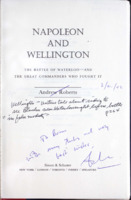 Napoleon and Wellington : the Battle of Waterloo and the great commanders who fought it Explores the relationship between the French emperor Napoleon Bonaparte and the Duke of Wellington prior to and in the aftermath of the Battle of Waterloo, the most decisive battle of the nineteenth century.
 -
 Passion for Islam : shaping the modern Middle East : the Egyptian experience Discusses Egypt's role in the growth of Islamic extremism.
 -
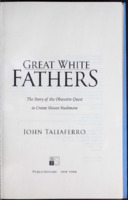 Great white fathers : the story of the obsessive quest to create Mount Rushmore The story of how Rushmore was conceived and built, and why controversy surrounded the project from the start. Great White Fathers is about the meaning of public art, the rise of automobile tourism, and the development of kitsch culture. At its center is Rushmore's feisty sculptor Gutzon Borglum, who waged an energetic campaign on behalf of his artistic vision and then carved the faces of four presidents into a mountainside.
 -
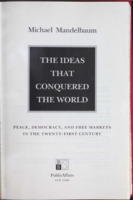 The ideas that conquered the world : peace, democracy, and free markets in the twenty-first century Continuing in the same tradition as Francis Fukuyama's The End of History, political science professor (and senior fellow of the Council on Foreign Relations) Mandelbaum continues the argument that capitalism and democracy are inextricably linked and that so-called "free markets" have emerged as indisputably triumphant in the world of contesting political and economic ideas. In exploring the political affairs of the United States, Europe, the Middle East, Russia, and China, he advances two propositions about liberal democracies that may seem surprising to observers of the current international scene: that democracies tend to conduct peaceful foreign affairs and that free markets naturally lead to democracy. One of America's leading foreign policy thinkers offers a major new statement about global politics in the 21st century, and shows how prevailing trends are remarkably favorable to the United States and the nations of the West.
 -
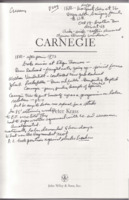 Carnegie Explores the life and career of the industrialist who made his fortune in the steel industry, and who was also one of the nation's greatest philanthropists.
 -
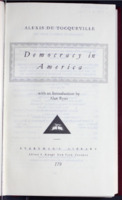 Democracy in America Contains Tocqueville's original eighteenth century writings on the American political experience and its effects upon the development of the American culture.
 -
 Buddha's child : my fight to save Vietnam Ky served as a general in the South Vietnamese Air Force and as prime minister from 1965 until 1967.
 -
 Franklin : the essential founding father Biography of Benjamin Franklin.
 -
 Slander : liberal lies about the American right Examines the shaping of political discourse in the United States as it has become increasingly hostile and more trivial, describing how the media's liberal bias has villianized the conservative right and obscured the true issues.
 -
 Six days of war : June 1967 and the making of the modern Middle East Explores the lasting impact six days of intense Arab-Israeli fighting had on world politics, providing information on the conflict's major participants, its causes, and the tragic outcome.
 -
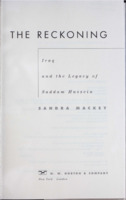 The reckoning : Iraq and the legacy of Saddam Hussein The reckoning is an account of the forces--historical, religious, ethnic, and political--that produced Saddam Hussein's dictatorship. Iraq was forged after World War I from the Mesopotamian region of the collapsed Ottoman Empire, and its people have never had a national identity or a sense of a common purpose. Hussein, ruling by terror, pitted the various ethnic groups, religious interests, and tribes against one another, and in so doing achieved the destruction of Iraq's middle class and civilized society. After he goes, the country could be the site of conflict even more vicious than the Balkan wars.
 -
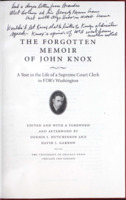 The forgotten memoir of John Knox : a year in the life of a Supreme Court clerk in FDR's Washington The Forgotten Memoir of John Knox - edited by Dennis J. Hutchinson and David J. Garrow - offers a candid, at times naive, insider's view of the showdown between Roosevelt and the Court that took place in 1937. At the same time, it marvelously portrays a Washington culture now long gone. Although the new Supreme Court building had been open for a year by the time Knox joined McReynolds' staff, most of the justices continued to work from their homes, each supported by a small staff. Knox, the epitome of the overzealous and officious young man, after landing what he believes to be a dream position, continually fears for his job under the notoriously rude (and nakedly racist) justice.But he soon develops close relationships with the justice's two black servants: Harry Parker, the messenger who does everything but breathe" for the justice, and Mary Diggs, the maid and cook. Together, they plot and sidestep around their employer's idiosyncrasies to keep the household running while history is made in the Court." "A foreword by Dennis Hutchinson and David Garrow sets the stage, and a gallery of period photos of Knox, McReynolds, and other figures of the time gives life to this engaging account, which like no other captures life in Washington, D.C., when it was still a genteel southern town."--BOOK JACKET.
 -
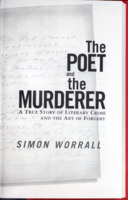 The poet and the murderer : a true story of literary crime and the art of forgery Chronicles Mark Hofmann's attempt to forge an Emily Dickinson poem at the end of the twentieth century, and discusses how his deceit and greed undermined some of the most prominent institutions of present-day academia.
 -
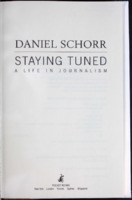 Staying tuned: a life in journalism Autobiographical work by journalist Daniell Schorr.
 -
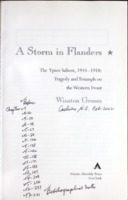 A storm in Flanders : the Ypres salient, 1914-1918 : tragedy and triumph on the Western Front An analysis of a pivotal battle of World War I revisits the four-year-long Battle of Ypres, an engagement that cost hundreds of thousands of lives and forever changed the way war would be waged.
 -
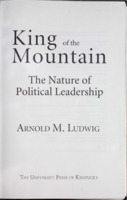 King of the mountain : the nature of political leadership Political leaders govern countries, negotiate treaties, control military forces, and shape economies. Advanced as these activities may seem, however, psychiatrist Arnold M. Ludwig contends that rulers' actions are rooted in the alpha-male behaviors of monkeys and apes.."Profiling every ruler of a recognized country in the twentieth century - over 1,900 people in all - Ludwig establishes how rulers came to power, how they lost power, the dangers they faced, and the odds of their being assassinated, committing suicide, or dying a natural death. Concentrating on a smaller set of rulers for whom more extensive personal information was available, Ludwig profiles the six different kinds of leaders, examining their characteristics, childhoods, and mental stability or instability to pinpoint chief predictors of later political success."--BOOK JACKET.
 -
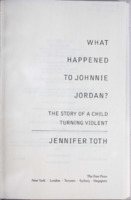 What happened to Johnnie Jordan? : the story of a child turning violent On an icy night five years ago, Johnnie Jordan - just fourteen years old - brutally murdered his elderly foster care mother, leaving the state of Ohio shocked and outraged. He could not tell police why he did it or even how it made him feel; all he knew was that something inside him made him kill. At the time, few people predicted the swift emergence of a class of young so-called super-predators" - criminals like Johnnie who injure and kill without conscience, personified to the nation by the Littleton, Colorado, tragedy in 1999." "In What Happened to Johnnie Jordan? journalist Jennifer Toth, author of The Mole People and Orphans of the Living once again takes a look at the people in our society whom we so often discard and altogether ignore. As Toth investigates Johnnie's crime and life, she unravels the mysteries of a child murderer unable to identify his emotions even after they converge in acts of fury and rage. In the course of her research, Johnnie grows dangerously into a young man who "will probably kill again," he says, "though I don't want to." Yet he also demonstrates great kindness and caring when treated as more than just a case number, when treated as a human. Through Johnnie's harrowing story, Toth examines how some children manage to overcome tragic beginnings, while others turn their pain, anger, and loss on innocents."--BOOK JACKET.
 -
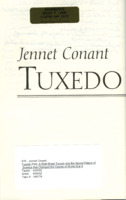 Tuxedo Park : a Wall Street tycoon and the secret palace of science that changed the course of World War II Wall Street legend Alfred Lee Loomis, who once owned Hilton Head Island, was devoted to his hobby of science experiments in his mansion. During World War II, Loomis played a key role in the development of radar and the atomic bomb.
 -
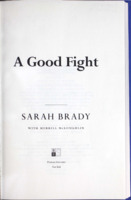 A good fight. The wife of Ronald Reagan's former press secretary describes life with her husband before and after he was shot by John Hinckley, the circumstances that led her to become a gun control activist, and her own battle with lung cancer.
 -
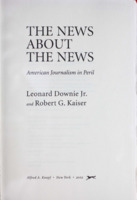 The news about the news : American journalism in peril Leonard Downie, Jr. and Robert G. Kaiser - both reporters and editors at the Washington Post for nearly four decades - take us inside the American news media to reveal why the journalism we watch and read is so often so bad, and to explain what can be done about it. "They demonstrate how the media's preoccupation with celebrities, entertainment, sensationalism and profits can make a mockery of news. They remind us of the value of serious journalism with inside accounts of how great stories were reported and written - a New York Times investigation of Scientology and the IRS, and a Washington Post expose of police excesses. They recount a tense debate inside their own newsroom about whether to publicize a presidential candidate's long-ago love affair."--BOOK JACKET.
 -
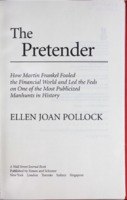 The pretender : how Martin Frankel fooled the financial world and led the feds on one of the most publicized manhunts in history Explains how Martin Frankel, a nerdy financial whiz, created a complex Ponzi scheme that embroiled some of the world's most powerful business leaders and led federal authorities on a bizarre manhunt from America across Europe.
 -
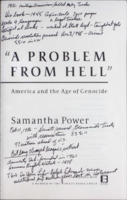 A problem from hell : America and the age of genocide A Problem from Hell is a path-breaking interrogation of the last century of American history. Samantha Power poses a question that haunts our nation's past: Why do American leaders who vow "never again" repeatedly fail to marshal the will and the might to stop genocide? She provides the answer in the form of the suspenseful story of courageous individuals who risked their careers and lives in an effort to get the United States to act. Drawing upon exclusive interviews with Washington's top policymakers, access to thousands of pages of newly declassified documents, and her own reporting from the modern killing fields, Power shows how those who urged U.S. action were thwarted again and again by ignorance, indifference, and, above all, a failure of imagination."--BOOK JACKET.
 -
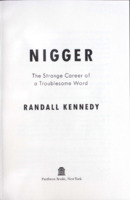 Nigger : the strange career of a troublesome word Nigger is arguably the most consequential social insult in American history. In this book, the author traces how the word has been used and by whom, while analyzing the controversies to which it has given rise. The author explores such topics as how "nigger" should be defined and whether blacks have a right to use "nigger" while others do not.
351–375 of 728