Booknotes
Item set
Items
-
 Khrushchev : the man and his era Drawing on newly opened archives in Russia and Ukraine, Taubman (political science, Amherst College) writes a thorough biography of one of the most complex and important political figures of the 20th century whose life and career spanned revolution, civil war, famine, collectivization, industrialization, terror, world war, the Cold War, Stalinism, and post-Stalinism. Includes two sections of good quality b&w photographs.
 -
 Reefer madness : sex, drugs, and cheap labor in the American black market Reports on America's "shadow" economy of illegal drugs, pornography, and illegal migrant workers, arguing that these underground industries continue to grow with government intervention.
 -
 Gulag : a history A fully documented history of the Soviet camp system, from its origins in the Russian Revolution to its collapse in the era of glasnost. Anne Applebaum first lays out the chronological history of the camps and the logic behind their creation, enlargement, and maintenance. Applebaum also examines how life was lived within this shadow country: how prisoners worked, how they ate, where they lived, how they died, how they survived. She examines their guards and their jailers, the horrors of transportation in empty cattle cars, the strange nature of Soviet arrests and trials, the impact of World War II, the relations between different national and religious groups, and the escapes, as well as the extraordinary rebellions that took place in the 1950s. She concludes by examining the disturbing question why the Gulag has remained relatively obscure, in the historical memory of both the former Soviet Union and the West.
 -
 The older the fiddle, the better the tune : the joys of reaching a certain age The author collects advice, anecdotes, and opinions from friends, family, and celebrities--including Maya Angelou, Yogi Berra, Bill Cosby, and others--to capture the joys of turning older and the challenges that accompany the process.
 -
 Useful idiots : how liberals got it wrong in the Cold War and still blame America first The author attacks American liberals as naive and disingenuous in their dealings with the world, accusing them of rewriting history to portray themselves as "Cold Warriors" along with conservatives.
 -
 A wilderness so immense : the Louisiana Purchase and the destiny of America Publisher's description: The remarkable story of the land purchase that doubled the size of our young nation, set the stage for its expansion across the continent, and confronted Americans with new challenges of ethnic and religious diversity. In a saga that stretches from Paris and Madrid to Haiti, Virginia, New York, and New Orleans, Jon Kukla shows how rivalries over the Mississippi River and its vast watershed brought France, Spain, Great Britain, and the United States to the brink of war and shaped the destiny of the new American republic. We encounter American leaders--Jefferson and Jay, Monroe and Pickering among them--clashing over the opening of the West and its implications for sectional balance of power. We see these disagreements nearly derailing the Constitutional Convention of 1787 and spawning a series of separatist conspiracies long before the dispute over slavery in the territory set the stage for the Missouri Compromise and the Civil War. Kukla makes it clear that as the French Revolution and Napoleon's empire-building rocked the Atlantic community, Spain's New World empire grew increasingly vulnerable to American and European rivals. Jefferson hoped to take Spain's territories--piece by piece, --while Napoleon schemed to reestablish a French colonial empire in the Caribbean and North America. Interweaving the stories of ordinary settlers and imperial decision-makers, Kukla depicts a world of revolutionary intrigue that transformed a small and precarious union into a world power--all without bloodshed and for about four cents an acre.
 -
 Terror and liberalism Berman shows how a genuine spiritual inspiration can be twisted into a fanatical demand for murder. He offers remarkable insights into the trends and conflicts influencing Islamic radicalism. He illuminates the surprising connections between very different political movements, and he reveals the several ways in which Islamic extremism resembles some all-too-familiar episodes in American and European experience. "Berman draws on sources that range from Albert Camus's The Rebel to the Book of the Revelation - from Lincoln's Gettysburg Address to the Islamist scholar Sayyid Qutb's magisterial In the Shade of the Koran. Berman condemns the foreign policy "realism" of the political right, and he diagnoses the naivete of the political left. He calls for a "new radicalism" and a "liberal American interventionism" to promote democratic values throughout the world - a vigorous new politics of American liberalism."--BOOK JACKET.
 -
 No crueler tyrannies : accusation, false witness, and other terrors of our times No Crueler Tyrannies recalls the hysteria that accompanied the child sex-abuse witch-hunts of the 1980s and 1990s: how a single anonymous phone call could bring to bear an army of recovered-memory therapists, venal and ambitious prosecutors, and hypocritical judges - an army that jailed hundreds of innocent Americans. The overarching story of No Crueler Tyrannies is that of the Amirault family, who ran the Fells Acres day care center in Malden, Massachusetts: Violet Amirault, her daughter Cheryl, and her son Gerald, victims of perhaps the most biased prosecution since the Salem witch trials. Woven into the fabric of the Amirault tragedy an unfinished story - with Gerald Amirault still incarcerated for crimes that, Rabinowitz persuasively argues, not only did he not commit, but which never happened - are other, equally alarming tales of prosecutorial terrors: the stories of Wenatchee, Washington, where the single-minded efforts of chief sex crimes investigator Robert Perez jailed dozens of his neighbors; Patrick Griffin, a respected physician whose life and reputation were destroyed by a false accusation of sexual molestation; John Carroll, a marina owner from Troy, New York, now serving ten to twenty years largely at the behest of the same expert witness used to wrongly jail Kelly Michaels fifteen years previously; and Grant Snowden, the North Miami policeman sentenced to five consecutive life terms after being prosecuted by then Dade County State Attorney Janet Reno ... who spent eleven years killing rats in various Florida prisons before a new trial affirmed his innocence. "No Crueler Tyrannies is at once a truly frightening and at the same time inspiring book, documenting how these citizens, who became targets of the justice system in which they had so much faith, came to comprehend that their lives could be destroyed, that they could be sent to prison for years - even decades. No Crueler Tyrannies shows the complicity of the courts, their hypocrisy and indifference to the claims of justice, but also the courage of those willing to challenge the runaway prosecutors and the strength of those who have endured their depredations."--Jacket.
 -
 Dark star safari : overland from Cairo to Cape Town Thoroughly updated to reflect the past decade's technological advances, this edition of the only authorized parliamentary procedure guide contains new information on conducting meetings over the Internet, on phone and video conference calls, and with members in absentia. Other editors are William J. Evans, Daniel Honemann, and Thomas Balch. The only authorized guide to parliamentary procedure, completely updated for the internet age.
 -
 Secret empire : Eisenhower, the CIA, and the hidden story of America's space espionage In a brief period of explosive, top-secret innovation during the 1950s, a small group of scientists, engineers, businessmen, and government officials rewrote the book on airplane design and led the nation into outer space. In an effort no less audacious than the creation of the atomic bomb, they designed, built, and operated the U-2 and supersonic SR-71 spy planes and Corona, the first reconnaissance satellites - machines that could collect more information about the Soviet Union's weapons in a day than an army of spies could assemble in a decade. "Their remarkable inventions and daring missions made possible arms control agreements with Moscow that helped keep the peace during the cold war, as well as the space-based reconnaissance, mapping, communications, and targeting systems used by America's armed forces in the Gulf War and most recently in Afghanistan. These hugely expensive machines also led to the neglect of more traditional means of intelligence gathering through human spies." "Philip Taubman follows this dramatic story from the White House to the CIA, from the Pentagon to Lockheed's Skunk Works in Burbank, from the secret U-2 test base in Nevada to the secret satellite assembly center in Palo Alto and other locations here and abroad. He reveals new information about the origins and evolution of the projects and how close they came to failing technically or falling victim to bureaucratic inertia and Washington's turf wars." "The incredibly sophisticated spies in the skies were remarkably successful in proving that the missile gap was a myth in protecting us from surprise Soviet attack. But in some ways, the failure to detect the planning for the terrorist attacks of September 11, 2001, can also be attributed to these powerful machines as the government became increasingly dependent on spy satellites to the neglect of human agents and informants. Now, as we wage a new and more vicious war against terrorism, we will need both machines in space and spies on the ground to fight back."--BOOK JACKET.
 -
 Authentically Black : essays for the Black silent majority In his New York Times bestseller, Losing the Race, John McWhorter, a Berkeley linguistics professor, tried to make sense of why so many African-Americans continue to define themselves by race and examined what he calls the cult of Victimology, Separatism, and Anti-Intellectualism he has witnessed on America's college campuses. In Authentically Black, McWhorter broadens his lens in this penetrating and profound collection of essays that continue his exploration of what it means to be black in America today. According to McWhorter, nearly forty years after the Civil Rights Act, African-Americans in this country still remain "a race apart." He feels that modern black Americans have internalized a tacit message: "authentically black" people stress initiative in private but cloak the race in victimhood in public in order to protect black people from an ever-looming white backlash. McWhorter terms this phenomenon the "New Double Consciousness" in homage to W. E. B. Dubois's description of a different kind of double consciousness in blacks a century ago. It is within this context that McWhorter takes us on a guided tour through the race issues dominating our current discourse: racial profiling, getting past race, the reparations movement, black stereotypes in film and television, black leadership, diversity, affirmative action, the word nigger, and Cornel West's resignation from Harvard. With his fierce intelligence and fervent eloquence, John McWhorter makes a powerful case for the advancement of true racial equality. Authentically Black is a timely and important work about issues that must be addressed by blacks and whites alike. Authentically Black is a book for Americans of every racial, social, political, and economic persuasion.
 -
 The mission : waging war and keeping peace with America's military An account of America's growing dependence on its military to manage world affairs describes the cultural clashes experienced by the nation's generals, soldiers, and Green Berets in eighteen different countries.
 -
 Of paradise and power : America and Europe in the new world order After years of mutual resentment and tension, there is a sudden recognition that the real interests of America and its European allies are diverging sharply and that the trans-atlantic relationship itself has changed, possibly irreversibly. Europe sees the United States as high-handed, unilateralist, and unnecessarily belligerent; the United States sees Europe as spent, unserious, and weak. The anger and mistrust on both sides are hardening into incomprehension. Author Robert Kagan reached incisively into this impasse to force both sides to see themselves through the eyes of the other. Tracing the widely differing histories of Europe and America since the end of World War II, he makes clear how for one the need to escape a bloody past has led to a new set of transnational beliefs about power and threat, while the other has evolved into the guarantor of that "postmodern paradise" by dint of its might and global reach.
 -
 The wish for kings : democracy at bay For the better part of twenty years Lewis H. Lapham has sketched the American social and political landscape with a fine sense of history and a sharp and caustic wit. In The Wish for Kings, his most provocative book to date, Lapham obliges us to take a long hard look at what has become of our hallowed democratic tradition. Although we like to believe that we live by Lincoln's famous words - "government of the people, by the people, for the people" - we have become accustomed to a government by and for the friends of privilege. The promise of democracy is synonymous with the idea of the citizen, but to people who have grown tired of self-government the belief in kings and queens and fairy tales replaces the will to engage in the rude and often uncomfortable arts of politics. Lapham notes the effects of our distaste for objection and dissent - an apathetic public debate, 90 percent of the wealth in the hands of 5 percent of the population, the media and the universities united in their defense of oligarchy - and discusses at length the ways in which a courtier spirit (the obverse of the democratic spirit) subverts and weakens the hopes of a free republic. It is a discussion that has particular relevance to the present moment. If the wish for kings is as old as Babylon and as modern as the worship of Hollywood celebrity, our 1992 presidential election translated the wish into nineteen million votes for H. Ross Perot. Frightened by the weakness in the economy and dissatisfied with the wisdom in office in Washington, a sizable percentage of the electorate embraced in the figure of a Texas millionaire what it imagined to be the comforts of autocracy. The question remains as to whether the enthusiasm for Perot was merely an angry protest against a government that had arrogantly distanced itself from the American people, or whether it expressed a more general longing for a magical figure capable of quieting all our fears and answering all our prayers. The question is an urgent one, and it defines the task of the Clinton administration. Unless President Clinton can sustain the public faith in the practice as well as the theory of Democracy, it is possible that the idea of democratic self-government will come to be seen as a once noble experiment no longer adequate to the specifications of the twenty-first century. The several facets of this question come into brilliant focus in this important book by one of our most incisive social critics. No one who cares about the future of our nation should miss reading The Wish for Kings.
 -
 To begin the world anew : the genius and ambiguities of the American founders The Pulitzer Prize-winning historian offers a series of profiles of the characteristics, achievements, political philosophy, influence, and ambiguities of some of the most important figures of the Revolutionary generation.
 -
 American road : the story of an epic transcontinental journey at the dawn of the motor age The story of the First Transcontinental Motor Train, an expedition of "eighty-one vehicles and nearly three hundred men" from the White House in Washington, D.C. to San Francisco in 1919.
 -
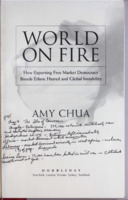 World on fire : how exporting free market democracy breeds ethnic hatred and global instability Examining the actual impact of economic globalization in every region of the world, from Africa and Asia to Russia and Latin America, Chua exposes an unexpected reality. In every one of these regions, free markets have concentrated disproportionate, often spectacular wealth in the hands of a resented ethnic minority. "Adding democracy to this volatile mix unleashes suppressed ethnic hatreds and brings to power ethno nationalist governments that pursue aggressive policies of confiscation and revenge. Chua also shows how individual countries may be viewed as market-dominant minorities at the regional or global level, a fact that may help to explain the Arab-Israeli conflict and the rising tide of anti-American sentiment around the world. America today has become the world's leading market-dominant minority, enjoying wealth and economic power wildly disproportionate to our numbers. This, perhaps more than anything else, accounts for the visceral hatred of Americans that we have seen expressed in recent acts of terrorism." "Chua warns that, far from making the world a better and safer place, democracy and capitalism - at least in the raw, unrestrained form in which they are currently being exported - are intensifying ethnic resentment and global violence, with potentially catastrophic results."--BOOK JACKET.
 -
 Boyd : the fighter pilot who changed the art of war John Boyd may be the most remarkable unsung hero in all of American military history. Some remember him as the greatest U.S. fighter pilot ever - the man who, in simulated air-to-air combat, defeated every challenger in less than forty seconds. Some recall him as the father of our country's most legendary fighter aircraft - the F-15 and F-16. Still others think of Boyd as the most influential military theorist since Sun Tzu. They know only half the story. "Boyd, more than any other person, saved fighter aviation from the predations of the Strategic Air Command. His manual of fighter tactics changed the way every air force in the world flies and fights. He discovered a physical theory that forever altered the way fighter planes were designed. Later in life, he developed a theory of military strategy that has been adopted throughout the world and even applied to business models for maximizing efficiency. And in one of the stories of modern military history, the Air Force fighter pilot taught the U.S. Marine Corps how to fight war on the ground. His ideas led to America's swift and decisive victory in the Gulf War and foretold the terrorist attacks of September 11, 2001"--Jacket.
 -
 Two steps ahead of the thought police Two Steps Ahead of the Thought Police presents one of the liveliest, funniest, and most insightful commentators in America - John Leo. No one gets to the heart of a social issue more quickly, or with more sharpness and wit. Leo goes to an academic convention where teachers attack the "white maleness" of the game show Jeopardy, and he reveals a plaintive letter from SWAM (Straight White American Males) demanding their own minority parade. He adds up the total number of victims in America - 1.2 billion in a population of 251 million - and explains Leo's First Law of Racial Folly: All setbacks for integration will immediately be hailed as triumphs for diversity. Ranging widely over popular culture, law, education, politics, and language, Leo writes about Ozzie and Harriet, "bodice-ripping" novels, the sneaky side of the sneaker business, Republican buzzwords, and the dizzying effect of an average Mario Cuomo phone call.When Mattel brings out the first talking Barbie in twenty years, Leo gets an exclusive interview with her. He discusses Indians in their pre-Kevin Costner period, analyzes the strange sexual hostility in Newport cigarette ads, and explains why the innocent-looking word "fair" functions like a grenade when lobbed into legislation. Here is Leo on:. The "seventy-five deadly isms" plaguing America: "Handing a woman a diet cola could be construed as sizeist, lookist, and sexist, and perhaps handist and laughist as well." The problem in hate-crime laws: "The legislation in effect divides America into two classes: those whose skulls can be cracked with a criminal penalty of, let us say, six months in jail, and those whose skulls are better protected and thus warrant nine months in jail. But if the skulls of all Americans are equally valuable, why not just give everyone nine months for cracking any cranium at all?" Journalism, the official language of journalists: "Suppose you wish to point out that Senator Forbush is a clod. Do you type, 'Forbush, the well-known incompetent'? Not at all. You simply write that the poor fellow's reputation is 'still dogged by doubts about his competence.' Or if you feel he should be indicted, depict him as 'haunted by allegations,' which, as a responsible and thorough reporter, you are obliged to dig up and embellish." For Leo loyalists or for readers just discovering him - but most of all for the beleaguered majority impatient with extremists of all stripes - Two Steps Ahead of the Thought Police will be a treasured source of unconventional wit and wisdom.
 -
 Them : adventures with extremists In the tradition of Bill Bryson, a fascinating and frequently hilarious look at extremists around the globe, and the conspiracy theory that unites them. Journalist Jon Ronson, the mild-mannered but ironic observer, learns some alarming things about the looking-glass world of them and us. Are the extremists onto something? Or has Ronson become one of Them?
 -
 Paris 1919 : six months that changed the world Between January and July 1919, after "the war to end all wars," men and women from around the world converged on Paris to shape the peace. Center stage was an American president, Woodrow Wilson, who with his Fourteen Points seemed to promise to so many people the fulfillment of their dreams. Stern, intransigent, impatient when it came to security concerns and idealistic in his dream of a League of Nations that would resolve all future conflict peacefully, Wilson is only one of the characters who fill the pages of this book. David Lloyd George, the British prime minister, brought Winston Churchill and John Maynard Keynes. Lawrence of Arabia joined the Arab delegation. Ho Chi Minh, a kitchen assistant at the Ritz, submitted a petition for an independent Vietnam. For six months, Paris was effectively the center of the world as the peacemakers carved up bankrupt empires and created new countries. This book brings to life the personalities, ideals, and prejudices of the men who shaped the settlement. They pushed Russia to the sidelines, alienated China, and dismissed the Arabs. They struggled with the problems of Kosovo, of the Kurds, and of a homeland for the Jews. The peacemakers, so it has been said, failed dismally; above all they failed to prevent another war. Margaret MacMillan argues that they have unfairly been made the scapegoats for the mistakes of those who came later. She refutes received ideas about the path from Versailles to World War II and debunks the widely accepted notion that reparations imposed on the Germans were in large part responsible for the Second World War.
 -
 Judging Lincoln Collection of nine essays on the topic of Lincoln compiled by Frank J. Williams, chief justice of the Rhode Island Supreme Court and one of the nation’s leading authorities on Abraham Lincoln.
 -
 The moral animal : evolutionary psychology and everyday life An accessible introduction to the science of evolutionary psychology and how it explains many aspects of human nature. Unlike many books on the topic, which focus on abstractions like kin selection, this book focuses on Darwinian explanations of why we are the way we are--emotionally and morally--and interweaves episodes from Darwin's own life as illuminating examples. Wright deals particularly well with explaining the reasons for the stereotypical dynamics of the three big "S's:" sex, siblings, and society.
 -
 The two faces of Islam : the house of Saʻud from tradition to terror In this informed, compelling exploration of Moslem beliefs and of the sectarian conflicts within the community, a Jewish historian paints a sympathetic portrait of mainstream Islam and exposes the centuries-old roots of Osama bin Laden's extremism.
 -
 Freedom : a history of US The companion volume to a major 16-part PBS series brings the story of the United States as viewed through the inspiring fight to uphold the ideal of freedom--from the forging of the Declaration of Independence to the power behind the Civil Rights movement to the challenge the nation faces following the terrorist attacks of September 11.
326–350 of 728